






Starting self-employment in Canada calls for evidence of paying demand, not just encouragement from interested contacts. Define the service, test a specific buyer problem and keep proposals, signed work and collected cash separate. No universal lead count makes leaving employment safe.
This guide combines fresh Canadian survey evidence with an original demand-validation register. Five charts distinguish reported experiences from fictional planning examples. You can use the free files privately, adapt their fields and decide which questions need professional advice. Research checked on 13 November 2026.
Starting self-employment in Canada: what the new survey shows
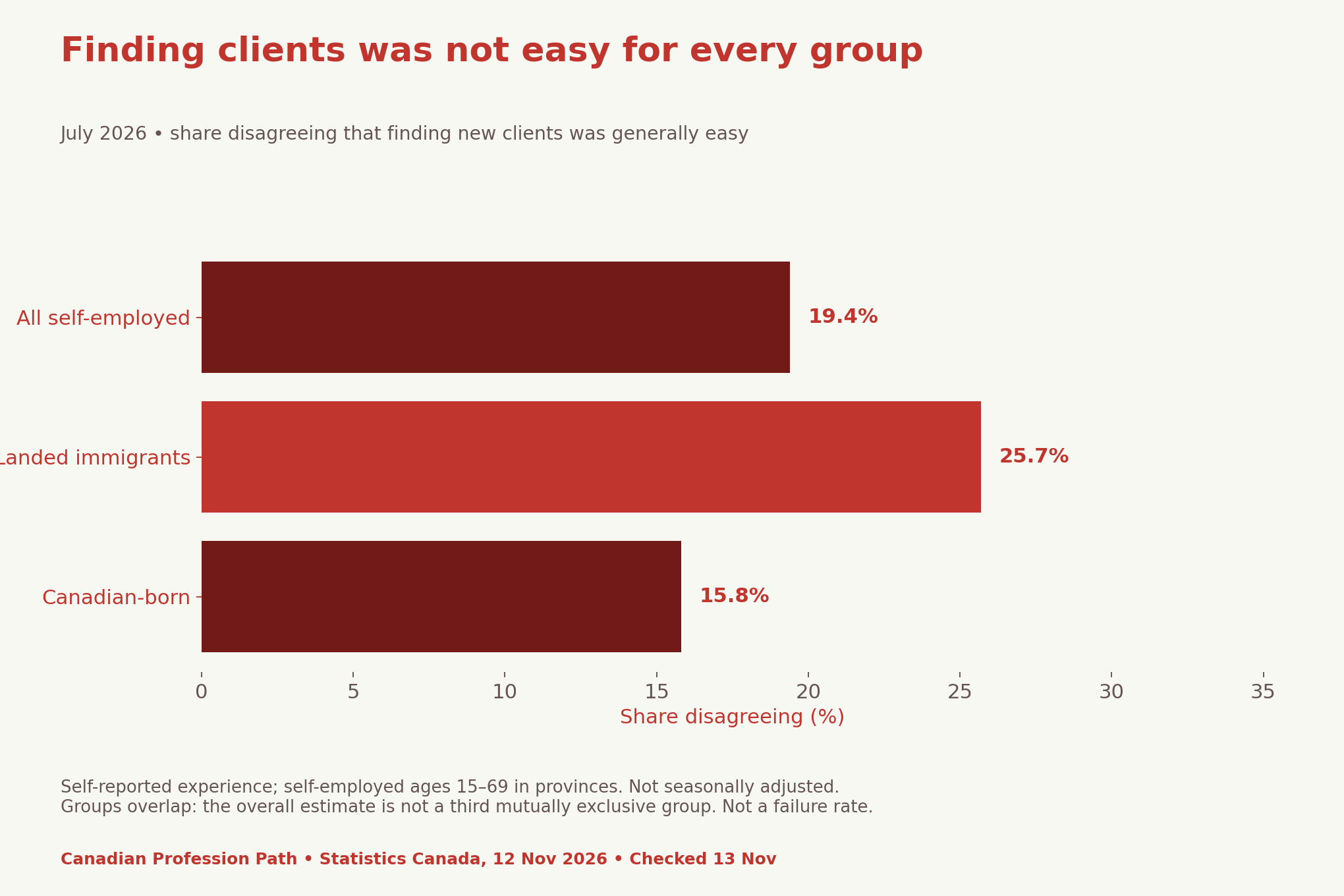
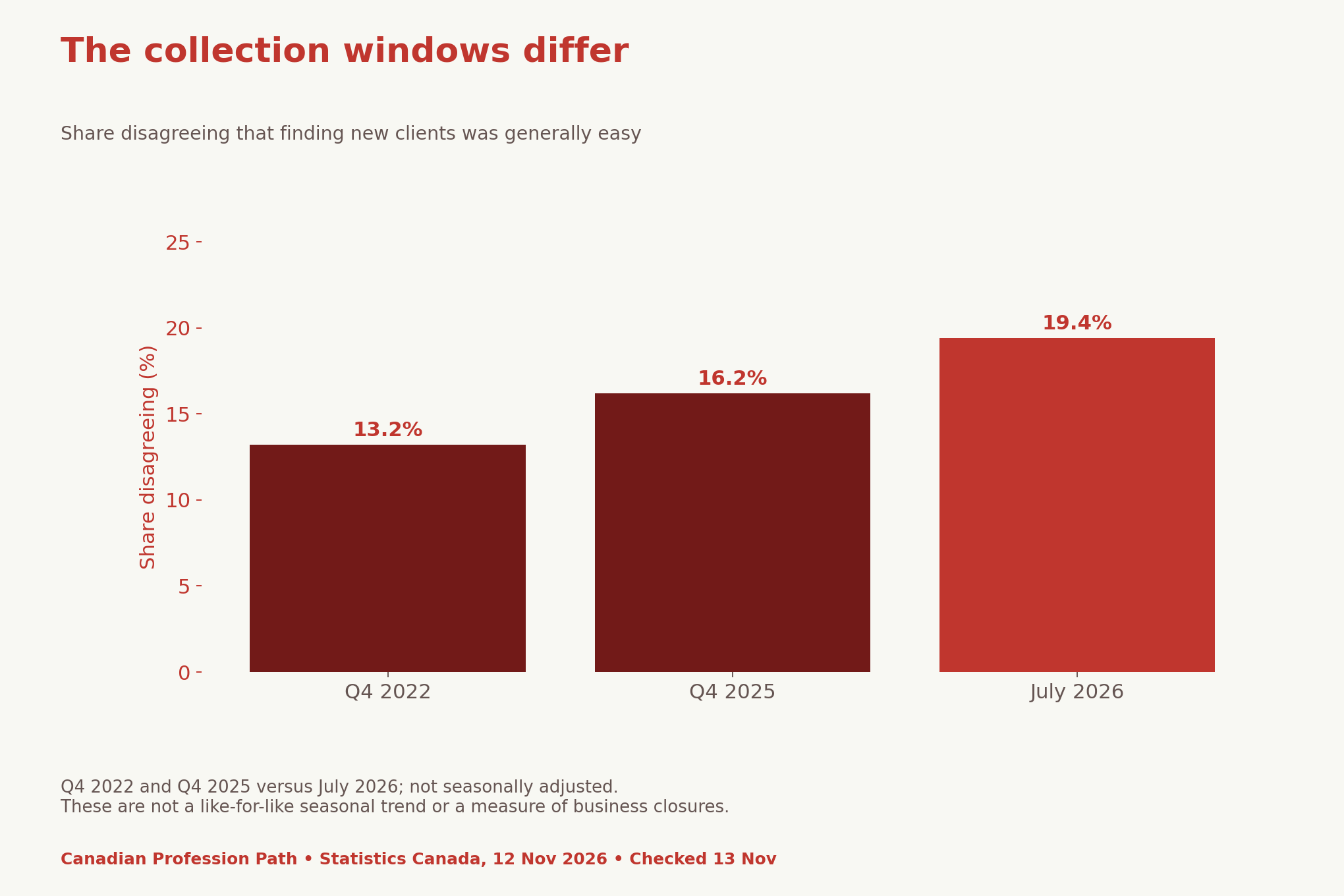
Statistics Canada’s 12 November release on self-employed workers reports that 19.4% disagreed that finding new clients was generally easy in July 2026. The figures were 25.7% for landed immigrants and 15.8% for Canadian-born respondents. All are not seasonally adjusted.
| Population | Share disagreeing |
|---|---|
| All self-employed | 19.4% |
| Landed immigrants | 25.7% |
| Canadian-born | 15.8% |
The immigrant–Canadian-born gap is 9.9 percentage points. It does not establish a cause or predict an individual outcome. Nor does the survey identify a tested acquisition technique. For a prospective independent professional, it raises a useful question: what buyer evidence supports your own plan?
Separate interest from a purchase commitment
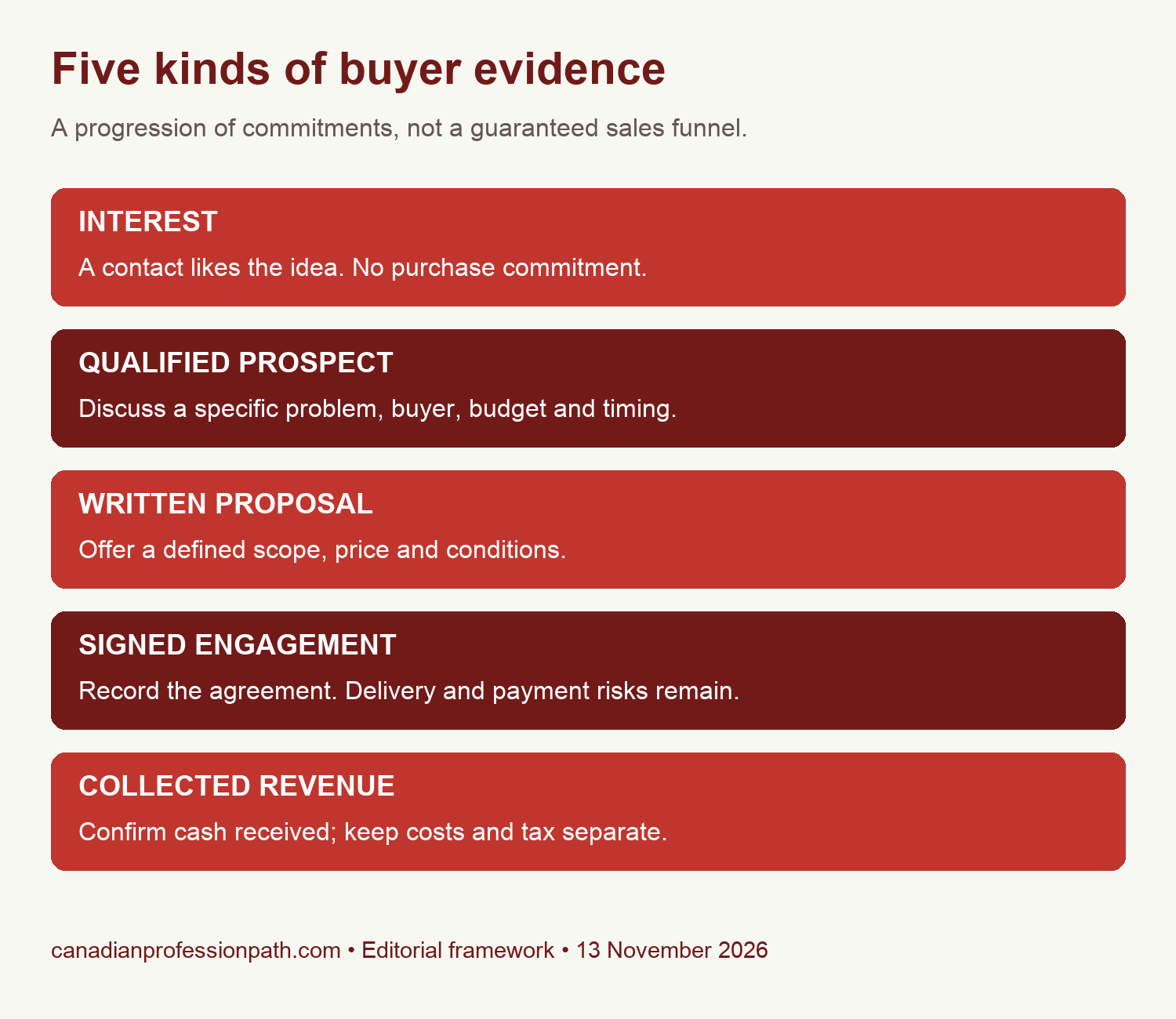
A friendly conversation can help you learn. However, it does not show that a buyer has authority, a budget or a reason to act now. Record what was actually said. If a contact introduces you to the person who approves spending, that is different evidence from a general compliment.
Our framework uses five evidence categories. A prospect can move backward, pause or disappear; the diagram is not a promised conversion path. A signed engagement also leaves delivery, cancellation and payment questions unresolved. Read the actual terms rather than treating a stage label as protection.
Define a service a real buyer can assess
Start with one clear description: the buyer, the problem, the deliverable and the boundary of the work. For example, a fictional independent analyst might offer a defined monthly reporting package. The proposal should say what information the client supplies and which decisions remain the client’s responsibility.
Next, ask how that buyer handles the problem today. Learn which alternatives already exist, who chooses them and what causes a change. A specific account of a current workflow is more informative than a broad question about whether the idea sounds useful.
The Government of Canada’s business-starting guide places planning alongside registration, permits and other operational steps. Meanwhile, British Columbia’s market-research guidance recommends investigating customers, competitors and trends, and gathering direct feedback. These are separate tasks from proving your own service will sell.
Budget time for finding clients before you promise delivery
A schedule filled with paid work on paper can conceal the time needed to win it. Therefore, keep acquisition, delivery and administration in separate columns. Count preparation and follow-up as well as meetings. Also record time spent on proposals that do not become work.
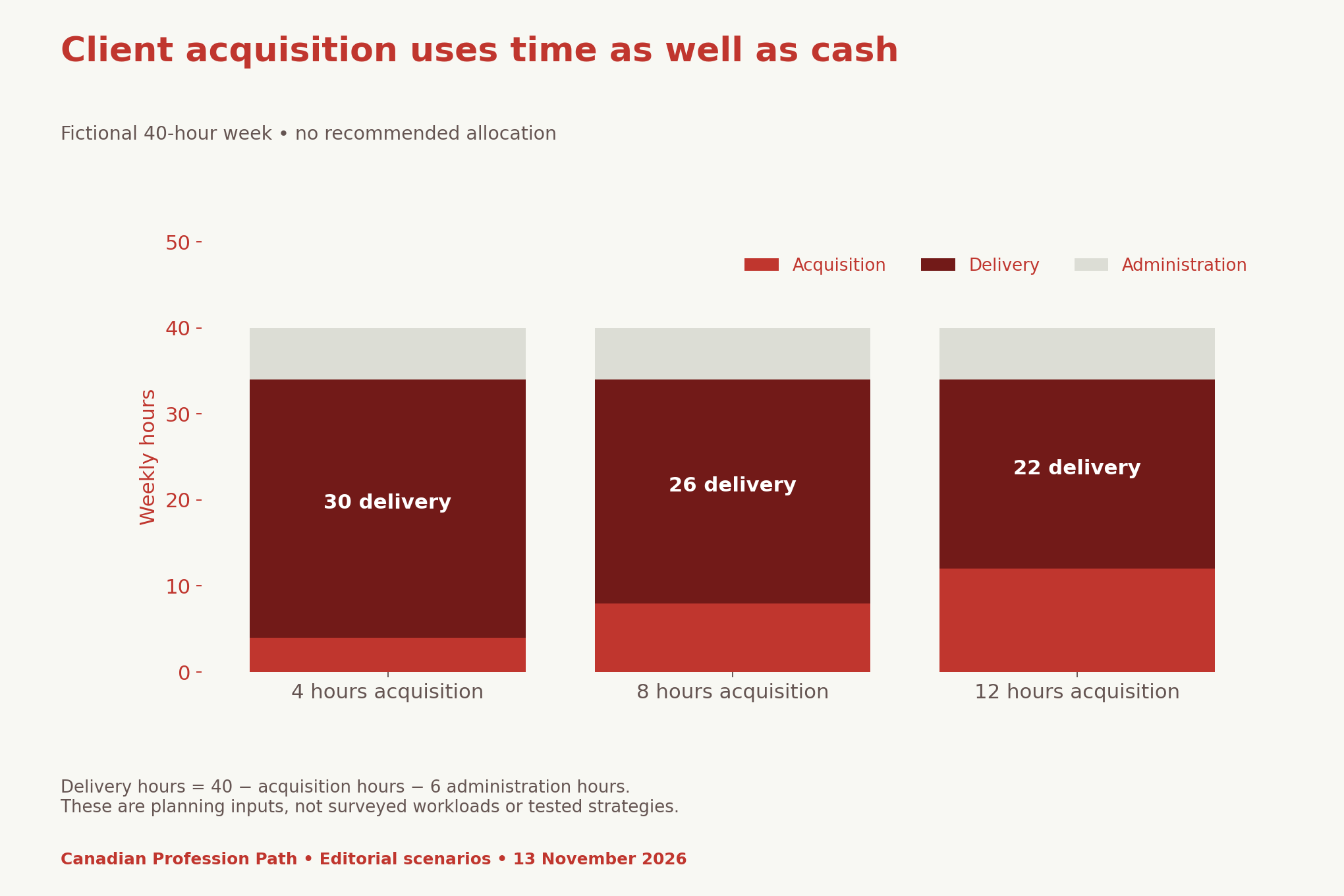
In the illustration, moving from four to twelve acquisition hours reduces delivery capacity by eight hours. That result follows from the assumptions. It is not evidence that more acquisition time generates more clients. Replace the inputs with your own observations and revisit them when the work changes.
Track cash received separately from work promised
Use distinct fields for a quoted amount, a signed amount, an invoice and cash received. Give each entry a date and a private document reference. Otherwise, the same potential engagement can accidentally appear several times in your planning total.
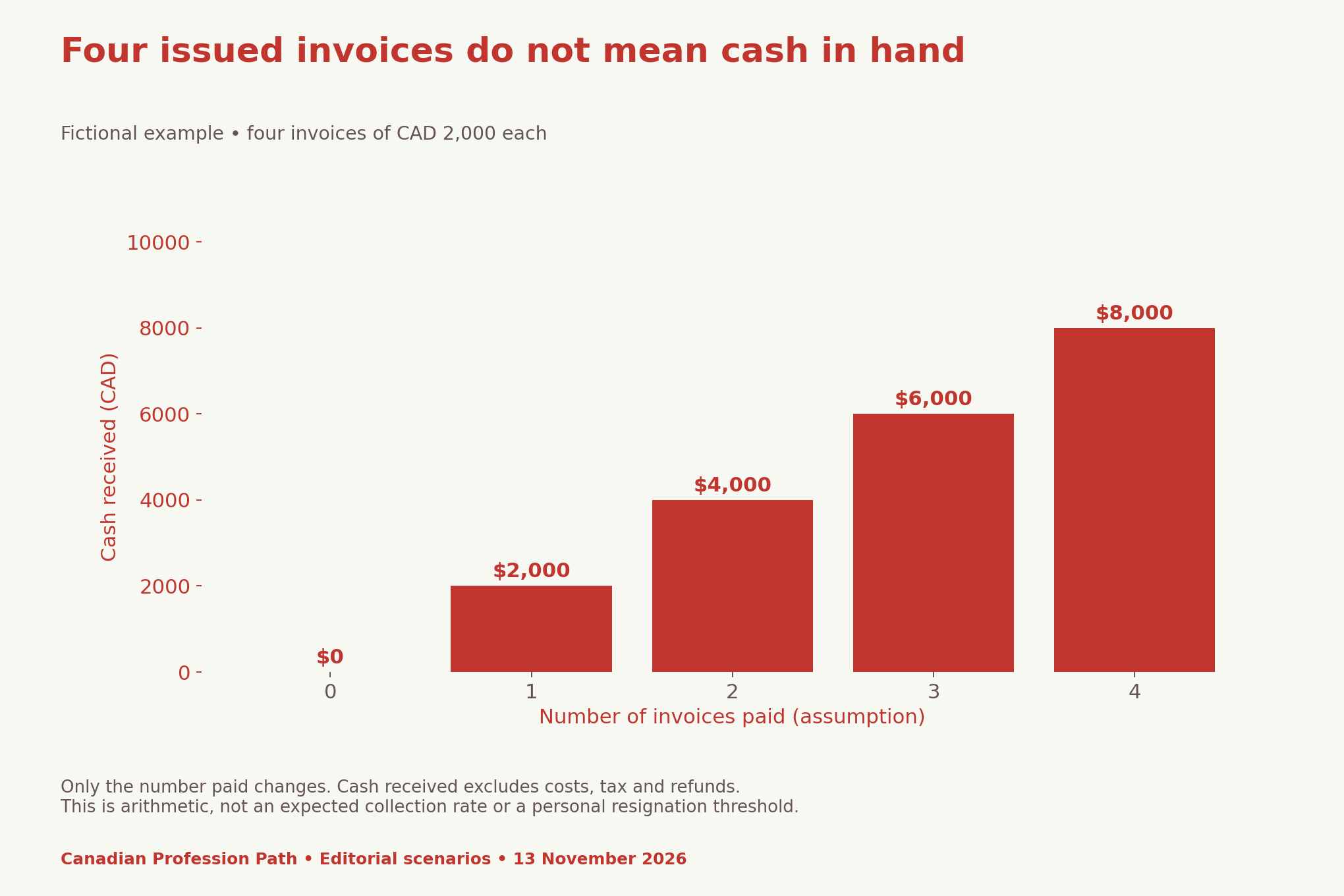
For example, four fictional invoices worth CAD 2,000 each total CAD 8,000. If only two have been paid, cash received is CAD 4,000. Neither number is profit. Keep business costs, tax obligations, refunds and personal spending outside that simple collection comparison until you assess them properly.
Look beyond the total to client concentration
Two businesses can report the same revenue yet depend on clients differently. In your register, identify each client consistently and calculate the largest client’s share of the same period’s total revenue. Do not mix invoices from one period with receipts from another.
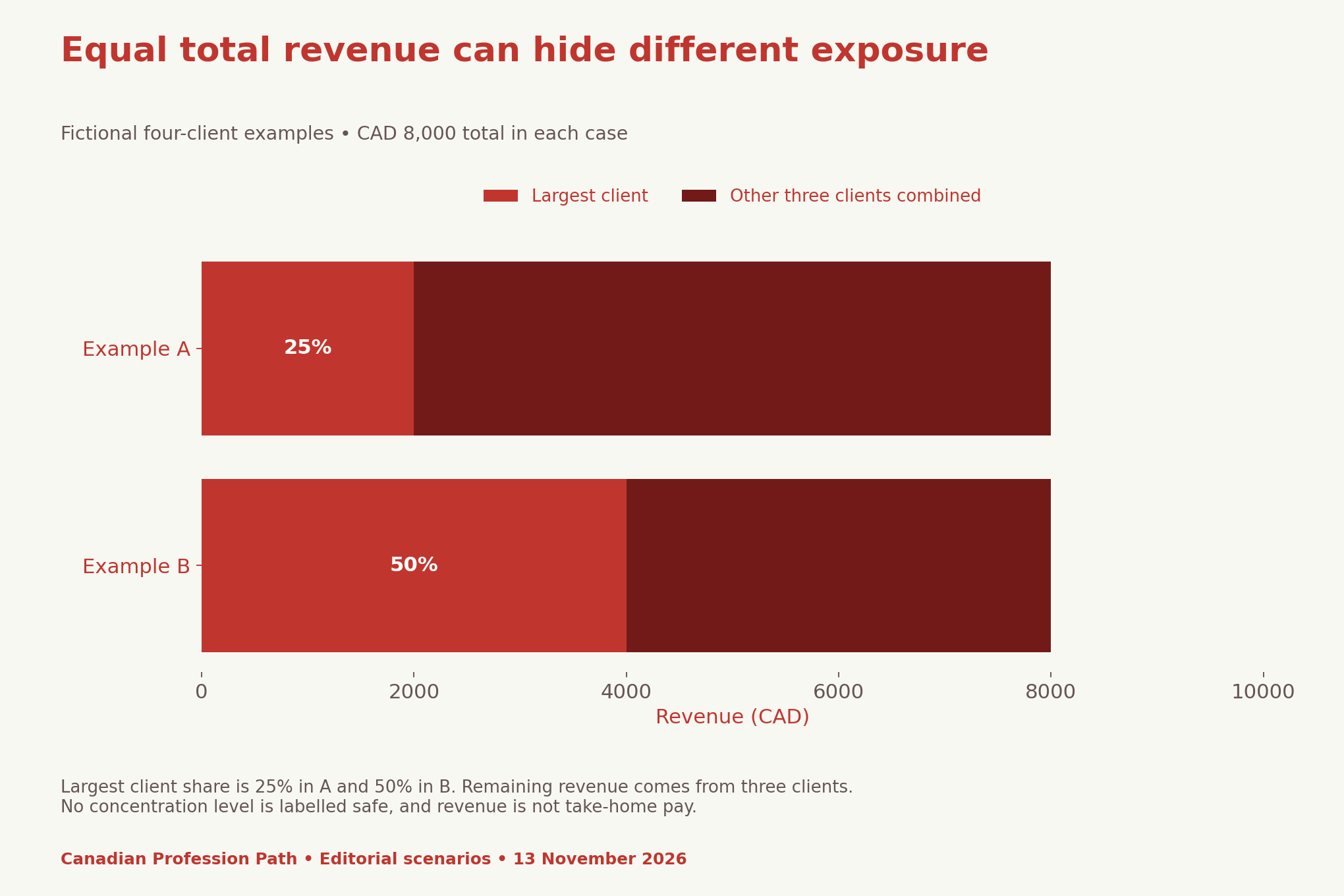
A concentration review can reveal questions about contract timing and replacement work. However, the chart does not prescribe an acceptable share. A dependable relationship, a short contract and a late-paying buyer carry different uncertainties that a single percentage cannot capture.
Newcomer guidance: test the local market, not a stereotype
Landed immigrant status in the survey does not mean every respondent is a recent arrival. Avoid turning the group difference into a claim about an individual’s skill or prospects. Instead, investigate the buyer’s actual purchasing process and the evidence required for that particular service.
The Immigrant Services Association of Nova Scotia business resource encourages research into customers and competitors and notes that market expectations may differ for newcomers. Ask a suitable local business-support provider what help fits your circumstances. Check any programme’s eligibility directly.
If you are comparing independent work with a paid offer, our salary-offer comparison guide separates guaranteed cash, variable pay and work costs. Our job-search planning research also explains why national rates cannot give you a personal deadline.
Use the demand-validation register privately
Create a code for each prospect rather than storing unnecessary personal details. Enter the service, buyer problem, dated evidence, current stage and next action. Keep proposal, signed, invoiced and collected amounts in their own columns. A blank means unknown, not zero.
Choose personal review points before the decision becomes urgent. At a review, consider what has changed, which assumptions remain untested and whether the service or target buyer needs revision. Respect your employment agreement, confidentiality duties and applicable work restrictions; seek qualified advice for your situation.
- Reported client-acquisition estimates and definitions (CSV)
- Fictional chart inputs and calculation rules (CSV)
- Blank private demand-validation register (CSV)
- Evidence-stage and worksheet dictionary (CSV)
Methods, limitations and suggested citation
We transcribed the published estimates and calculated the subgroup gap by subtraction. The supplement covers self-employed people aged 15–69 in the provinces and excludes unpaid family workers. Other exclusions include reserves, institutions and full-time regular Armed Forces members. Estimates have sampling variability; the release uses a 68% confidence level for its comparisons.
Our examples use stated fictional inputs only. Time available for delivery equals total hours minus acquisition and administration. Collected cash equals paid invoices times invoice value. Concentration equals largest-client revenue divided by total revenue. We did not estimate conversion rates, business survival, personal income replacement or a safe resignation date.
Suggested citation: Canadian Profession Path (13 November 2026), “Starting Self-Employment in Canada: Test Client Demand”, analysis of Statistics Canada’s 12 November release and original planning tools. Retain the survey population, collection periods and fictional-example labels when reusing the charts.


