






A construction career change in Canada in 2026 deserves a closer look at the entry route, not just the industry headline. October employment grew, but that does not tell a beginner which employer will train them. Before paying for a course, connect a specific occupation and location to dated evidence about duties, experience, supervision and costs.
This report separates national survey evidence from Ontario training structures and a single advert example. It provides three charts, an evidence-gate infographic and four free CSV tools. Research checked on 9 November 2026. We do not claim to have completed a representative advert survey or tested a training provider’s placement performance.
Read October construction growth in the right units
Statistics Canada’s 6 November Labour Force Survey release reports construction employment up 16,000, or 0.9%, from September to October 2026. The year-over-year increase was 47,000, or 2.9%. These seasonally adjusted estimates concern employed people, not advertised openings. The survey reference week was 11–17 October.
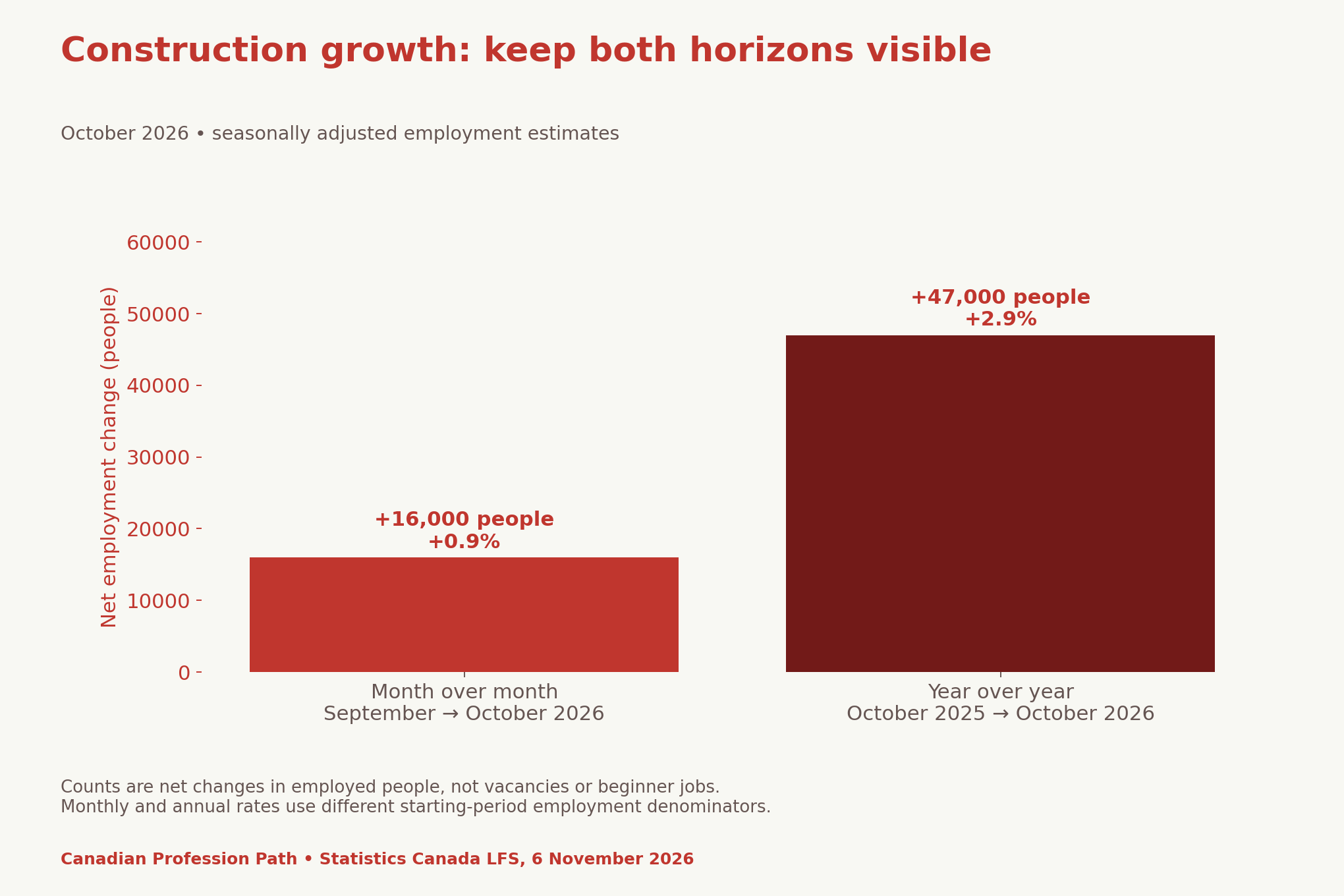
Net employment growth can coexist with hiring, departures and changes in the mix of roles. Construction also includes experienced workers and jobs outside the trade you have in mind. National estimates therefore give context for investigation. They cannot rank local courses or establish that a new entrant can start immediately.
Test a construction career change in Canada in 2026
Write down the occupation, the work you want to do and the area you could realistically reach. A construction helper, a carpenter and a construction electrician have different duties and routes. Use the official Job Bank occupation research tools to investigate the relevant occupation and region. Keep an employer’s title alongside its actual tasks.
Then distinguish three evidence types. A regulator describes the conditions for practising a trade. An employer sets requirements for a particular job. A training provider describes its course. One does not automatically prove the other two. Ask which exact requirement the course meets and what remains after graduation.

Ontario example: workplace learning is a substantial part
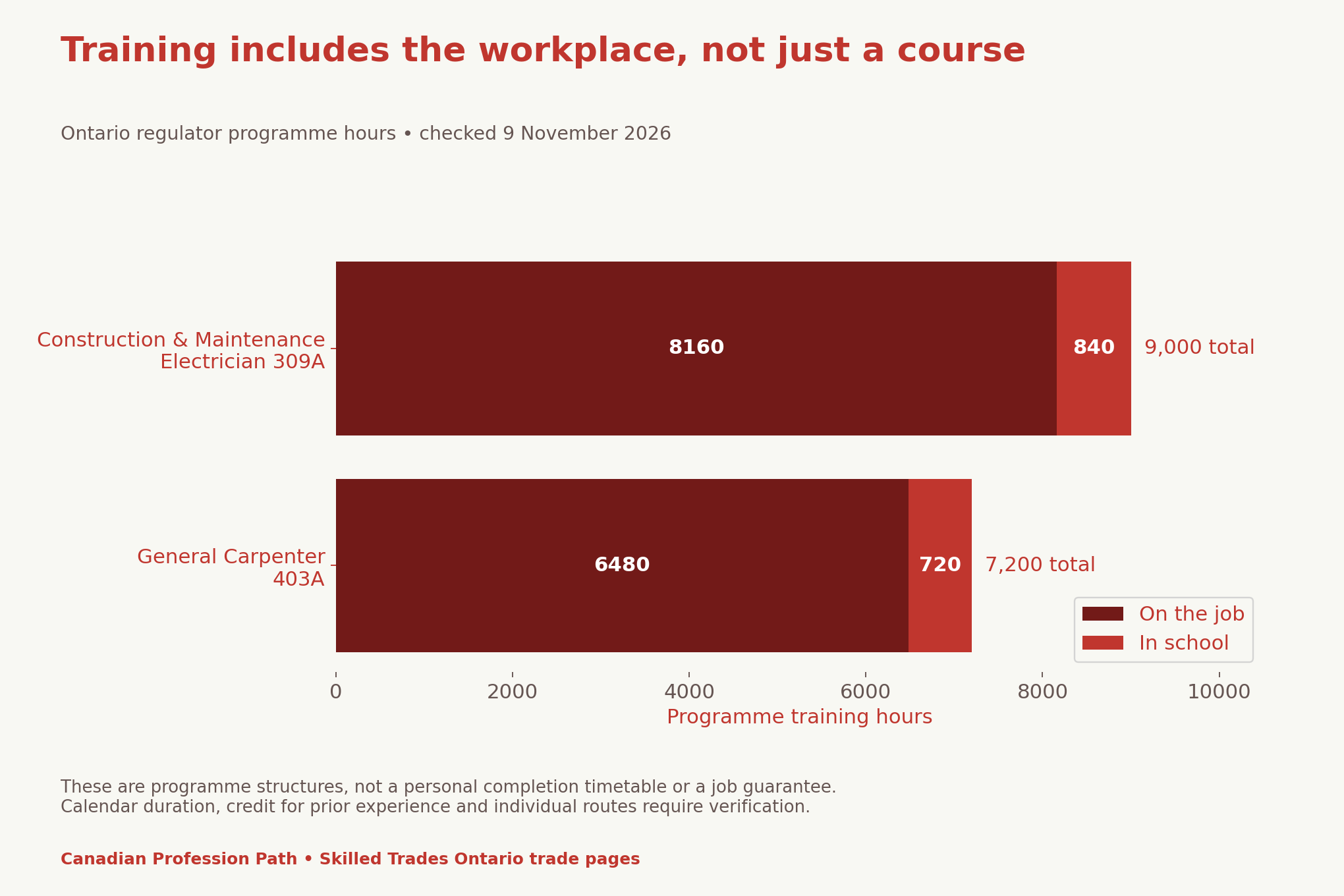
The General Carpenter page from Skilled Trades Ontario sets out 7,200 programme hours: 6,480 on the job and 720 in school. The regulator classifies the trade as non-compulsory. That classification does not remove an employer’s experience requirements or guarantee that a particular course supplies workplace access.
For Electrician – Construction and Maintenance, the regulator gives 9,000 hours: 8,160 on the job and 840 in school. It is a compulsory Ontario trade. The regulator specifies the authorized training or qualification status and Public Register requirement for legal practice. Check that page and your own route before performing trade work.
This example applies to Ontario. Other provinces and territories have their own authorities, classifications and pathways. If you trained outside Canada, ask the relevant authority how it assesses prior learning and qualifications. A general newcomer resource or an overseas certificate does not itself confirm permission to perform a regulated task.
What one advert can teach without becoming a market survey
A dated ROC ELECTRIC LTD construction and maintenance electrician advert, posted 21 October and inspected on 9 November, specified five years or more of experience. Its tasks included instructing apprentices. That is an experienced-worker example. A task involving apprentices does not mean the advertised position accepts an untrained beginner.
We attempted a structured snapshot of direct Job Bank adverts for helpers, carpenters and electricians within 25 km of Toronto. Server errors prevented consistent retrieval across the three groups. We retained the protocol and failure notes, but do not publish beginner-access percentages or comparisons from an incomplete collection. This single advert illustrates a reading method, not current market prevalence.
Use the blank audit to distinguish explicit novice acceptance, an experience requirement and unknown information. Code silence as unknown. Record apprentice recruitment separately: an employer welcoming a registered apprentice may still require prior training or a particular apprenticeship level. Verify the advert is still open before acting; our snapshot is not a recommendation to apply.
Build your own repeatable advert audit
Before collecting results, specify your date, source, geography and occupation codes. Define the selection order and how many adverts you will inspect. Retain the job identifier and deduplicate repeated employer, title and location records. Exclude external aggregator copies if your protocol is for direct employer postings.
For each included advert, capture its source URL, checked date, experience field, licence condition, paid hours and supervision evidence. Keep the original wording short and separate from your interpretation. Do not turn an empty field into “no requirement.” Where facts conflict or remain unclear, ask the employer or authority rather than guessing.
A small convenience sample can reveal questions to investigate. It cannot establish the share of all regional employers willing to train beginners. Search ranking, duplicated adverts and jobs filled through other channels can shape what you see. Publish the exclusions and missing records alongside any eventual counts.
Stress-test costs beyond the advertised tuition
A useful comparison needs dated written quotes for the route you can actually take. Separate tuition, tools, travel, required assessments and income forgone while learning. Ask whether workplace access is arranged, what supervision is provided and which conditions must be met. Keep promised services distinct from independently verified outcomes.
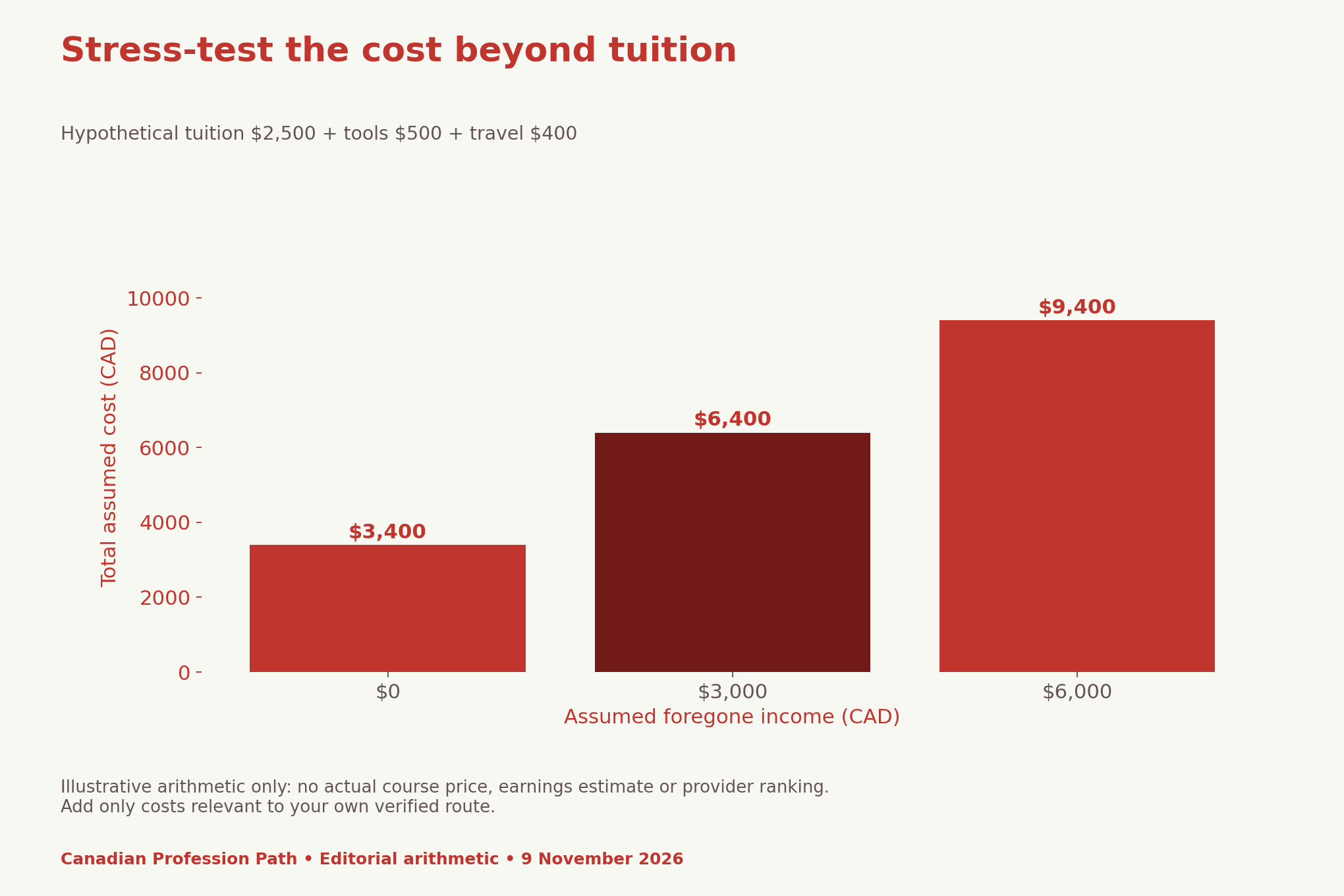
Set your own go/no-go conditions before committing money. For example, you might require a verified occupation route, a written cost breakdown and a credible explanation of workplace learning access. This is a decision checklist, not proof that any provider meets those conditions. Avoid treating an affiliate recommendation as evidence of placement.
Our Canadian job-search runway guide helps separate a private budget horizon from a promised hiring date. Once you have an offer, the salary-offer comparison helps distinguish guaranteed cash, variable payouts and recurring work costs. Neither tool predicts your hiring outcome.
Download the evidence and blank tools
The source table retains the monthly and annual horizons. The Ontario file records each programme’s component hours and regulator link. Keep your advert audit private where it contains personal notes, and replace the hypothetical cost inputs with verified figures before using them for a decision.
- October construction employment figures (CSV)
- Ontario programme-hour comparison (CSV)
- Blank entry-route advert audit (CSV)
- Hypothetical training-cost calculations (CSV)
Methods, limitations and citation
We transcribed dated official estimates and regulator programme hours, then checked component sums. The cost chart adds the stated hypothetical amounts. The attempted advert snapshot did not yield a complete comparable sample, so no advert-based market rates are estimated. National LFS estimates exclude the territories and carry survey uncertainty. Local requirements and adverts can change.
Suggested citation: Canadian Profession Path (9 November 2026), “Construction Career Change Canada 2026: Test the Entry Route”, analysis of Statistics Canada’s October LFS and Skilled Trades Ontario programme structures. Retain the geography, dates and distinction between employment growth, training hours and hypothetical costs when reusing the figures.


