







A public vs private sector job search in Canada needs more than the latest monthly headline. October’s public-sector rebound and private-sector decline point in opposite directions from their annual changes. Use those figures to check your assumptions, then build two evidence-based application tracks around the work you can demonstrate.
This report downloads and analyses thirteen months of official class-of-worker data. It adds three charts, a parallel-track infographic and four free CSVs. Our application framework uses hypothetical duties, not live vacancies. We have not tested whether it improves hiring outcomes. Research checked on 9 November 2026.
Read the month and the year together
The 6 November Labour Force Survey release rounds October’s public-sector increase to 50,000 in the month, alongside a 70,000 annual decline. It reports private-sector employment down 53,000 monthly but up 35,000 annually. These are employment stocks and their changes, not the number of applications accepted or new hires.
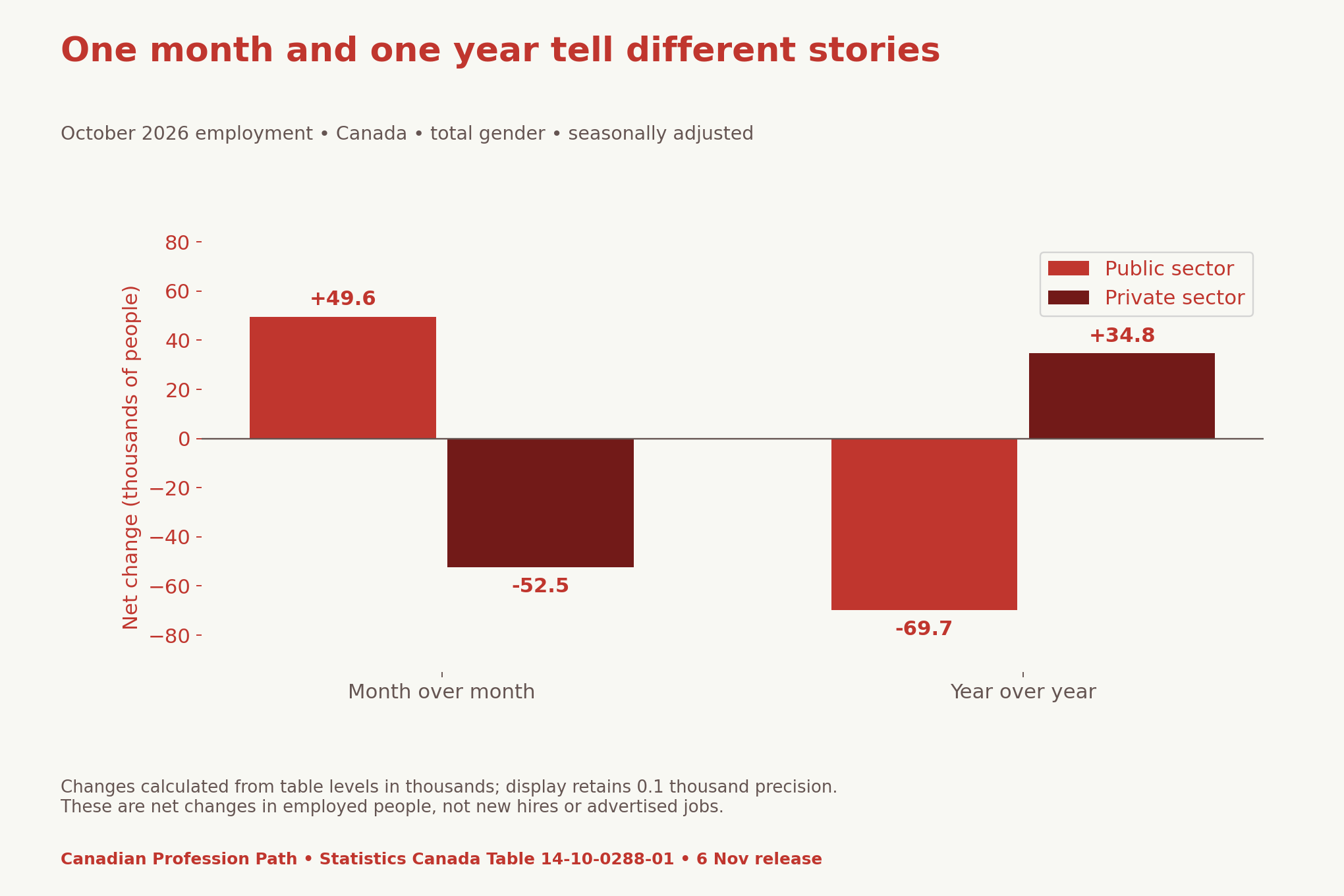
Our download of Table 14-10-0288-01 gives public-sector employment at 4,497.5 thousand in October, compared with 4,447.9 thousand in September and 4,567.2 thousand a year earlier. Private-sector figures were 13,863.5, 13,916.0 and 13,828.7 thousand respectively. Subtraction reproduces the more precise chart values.
A one-month rise can occur within an annual decline. That is not a contradiction. It means the comparison starts at a different point. Equally, a monthly private-sector fall does not erase the small annual increase. Neither result establishes which employer is recruiting for your occupation and location.
Use a longer view for a public vs private sector job search in Canada
We selected Canada, total gender, the estimate statistic and seasonally adjusted data. The analysis retains October 2025 through October 2026 for each employer class. To compare relative movement without confusing workforce sizes, Figure 2 sets each class’s own October 2025 level to 100.
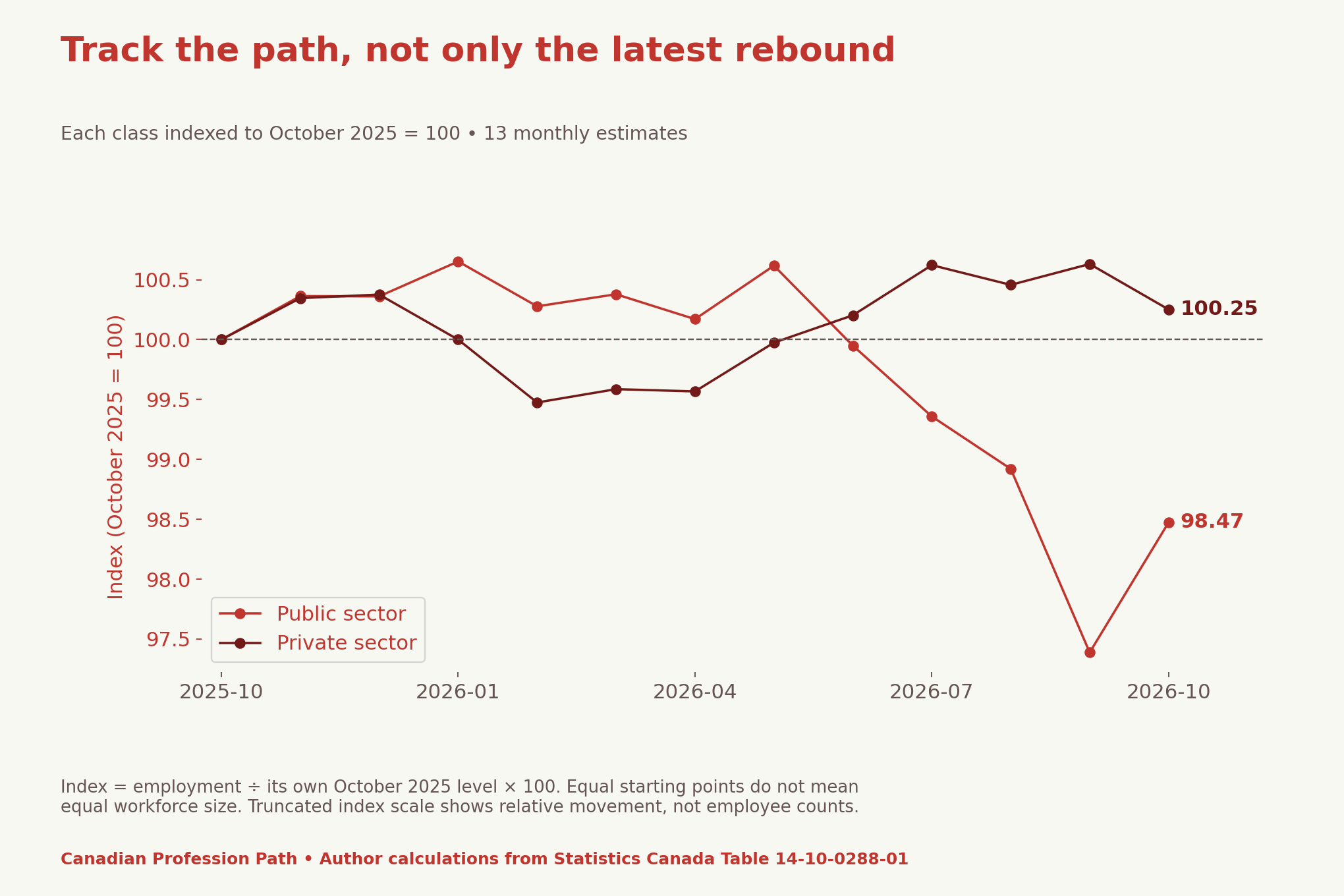
The public-sector series ended below its starting level despite the October rebound. The private-sector series ended slightly above its starting level despite that month’s decline. Indexing helps expose that distinction. However, the choice of starting month matters, and a thirteen-month view is not a long-run forecast.
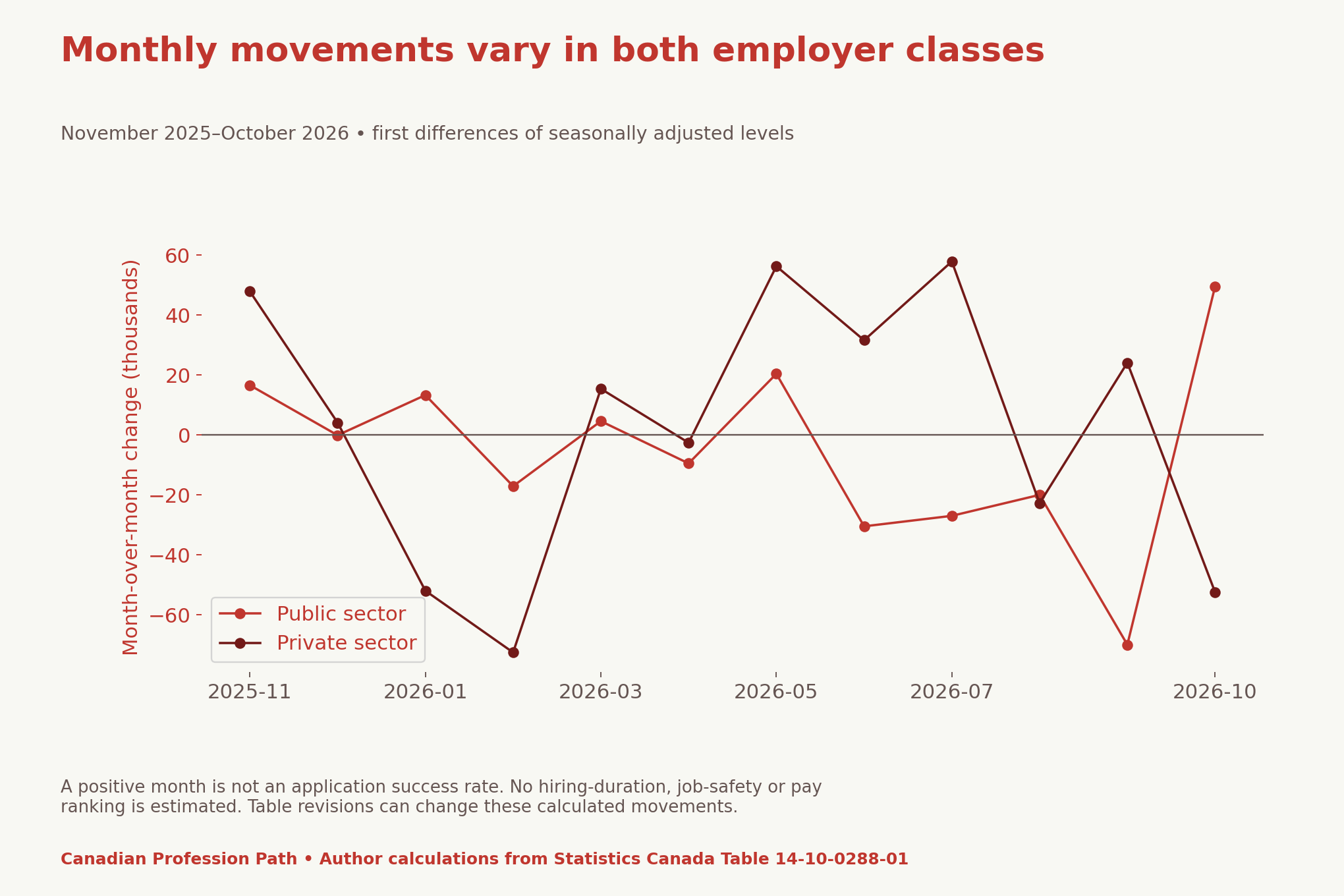
Employer class is not a career ranking
Public-sector employment is broader than federal public administration. Do not read the national series as a count of federal recruitment campaigns. Likewise, private-sector employees work across many industries and occupations. Self-employed people are a separate class in the source table and are outside this two-employee-class comparison.
The figures do not show that one class is safer, faster to enter or better paid. Those claims need different evidence. Job duties, contract terms, location, language, qualifications and actual recruitment processes can matter more to an individual application than the direction of one national estimate.
Translate one capability into two sets of duties
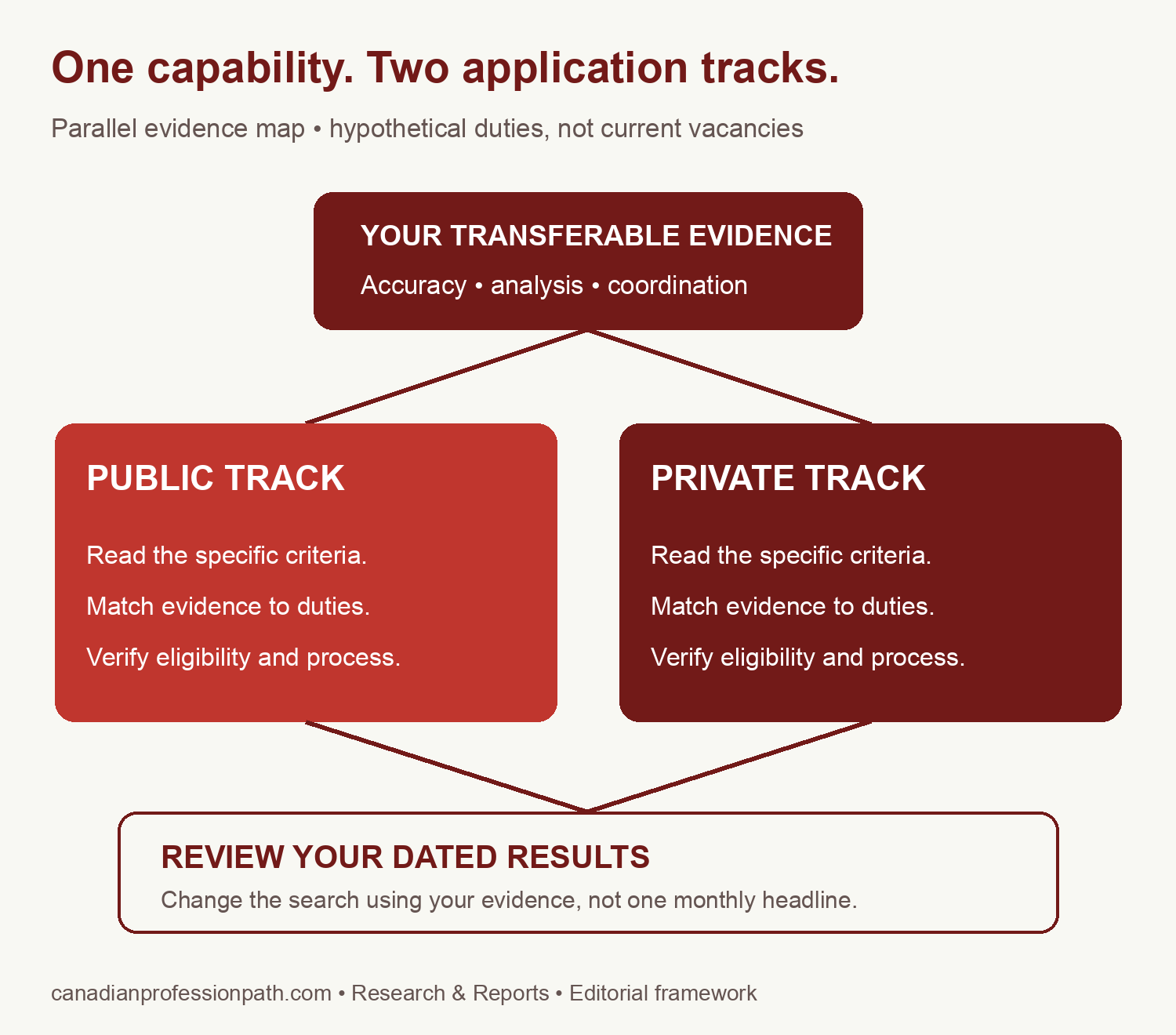
Start with a capability you can demonstrate, such as accurate records, practical analysis or coordination. Then read the duties and essential criteria of each actual vacancy. Use a concrete example showing what you did, how you checked it and what evidence remains. Keep confidential employer and personal information out of public portfolios.
| Capability | Hypothetical public duty | Hypothetical private duty |
|---|---|---|
| Records accuracy | Check a programme case register | Reconcile an operations log |
| Analysis | Explain a service-volume pattern | Explain a customer-volume pattern |
| Coordination | Track a service-request handoff | Track a supplier-request handoff |
For an analysis example, prepare a small reproducible calculation with clear assumptions. For a records example, explain an error check and correction. The same underlying capability can support more than one application, but the wording and evidence must answer that employer’s actual criteria. Reusing a generic statement is not the same as making a relevant match.
Keep a dated two-track application board
The blank board records employer, role, source URL, checked date, essential criteria, evidence example, deadline and next action. Give each application a public or private track label. Record an eligibility question explicitly when it remains unresolved. Do not infer permission to work, security clearance or language eligibility from a national employment chart.
For newcomers, separate your existing experience from the local conditions of the specific role. Ask the employer or relevant authority about any uncertain requirement. A national public-sector increase does not establish citizenship eligibility for a particular vacancy, and a private employer’s title does not establish recognition of a professional licence.
Review responses, interviews and next actions on a date you choose. Keep unanswered applications distinct from confirmed rejections. If you change the allocation of effort, write down the reason: a better fit, clearer evidence, a verified opening or a practical constraint. Do not claim that a tiny personal response count proves one sector is generally easier to enter.
Connect the search to your own constraints
A two-track search is an organizational option, not a requirement to apply everywhere. You may have strong reasons to prioritize a specific role or employer. The point is to make those reasons explicit and testable. Course advertising, an appealing title or a national monthly rebound should not substitute for the vacancy’s actual conditions.
Our Canadian job-search runway guide separates budget planning from a promised hiring date. The salary-offer comparison helps assess written cash terms when an offer arrives. For a local-entry example, see the construction entry-route evidence test.
Download the series and search tools
The source extract includes all 26 selected observations, with vector identifiers, units and status fields. The change file reproduces Figure 1. A blank board and a separate hypothetical skills matrix support your own research. These files do not collect your application information.
- Thirteen-month public/private source extract (CSV)
- Monthly and annual change calculations (CSV)
- Blank two-track application board (CSV)
- Hypothetical transferable-evidence matrix (CSV)
Methods, revisions and citation
We retained the complete official CSV download and its metadata on 9 November 2026. The table release was 6 November; the latest selected reference month was October 2026. Differences subtract the relevant table levels. The index divides each observation by its class’s October 2025 value and multiplies by 100. Monthly first differences use consecutive observations.
The LFS is a sample survey, and national estimates exclude the territories. Seasonal adjustment and later revisions can change historical figures. We retain the retrieved snapshot rather than silently replacing it with a later vintage. No new significance test, causal model, salary comparison or individual hiring forecast is presented.
Suggested citation: Canadian Profession Path (9 November 2026), “Public vs Private Sector Job Search Canada: Build Two Tracks”, calculations from Statistics Canada Table 14-10-0288-01, October 2025–October 2026, seasonally adjusted, total gender, retrieved 9 November 2026.


