







A temporary layoff Alberta employee checklist should start with your actual notice, agreement and recall information. Keep a news report’s estimated duration separate from the dates in your own documents. A simple countdown cannot establish your legal position.
This research uses Sherritt’s older announcement and Unifor’s 12 November response as a case study. Two figures, a document-route infographic and four free CSV tools help readers organise questions. Official guidance was checked on 13 November 2026. We make no finding about an individual worker’s rights or the company’s compliance.
What the Sherritt case reports—and what it does not
Unifor’s 12 November statement reports approximately 280 temporary layoffs in Canada, including 134 Local 530-A members at the Fort Saskatchewan refinery. Its roughly ninety-day duration is an estimate. The union is an interested primary source; its policy argument is not an independent finding of causation.
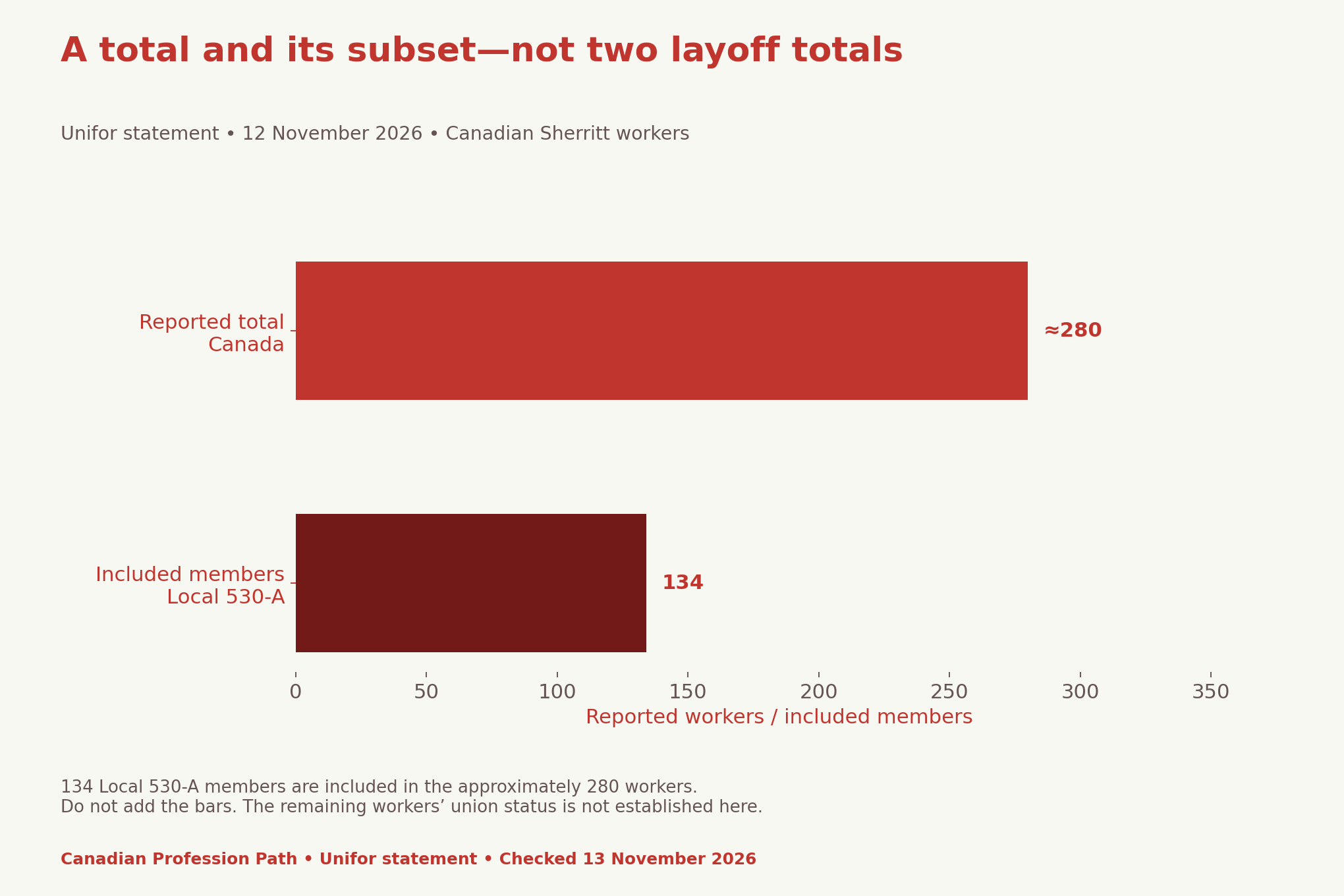
The company’s news index dates its announcement to 4 November. In that Sherritt announcement, the employer describes approximately ninety days and says earlier recall may occur based on operational needs. Its forward-looking cautions apply. Neither public statement provides a particular reader’s notice or guaranteed restart date.
Temporary layoff Alberta employee checklist: establish the rule first
Alberta’s termination and layoff guidance gives a general maximum of ninety layoff days within a 120-day period. However, it identifies exceptions, including collective-agreement recall or termination rights, and an extension involving certain continuing payments accepted by the employee. The applicable documents and circumstances matter.
The same guidance describes written notice requirements and warns that contractual or constructive-dismissal issues can arise. Therefore, meeting a statutory time limit does not by itself settle every right. If you are unsure, ask your union, the appropriate standards authority or a qualified employment lawyer about the actual documents.
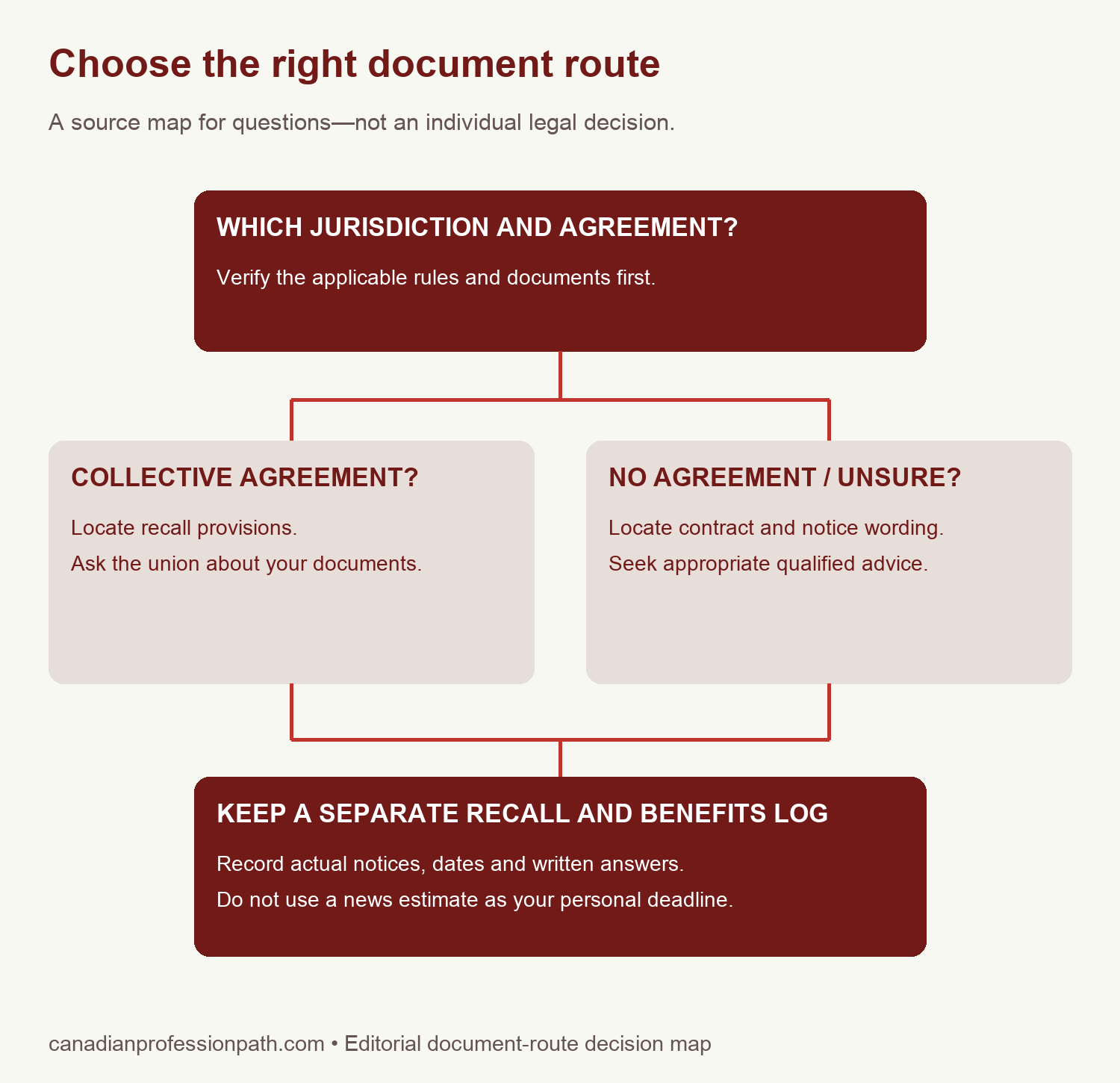
First verify jurisdiction. The federal government has separate federal labour-standard layoff guidance. A workplace’s location alone is not a complete legal assessment. The checklist records the jurisdiction question before asking you to apply any numerical rule.
Separate public announcement dates from personal dates
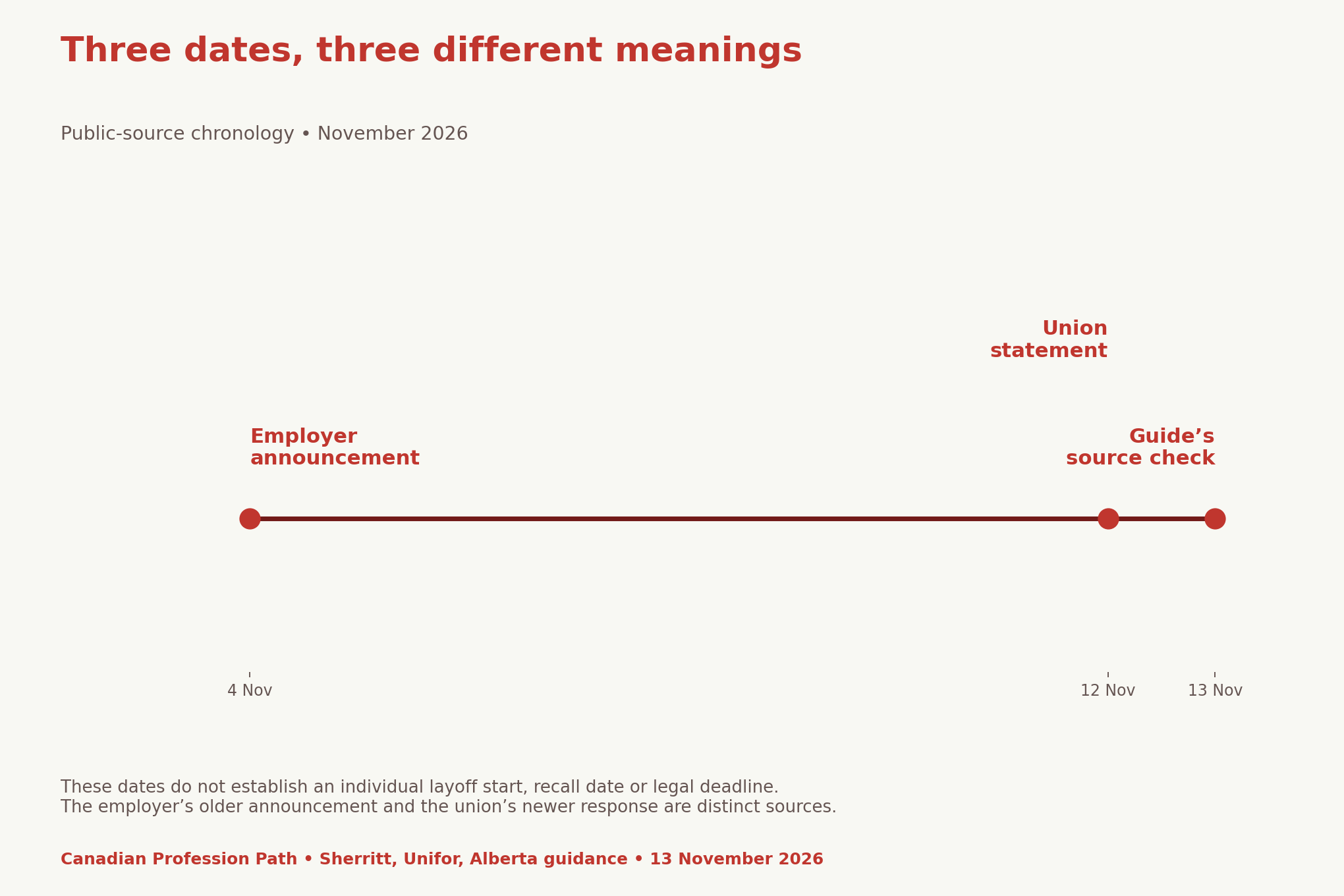
Keep the publication date, date received and effective date in separate fields. They can answer different questions. If a document is unclear, retain the wording and ask for clarification rather than choosing whichever date fits a convenient calendar calculation.
For example, a public announcement may arrive before you receive an individual notice. Record both without assuming they have the same effect. The blank tools intentionally contain no automatic termination date or entitlement formula. Such a formula would conceal the jurisdiction and agreement questions.
Gather documents in a useful order
Start with the written notice and any later messages that change it. Next, locate your contract, amendments and applicable collective agreement. Keep a reference to each document’s version and where it is stored. A summary from a colleague is not a substitute for the wording that applies to you.
Then collect written information about benefits, pension arrangements and recall communication. Make unknown items explicit. Ask who will answer each question and how you should receive updates. A practical file should help you retrieve the right document quickly, not become a store of unnecessary personal information.
Keep a recall communication log
Record when a message arrives, who sent it, the channel and the exact action or date it states. Save the original alongside your log. If a message refers to another document, preserve that reference too. Distinguish a proposed return from an actual recall instruction.
Alberta’s guidance describes written recall notices and a seven-calendar-day return requirement under its rules. Agreements and the applicable legal framework still need checking. Do not ignore an actual notice while waiting for a general news estimate to run out; seek prompt advice if its meaning or your obligations are unclear.
The communication log is a memory aid. It does not prove that a notice was validly served, calculate a legal deadline or replace a union grievance process. Keep facts, questions and answers in separate columns so a later reviewer can see what was known at each point.
Check benefits and income support separately
Ask which benefit arrangements continue, who pays any contribution and when the answer takes effect. Record the written source. A phrase such as “benefits continue” may leave important questions unanswered. The article does not assume that every worker has the same plan or extension arrangement.
Service Canada’s EI application guidance says to apply promptly and not wait for all required documents; applying more than four weeks after the last day worked may cost benefits. Eligibility still needs assessment. Use the official guidance and service rather than treating a company estimate as a benefit decision.
If your work authorisation is also relevant, keep that as a separate question. Our worker-retention measure guide explains why residence capacity does not settle work permission. Our benefits continuity audit offers another document-led comparison; it does not tell you to switch into self-employment.
Download the source boundaries and blank tools
Use the checklist and communication log privately. Store document references rather than sensitive identifiers. Do not send us notices, payroll records, immigration documents or personal financial details. The source register lets another reader reproduce what came from the employer, union and official guidance.
- Reported layoff figures and interpretation boundaries (CSV)
- Blank layoff document and questions checklist (CSV)
- Blank recall communication log (CSV)
- Public-source dates and their separate meanings (CSV)
Methods, limits and citation
We compared two interested primary statements with official provincial, federal and EI guidance. We did not inspect individual notices, determine jurisdiction, review a collective agreement or assess compliance, dismissal rights, benefits or termination pay. Approximate figures remain approximate; the included union members are a subset, not an additional total.
The chronology records public sources rather than a worker’s layoff period. The tools and decision map are editorial organising aids, not validated legal assessments. Suggested citation: Canadian Profession Path, 13 November 2026, “Temporary Layoff in Alberta: Recall and Documents Checklist”, with the linked primary sources and checked date.


