







Manitoba security guard licence requirements should be checked against current regulator guidance before you buy training or accept a start date. Bill 3 proposes changes, but a proposal is not an effective rule. Keep the applicant’s licence, the employer’s status and the bill’s progress in separate fields.
Status checked 25 November 2026: the official bills index has no enacted version beside Bill 3. The status table, last updated 23 November, shows first reading on 19 November and no assent or in-effect entry. Recheck these records before relying on this guide.
Manitoba security guard licence requirements: use current guidance
The Manitoba Justice individual FAQ describes the standard route as an approved 40-hour training course, the final provincial exam and proof of completion with the licence application. Limited equivalency routes require the registrar’s approval. A course advertisement does not establish that its provider or your prior training is accepted.
Before paying, compare the provider with the official approved-trainers list. Ask which course, exam and documents the quoted price includes. Keep the response and checked date in your planner. This article does not recommend a provider, decide eligibility or quote a complete personal application cost.
What Bill 3 proposes, and what it does not yet establish
The 19 November government release presents Bill 3 as proposed legislation covering training, oversight, employer licensing and temporary licences. The first-reading bill text sets out proposed training subjects and changes to licensing arrangements. Read its conditional status with every proposed requirement.
In particular, the draft would require additional training for existing guards on Indigenous cultural awareness, community diversity, systemic racism and systemic discrimination. The registrar would specify a deadline. We do not invent an effective date, a new course duration or a completion deadline from that proposal.
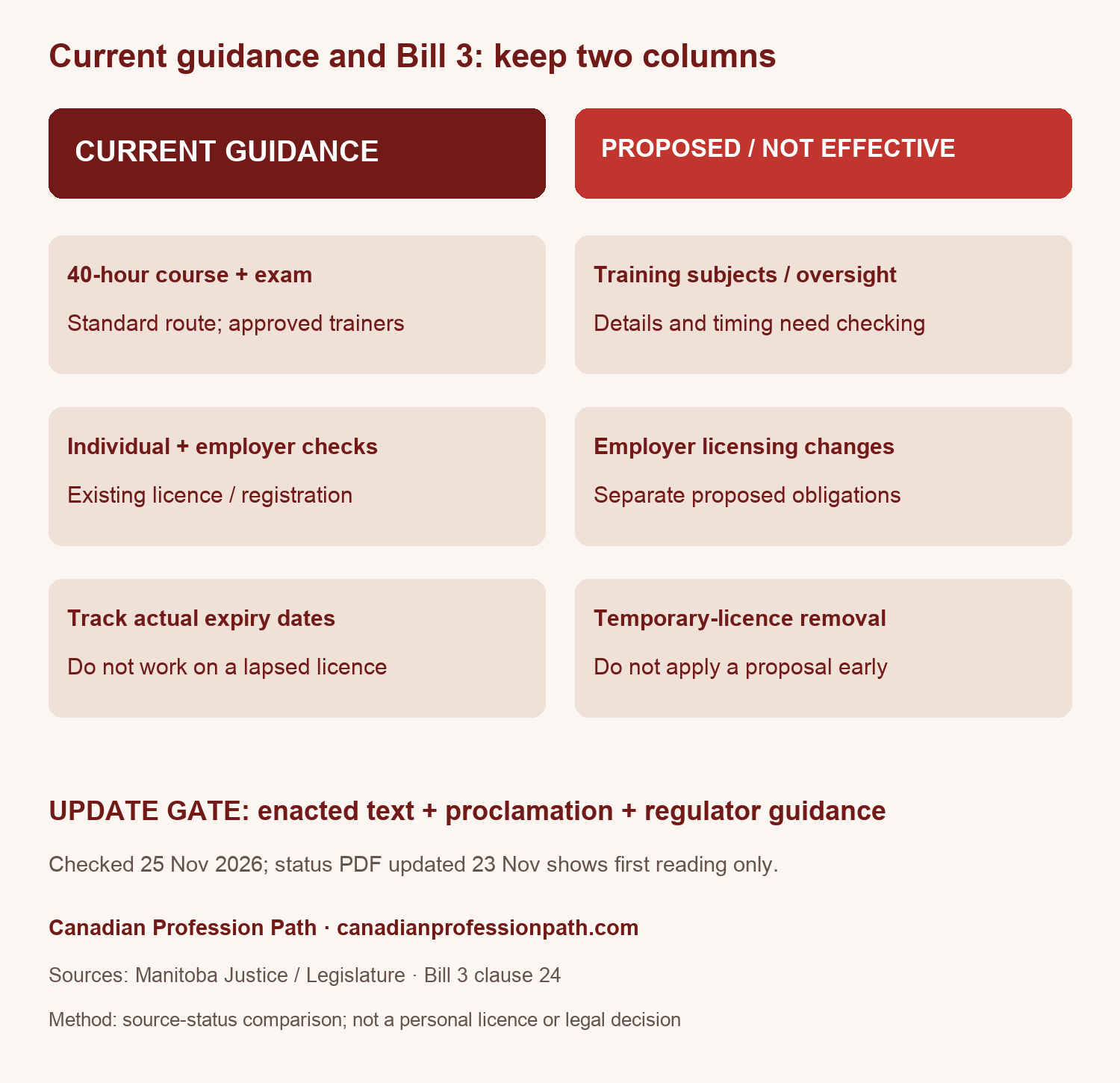
| Question | Current guidance | Bill 3 proposal / next check |
|---|---|---|
| Training | Standard route: approved 40-hour program and provincial exam | Bill would specify training subjects and registrar oversight; Confirm approved provider before buying a course |
| Existing guards | Follow current licence and document conditions | Additional cultural-awareness and systemic-racism training by registrar deadline; Do not invent a deadline or number of new hours |
| Employer status | Licensed provider or registered security-guard employer under current guidance | Would require employers guarding their own premises to be licensed; Check employer separately from individual licence |
| Temporary licences | Ask regulator about current route and eligibility | Bill proposes removal; Do not assume removal already applies |
| Effective date | Current rules still require checking | Draft clause 24: commencement by proclamation; Check enactment plus effective date and regulator guidance |
The start-date gate is more than sending an application
Consider a fictional applicant who finds a discounted training advert. Their first action is to check the provider and intended route with the regulator’s information. They then track course completion, exam evidence and the application as separate milestones. None of those alone proves that the licence has been issued.
The current FAQ says applicants cannot start work until they receive their physical licence card. Ask the regulator about your actual status instead of relying on a recruiter’s preferred start date. For a newcomer, overseas experience or a Canadian job offer does not automatically settle the regulator’s training-equivalency decision.
The employer has a separate check. Current guidance refers to a licensed provider or registered security-guard employer, depending on the arrangement. The proposed bill would change employer licensing, including guarding an employer’s own premises. Do not use the proposed terminology to skip the current employer check.
Keep training, licence and record-check clocks separate
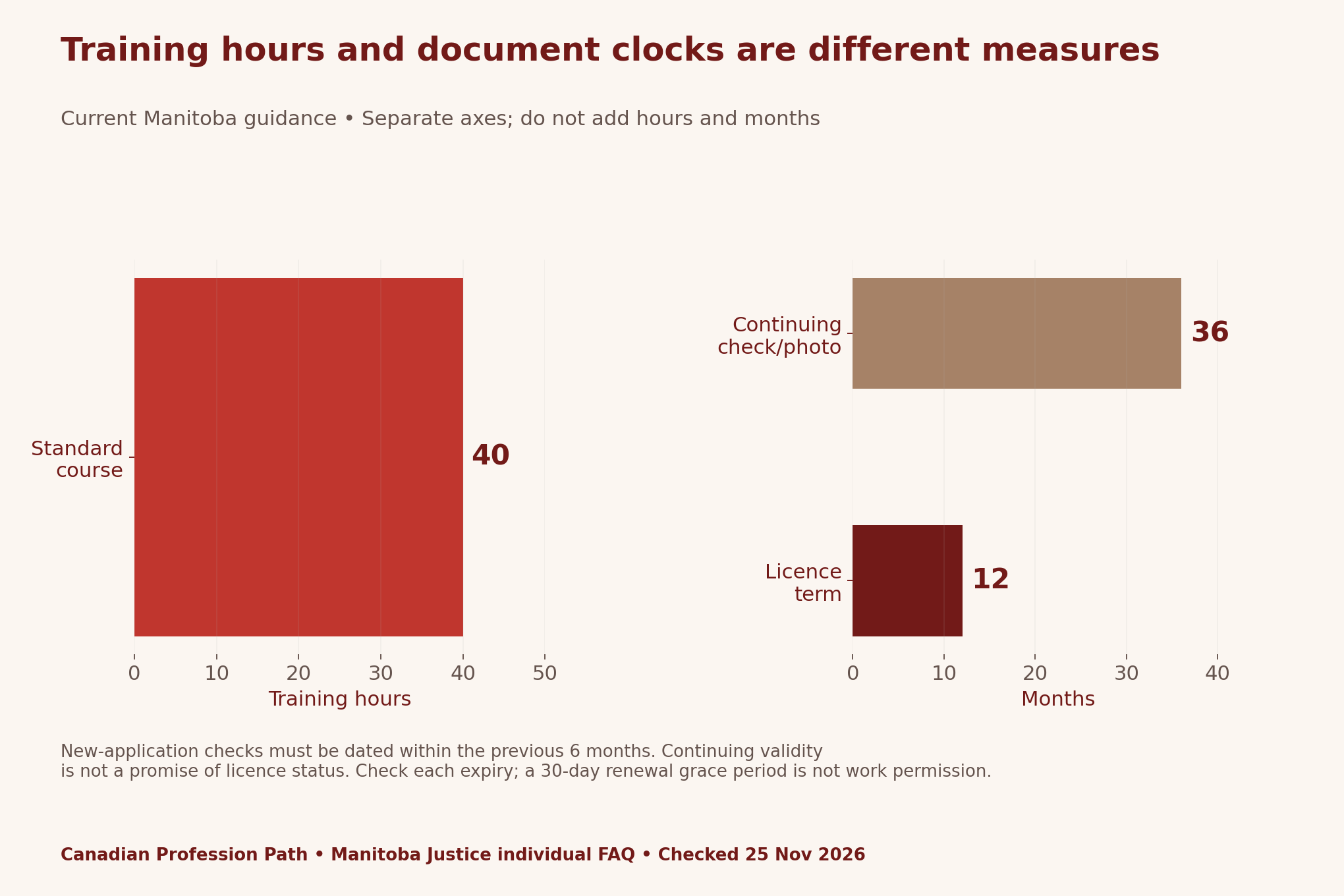
The regulator describes annual licence renewal, while supporting checks and the photo have their own dates. New applicants need checks dated within the previous six months. Continuing record-check validity is a different question. Therefore, a valid-looking card date does not remove the need to keep supporting requirements current.
The FAQ also describes a 30-day renewal grace period after licence expiry, but it expressly says a person may not work on a lapsed licence. A grace period for an application process is not extra permission to work. Use the regulator’s actual dates and instructions rather than estimating them from the diagram.
Use update triggers instead of guessing when the bill applies
Bill 3’s draft commencement clause says it would come into force on a day fixed by proclamation. Assent and commencement are separate events. If the bill progresses, check the enacted text, the proclamation and any transition directions. A news headline about passage may not answer all three questions.
Give each trigger a source link and a checked date. A blank field means the evidence has not been recorded, not that the event happened. Employers should keep their business-status question separate from staff training questions, because one may change before another obligation becomes relevant.
A checklist can track questions without collecting sensitive records
The downloadable checklist records source URLs, dates, open questions, an owner and the next action. It deliberately does not request identity documents, fingerprints, criminal-record results or registry records. Submit required personal evidence only through the regulator’s approved process. Do not paste it into a shared planning sheet.
For example, the fictional trigger log records “ask the regulator whether the licence and card are ready.” It does not store a card number or decide that a person may begin work. If information conflicts, pause the affected decision and obtain a written answer from the responsible authority.
Our UNB study-and-practicum guide separates another training decision from professional authorization. The Research & Reports archive offers other source-based Canadian planning tools.
Method, limits and reusable files
We compared Manitoba security guard licence requirements in the regulator’s current FAQ with the first-reading proposal, official index and status table. Years are converted to months only to label the timing figure. No applicants, providers or employers were audited. This guide is general information, not legal advice or a personal licensing decision. Confirm current instructions before paying or starting work.
- Dated current and proposed requirement matrix (CSV)
- Current training and document timing measures (CSV)
- Blank provider and employer verification checklist (CSV)
- Fictional applicant and legislative trigger log (CSV)
Suggested citation: Canadian Profession Path, “Manitoba Security Guard Licence: Current Rules and Bill 3”, 25 November 2026. Cite official sources for the rules and this article for the dated comparison and planning tools.


