







Saskatchewan allied health training programs offer different entry routes, even when they appear in the same announcement. A Grade 12 applicant should not assume that a new master’s program is open to them. A degree holder should not assume that their prerequisite courses, residency or placement plans are already acceptable.
Start with the provider’s entry requirements, then check the intended intake. This comparison covers occupational therapy and speech-language pathology at USask, plus respiratory therapy at Saskatchewan Polytechnic. It includes two sourced figures, an entry-route infographic and four original CSV tools. We checked the sources on 25 November 2026.
Saskatchewan allied health training programs: read capacity carefully
The province’s 24 November announcement reports C$295 million invested since 2022, over 1,000 new seats across 34 health professions, and 100 seats offered across three programs that began this fall. These measures describe expansion and offered capacity. They do not count seats available to a new applicant today.
Sask Polytech’s first-cohort report says all 25 respiratory-therapy places were filled. Do not subtract that cohort from the 100-seat headline to reconstruct current vacancies. The sources describe different scopes, and this article does not estimate acceptance odds.
Compare prior education before comparing deadlines
The USask occupational therapy page requires a four-year degree or equivalent. It lists a minimum 70% average in the latest 60 graded credits, four prerequisite subjects, CASPer and a written submission. Prerequisites need at least 70% each and 75% collectively. Canadian citizenship or permanent residence and the published residency conditions also matter.
For this route, the named subjects are anatomy or neuroanatomy, Indigenous Studies, statistics and behavioural science. Do not infer course equivalency from a similar title. Ask the admissions team to assess an unlisted course. The page sets January 31 for equivalent-course approval after the application deadline.
The speech-language pathology page also requires a four-year degree or equivalent, the 70% latest-60-credit average, CASPer, a written submission and status/residency conditions. Its six prerequisite subjects include linguistics and phonetics as well as anatomy, Indigenous Studies, psychology and statistics. The same individual and collective prerequisite thresholds apply.
Newcomers should separate immigration status from academic equivalency. Permanent residence does not by itself resolve a residency rule or approve a foreign course. Likewise, living in Saskatchewan does not replace the degree requirement. Record each question separately and retain the provider’s written answer.
The respiratory therapy advanced diploma lists Grade 12 with a 70% average across the named English, biology, chemistry and mathematics subjects. Admission is competitive. High-school and postsecondary applicants have distinct categories, so a qualifying minimum does not guarantee selection. The program is based in Regina and combines virtual lectures with required practical activity.
Separate the application date from the document date
Both USask pages list a December 15 application deadline for September entry, a January 18 personal-statement date and May 15 supporting documents. The annual schedules are not an individual offer. Confirm the cycle before paying an application fee or planning an irreversible move.
For RT, the provider lists domestic applications by February 15 and documents by March 1. Its international schedule lists December 31 and January 31 respectively. Documents are due at 4:30 p.m. CST; a weekend document deadline moves to Monday. Confirm which applicant route applies before relying on a date.
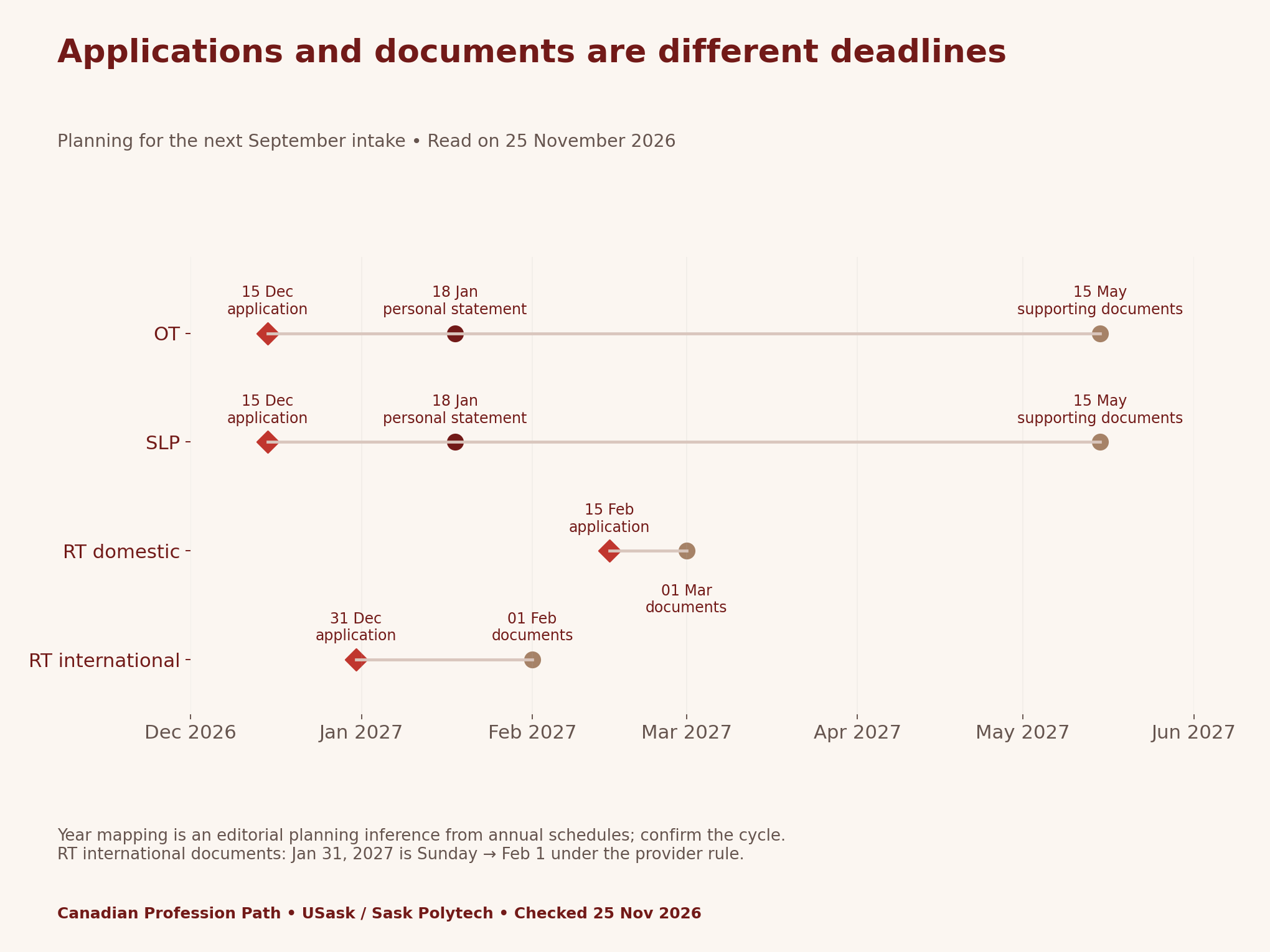
Use the timeline to work backwards. Give transcript requests, translations and unresolved course assessments their own tasks. Add an owner and a reply date. A document uploaded to a portal is not necessarily a document accepted as complete. Your ledger should distinguish requested, received and confirmed.
Plan the placement commitment before reducing paid work
The two USask programs each run for 27 months and describe 30 weeks of clinical placements. Their pages warn that students pay associated travel and accommodation costs. Some placements are outside Saskatoon. The RT page instead describes 96 weeks, also calls the program two-and-a-half years, and lists five practicums; we do not convert these into a comparable total of clinical weeks.
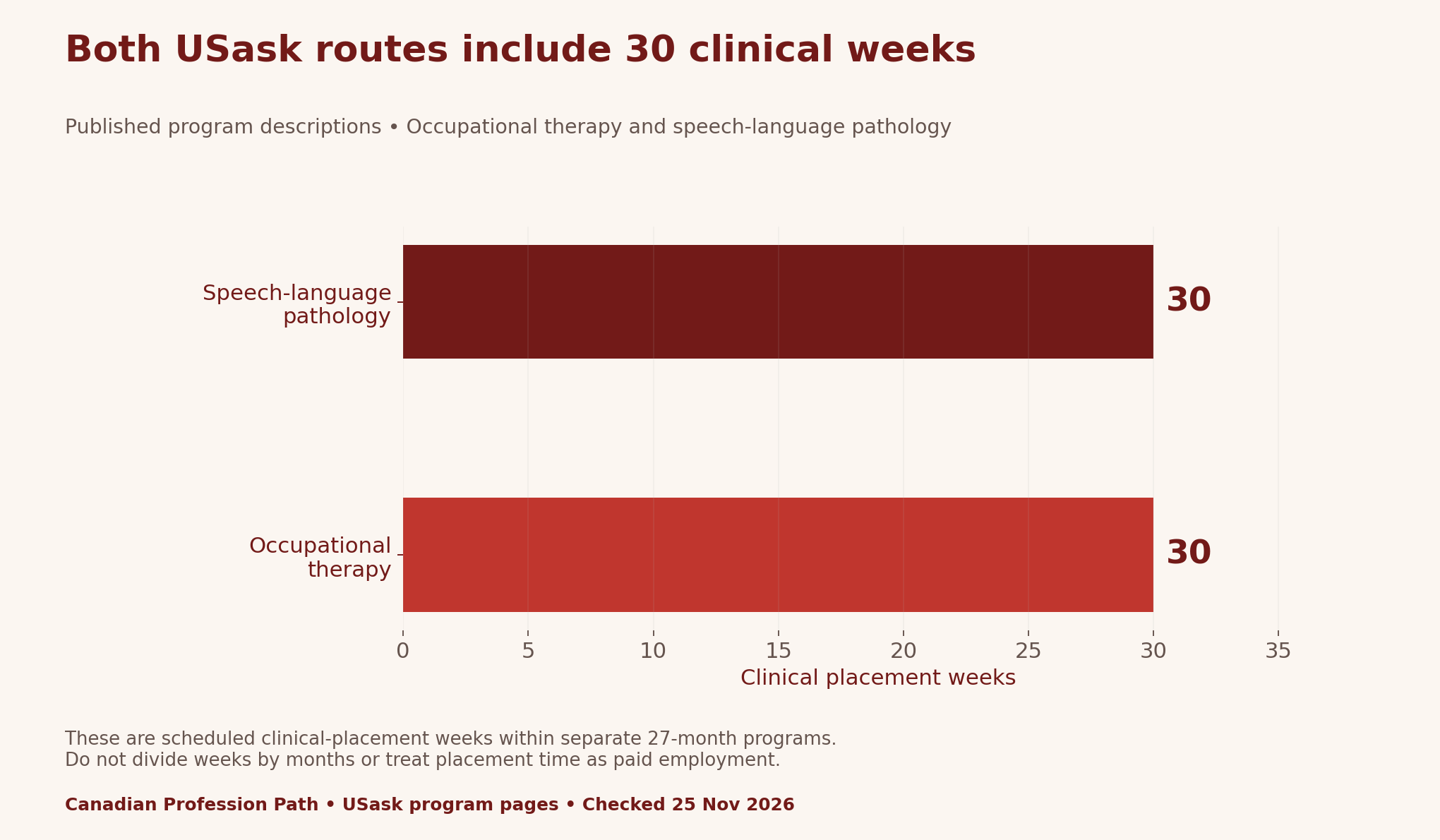
Create a placement budget with separate lines for travel, a second room, food away from home and lost work income. Leave amounts blank until you have usable quotes and a confirmed schedule. If a placement location is unknown, mark it unknown rather than entering zero. A seemingly affordable tuition figure can hide that timing risk.
Two fictional applicants, two verification actions
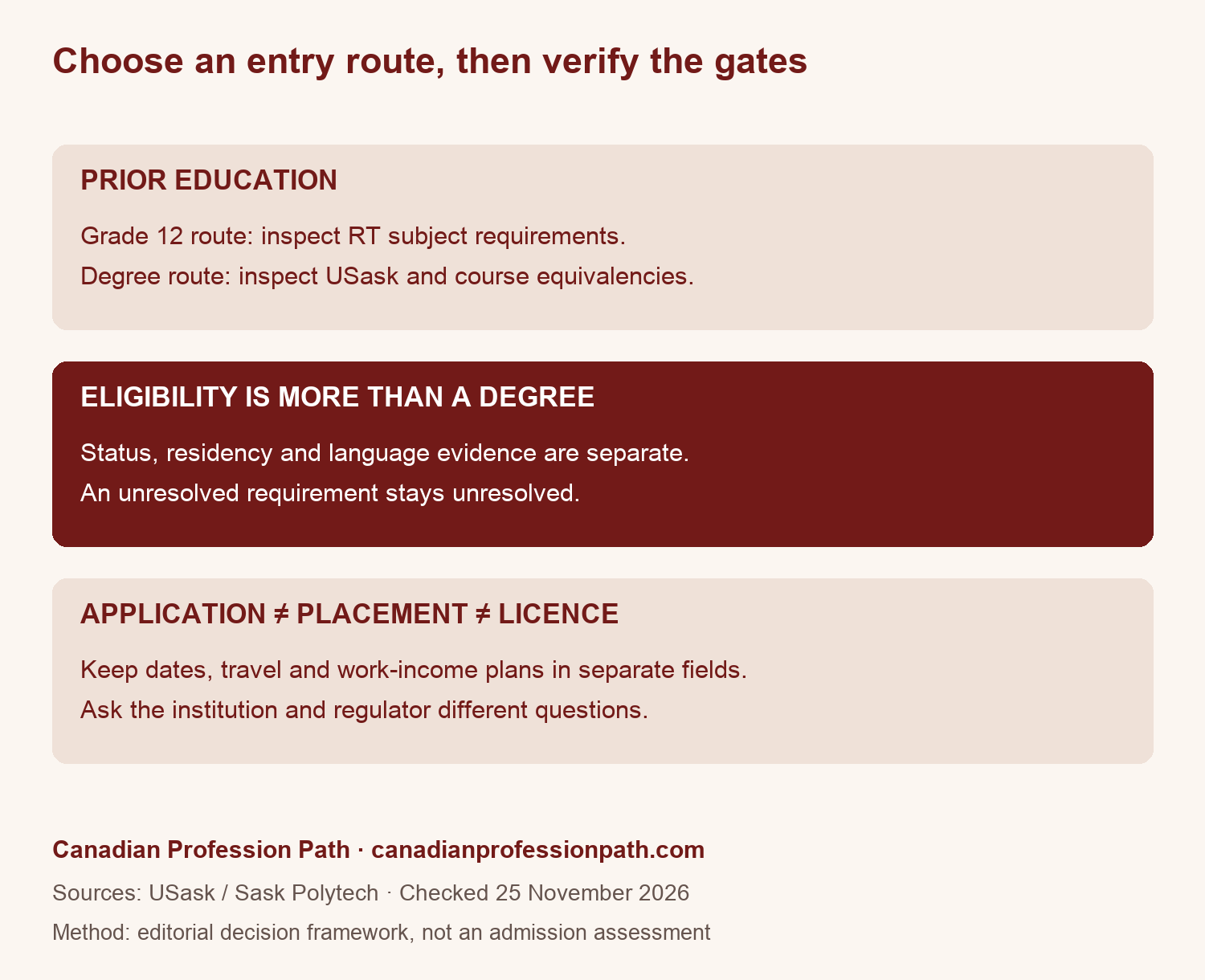
Applicant A is a fictional Saskatchewan resident with Grade 12 and no degree. Their next action is to compare the exact RT subjects and competitive category with the provider. The two graduate routes require further prior education in this example. This is a route-screening exercise, not an admission decision.
Applicant B is a fictional permanent resident with a degree and an unresolved prerequisite. Their next action is to request a course assessment and check the separate residency conditions. They should not mark eligibility complete simply because they have a degree. A missing answer is an open task, not a refusal or a pass.
Keep licensing and employment as separate decisions
Ask the provider what completing the program establishes, then ask the relevant professional regulator what registration requires. Training, graduation and permission to practise are different milestones. Do not treat a workforce-demand headline as an employment offer. The SLP page, for example, notes additional supervised hours before its entry-to-practice exam pathway.
For a broader comparison of nursing routes, see our LPN and RN research guide. It addresses a different education decision. Use the Research & Reports archive for other sourced Canadian decision tools.
Method, limits and downloadable planning files
We compare Saskatchewan allied health training programs by transcribing three provider routes and keeping each source URL beside its claims. We applied their annual dates to the next planning cycle and flagged that inference. No applicants were surveyed, no admissions were tested and no current vacancies were counted. Provider pages and regulator requirements can change; request written confirmation before committing money or leaving work.
- Three-route admissions comparison (CSV)
- Next-cycle date planner with inference notes (CSV)
- Blank eligibility and placement-cost ledger (CSV)
- Source-scope register and fictional applicant exercises (CSV)
Suggested citation: Canadian Profession Path, “Saskatchewan Allied Health Training: Which Entry Route Fits?”, 25 November 2026. Cite the original provider for its requirements and this article for the comparison, timeline and blank planning tools.


