






A web archiving portfolio project should show what another reader can retrieve, not merely a screenshot of a saved home page. Define the expected items, open the public capture and keep a dated record of what works. Missing documents and broken media belong in that record.
Concordia Library’s new service offers a timely Canadian example. This guide separates its local submission rules from a reusable portfolio exercise. Our five-item dataset is entirely fictional: it teaches the calculation and reporting method without claiming to measure the university’s archive.
Why build a web archiving portfolio project now?
Concordia’s 18 November announcement describes a service for preserving selected research websites. One contributing lab supplied two sites; its ACT Project documented work spanning 2012–2021. That example concerns scholarly material whose online life can extend beyond active project funding. It is not evidence that every project has been completely preserved.
For a library trainee or research assistant, the useful work sample is a small, traceable audit. It should let a reviewer follow your sources, understand your selection and repeat your checks. A polished percentage alone tells them much less than a clear explanation of one unresolved document or media gap.
Concordia eligibility is a local decision
The Library’s selection guide concerns public research sites with a strong Concordia connection. Submissions undergo a committee decision; review occurs each semester. Capture preparation can take two weeks to several months, depending on complexity. These are process descriptions, not an individual acceptance or delivery guarantee.
This collection excludes authenticated sites, search engines and social accounts. Concordia-domain sites are handled through a different institutional collection. Do not turn those local boundaries into a claim that such content can never be archived anywhere. Ask the relevant institution about its actual scope and permissions.
Start with a rights and selection record
Use a site you control with suitable rights, obtain permission for a small teaching example, or inspect material already offered publicly by an archive. Public visibility alone does not grant permission to republish every image, document or recording. Record the rights basis and any unanswered question before sharing a copy.
Write down the project owner, original address, selection reason and excluded areas. Keep that record beside the capture reference. If your scope covers only a public landing page and its linked brochure, do not describe it as the whole project. Avoid collecting private logins, personal records or restricted research material.
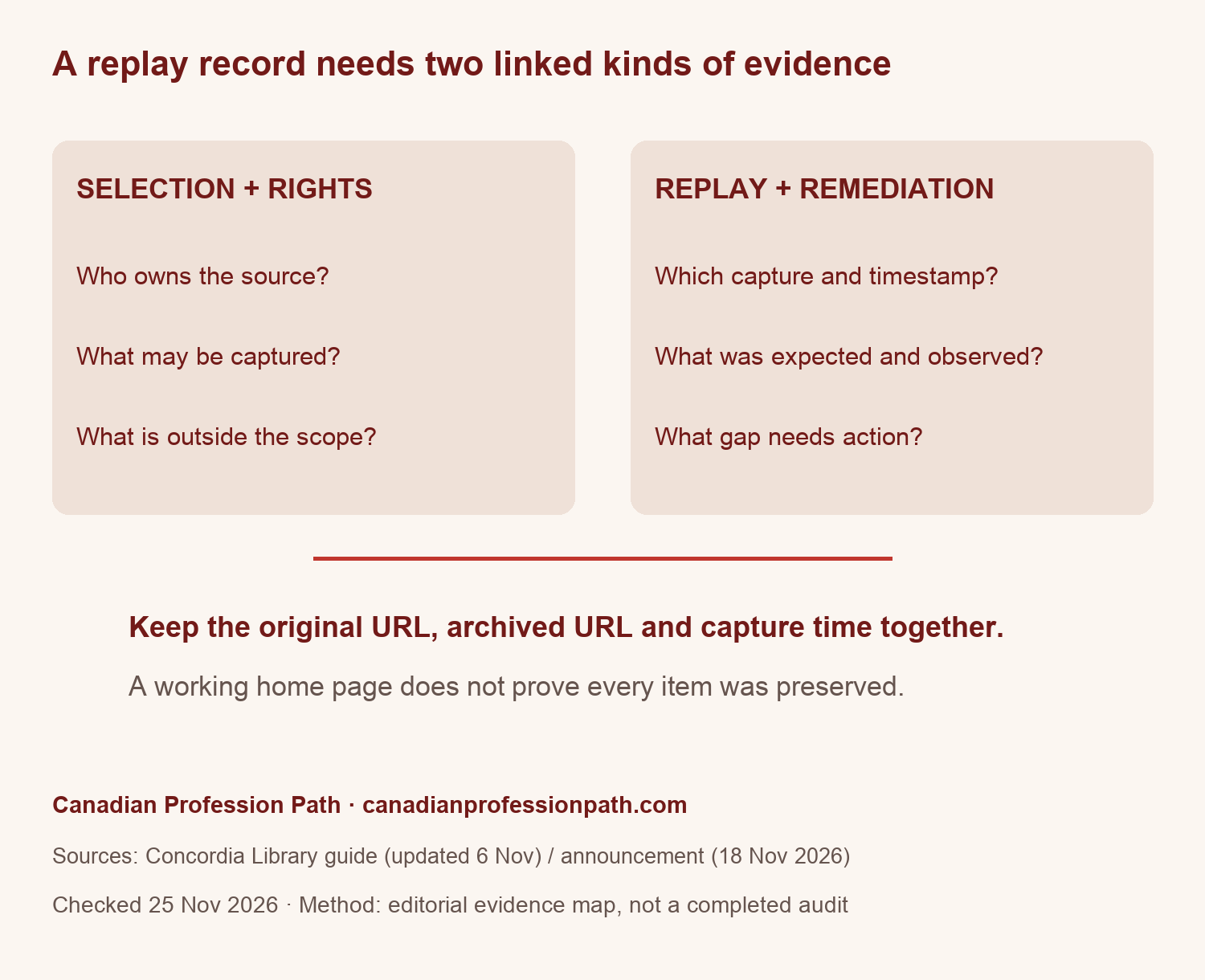
A public example that opens, with a limited claim
On 25 November, we opened the Concordia Research Projects collection in Chrome. Its list linked to an ACT Project capture whose banner identified 16 January 2026 at 00:05:37. The landing-page text and navigation were visible. This confirms that the example opened at our check, not that every linked item worked.
The collection also carries an access note explaining that some embedded audio and video may need the archive banner’s playback controls. A portfolio reviewer should see that kind of limitation, rather than an unsupported “all media preserved” label. We did not run the five-item mock exercise on this capture.
Define five expected checks before looking at the score
| Item | What a replay check should record |
|---|---|
| Page | Expected text appears in the chosen capture |
| Image | The selected image loads and matches the expected item |
| Usable document | The intended document opens with readable content |
| Navigation link | The expected destination can be reached in the archived context |
| Embedded item | The selected media actually plays, with any required archive control noted |
Choose a concrete expected item for each eligible check. An empty audio slot on a site that never contained audio is different from missing audio that should be present. Explain any truly inapplicable category before computing the denominator. Never exclude an expected item simply because it failed to load.
Record both the original and archived addresses, plus the capture timestamp. An archived link may lead to another capture time or to the live web. Note that transition instead of treating every successful click as the same kind of preservation result. Keep observations separate from your proposed remedy.
The mock calculation: three passes out of five eligible checks
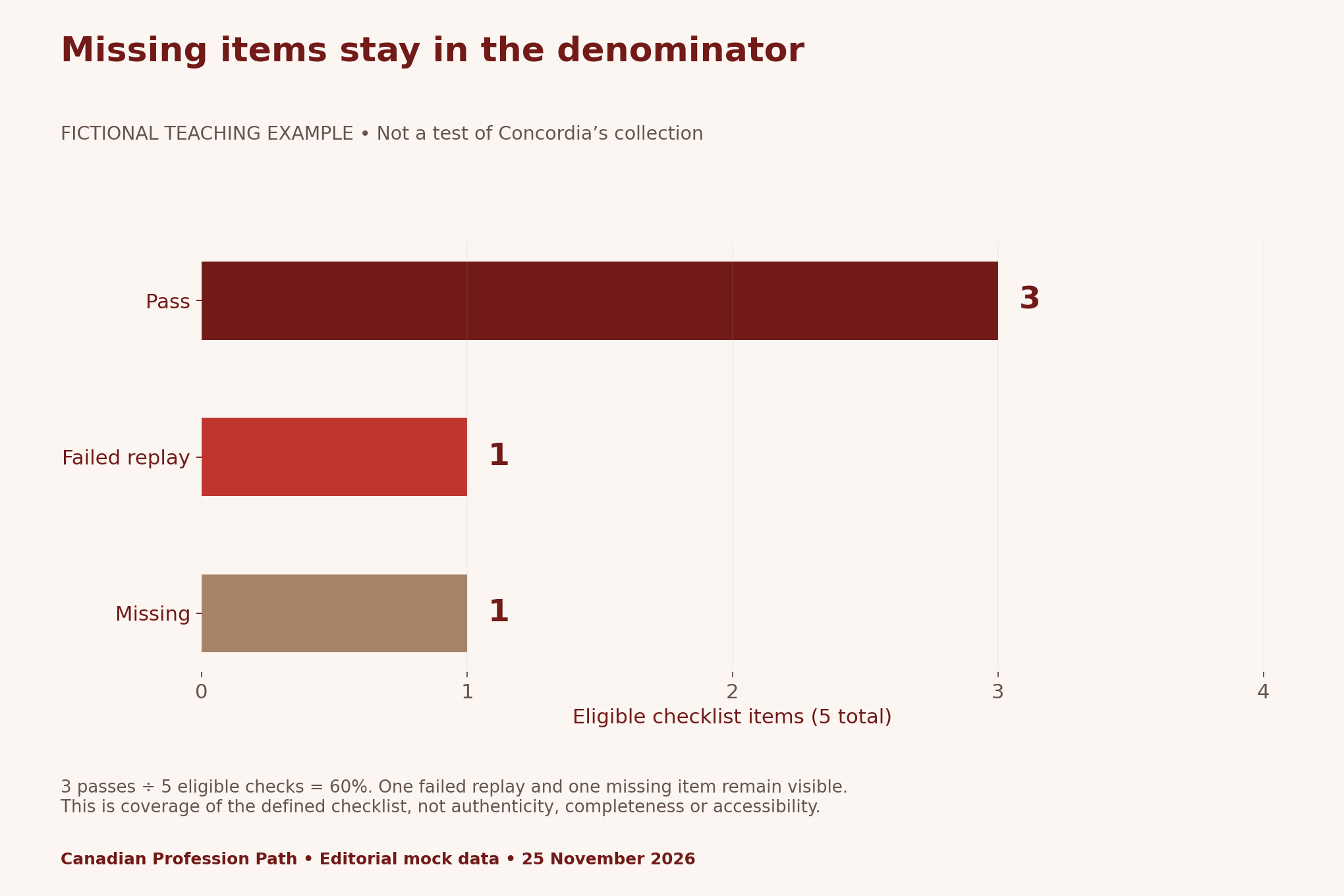
In our mock data, the page, image and navigation check pass. The expected PDF is missing, while the audio container appears but playback fails. Therefore, three divided by five gives 60%. Reporting three divided by three would hide both unresolved items and falsely suggest complete success.
Keep the failed and missing counts visible beside the fraction. With only five checks, one changed result moves the share by 20 percentage points. The number describes this defined checklist only. It cannot establish authenticity, accessibility, preservation of the full site or the reliability of the archiving service.
Package a reproducible work sample
A concise portfolio package can include the scope and rights record, expected-item list, dated observations and remediation log. For a gap, state the next check: review capture scope, try the documented media control, or ask the collection owner. Do not claim that a proposed remedy has already succeeded.
Canadian residents and newcomers can use the exercise to discuss a concrete digital-preservation skill with training providers or employers. It is not a qualification or hiring guarantee. Our research-partnership guide covers a separate project-planning decision; browse more tools in Research & Reports.
Method and reusable files
We checked the announcement, selection guide, public collection list and one capture landing page on 25 November 2026. The checklist and mock dataset are original teaching tools. No full public-site replay audit or user study was conducted. Recheck institutional rules and capture availability before relying on them.
- Clearly labelled mock five-item replay audit (CSV)
- Mock coverage calculation and limits (CSV)
- Blank rights and selection record (CSV)
- Blank replay checklist with capture metadata (CSV)
Suggested citation: Canadian Profession Path, “Web Archiving Portfolio: Can Someone Replay Your Research Site?”, 25 November 2026. Cite Concordia for its service rules and this article for the original checklist and mock teaching example.


