




Canada Summer Jobs 2027 is a chance to ask what a summer role will teach you. A useful title matters less if no one can explain who reviews your work, when mentoring happens or which task builds a skill. This guide separates the official funding rules from three practical questions you can use when an actual offer appears.
Service Canada’s preparation guide carries a 16 November 2026 update, and its employer information-session page was updated 18 November. These are guidance updates during intake, not a new programme opening. The employer application period began 27 October. Our focus is the youth worker’s decision, not completing an employer funding application.
Canada Summer Jobs 2027 has two different clocks
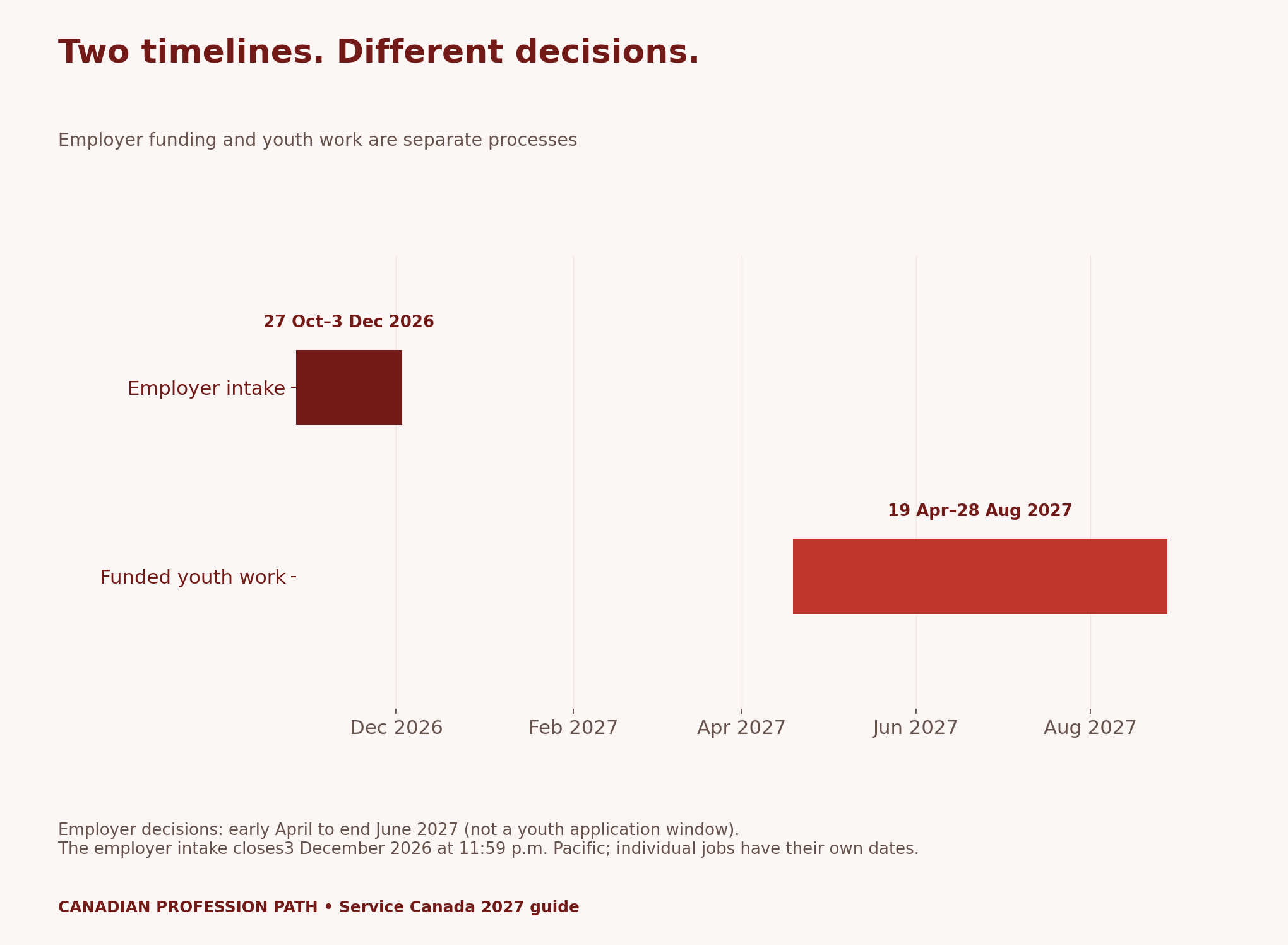
The official application page sets the online employer deadline at 3 December 2026,11:59 p.m.Pacific Time. The decision timetable says notifications begin in early April, with all organisations receiving a decision by the end of June 2027. Funding is limited; an application does not establish approval.
For your search, keep a different calendar: the date a real posting appears, its application deadline, the proposed start and end dates, and the employer’s response. Do not enter the December funding deadline as your own job deadline. Likewise, an employer’s past participation is a research lead rather than a present offer.
Check participation rules before comparing offers
The 2027 eligibility page requires youth to be 15–30 at the start, be Canadian citizens, permanent residents or people granted refugee protection, and be legally entitled to work. A valid Social Insurance Number is required at the start. International students are ineligible for this programme. Student status itself is not required, as the preparation guide explains.
For newcomers, the programme’s status conditions matter independently of your skills or an employer’s interest. Use the official guidance when checking your circumstances. Our planning downloads do not request a SIN, identity document, immigration file or other sensitive record. Keep eligibility documentation within the appropriate official hiring process.
Eligible work generally runs 30–40 hours per week for 6–16 consecutive weeks, within 19 April–28 August 2027. The official rules allow certain exceptions with advance approval. Check the actual offer’s hours and dates; the outer programme window does not promise that any one role lasts the entire summer.
Why supervision, mentoring and skills deserve questions
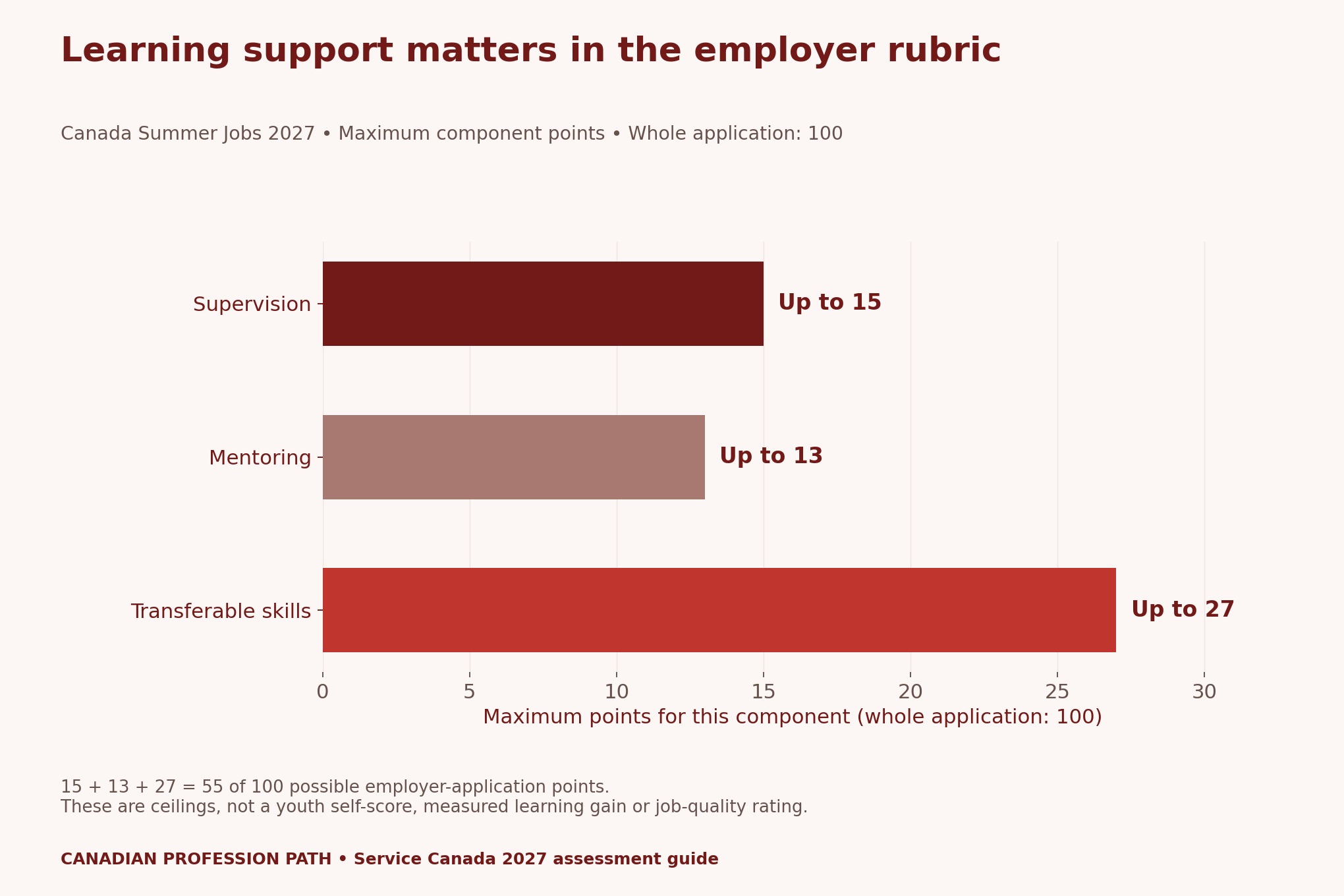
The assessment guide assigns those component ceilings to the employer’s proposal. That provides a reason to ask about the support behind a title. It does not let us score an advertisement out of 55, determine its funding result or claim that 55% of participants learn a skill.
Separately, section 9.1 of the contribution agreement requires adequate supervision, mentoring and skills-development opportunities. Government conditions and our interview questions serve different functions. Our prompts help you clarify an actual arrangement; they do not replace the agreement or guarantee that a particular experience will be good.
Three questions before accepting Canada Summer Jobs 2027 work
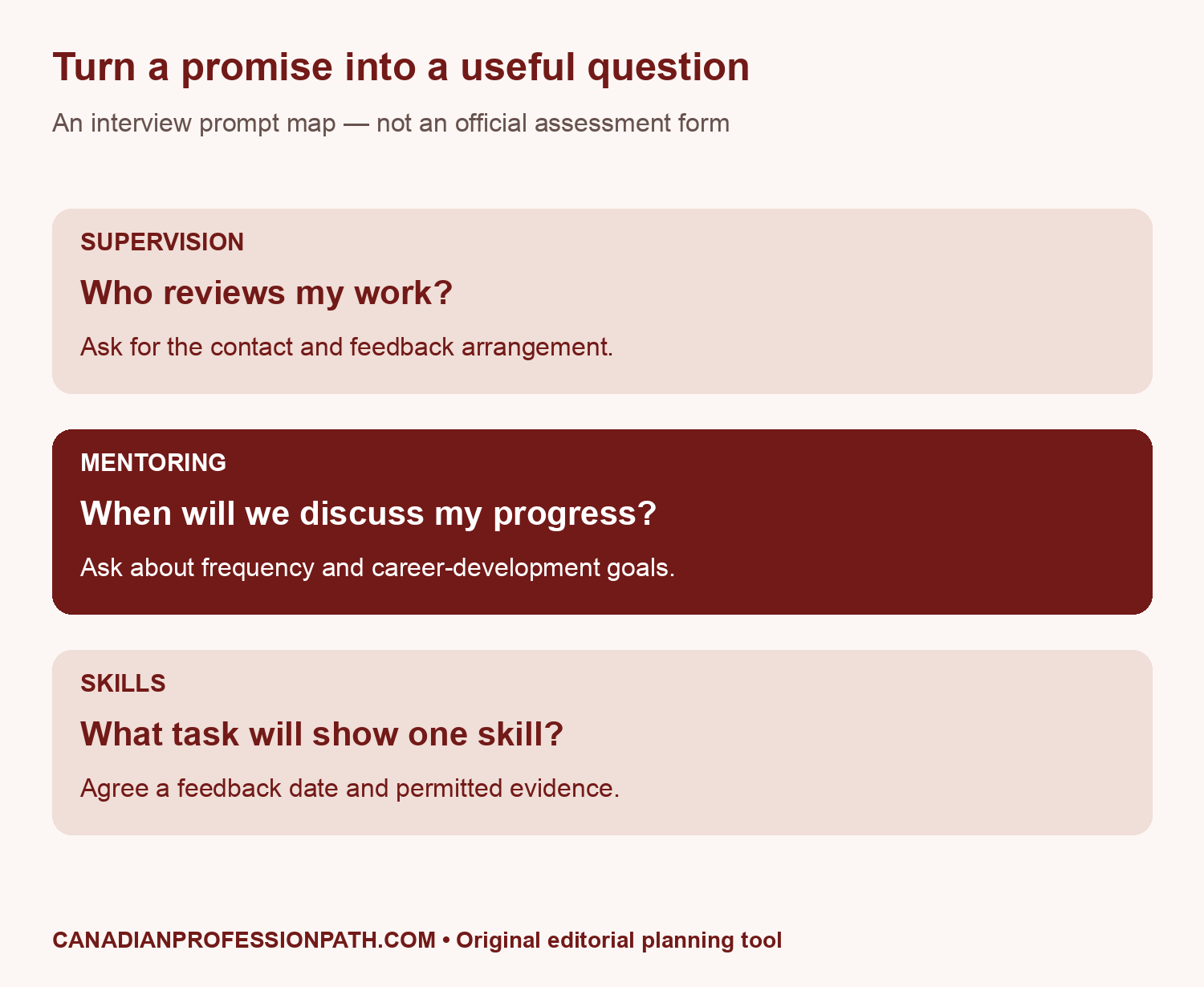
Who reviews my work? Ask who will provide instructions, check the first attempt and explain what to improve. A named contact or role makes the arrangement easier to understand. Also ask what happens if that person is away. The goal is a usable feedback route, rather than a promise that you will work alone immediately.
When will we discuss my progress? Ask how mentoring fits the schedule and whether the discussion covers your learning goals. A brief, planned conversation can be more useful than a vague invitation to ask anything. However, do not treat a missing detail in an advertisement as proof that mentoring is absent. Ask and record the reply.
Which task will demonstrate one named skill? Choose something tied to the actual duties. For example, a fictional office role might use an inventory sheet to practise accurate data handling. Agree how someone will review that work and what non-confidential evidence you may describe or retain with permission. Do not keep customer records or employer files without authority.
Compare fictional offers without inventing a quality score
| Planning question | Fictional example A | Fictional example B |
|---|---|---|
| Feedback route | Named team lead; midpoint review | Not stated: ask |
| Mentoring | Weekly career conversation | Not stated: ask |
| Skill practice | Improve a fictional inventory sheet | General office support: clarify task |
| Evidence | Ask permission before retaining a sample | Permission not stated: ask |
Save the live posting and the date you checked it. Then record the duties and answers in the blank comparison sheet. If two offers use different titles, compare the work you will practise and the support available. You can leave a cell blank until the employer answers; a tidy spreadsheet should never conceal uncertainty.
Before deciding, check practical terms such as schedule, location and pay in the actual offer. Our questions supplement those checks. They do not predict selection, continued employment, funding or earnings. If an answer changes, update the checked date and retain the current version rather than relying on an earlier conversation.
Sources, method and four free CSV tools
We transcribed official 2027 dates and three assessment ceilings, then calculated 15+13+27=55. The chart retains the 100 point whole-application denominator and the “up to” qualification. Our separate question map and fictional comparison are original planning aids, not government forms or a survey of outcomes. Sources were checked 21 November 2026 and may change.
Use Job Bank to check funded postings when published, then read the employer’s current instructions. A historical 2026 employer disclosure is not a 2027 vacancy list. Browse our Education and Training guides and Research & Reports for related evidence-based career planning.
- Original assessment ceilings and calculation (CSV)
- Dates, process and source dictionary (CSV)
- Blank live-offer comparison (CSV)
- Fictional offer comparison example (CSV)
Suggested citation: Canadian Profession Path, “Canada Summer Jobs 2027: Three Questions Before Accepting”,21 November 2026. Programme evidence: Service Canada’s 2027 Applicant Guide. Calculations, graphics and planning tools: Canadian Profession Path.


