







A Mitacs Accelerate internship starts with a research partnership, not an award-winning idea alone. Before drafting, identify an eligible intern, an academic supervisor and a partner with a specific problem. Then check who will approve the scope, contribute resources and administer the funds.
The standard C$15,000 research award is not a C$15,000 personal pay cheque. This guide separates its funding inputs from the minimum intern payment. Two figures, a role-map infographic and four downloadable tools help you prepare a focused conversation. We checked the linked terms on 25 November 2026.
What the Mitacs awards announcement establishes
The organizer’s November awards release recognizes ten innovators across six categories. Its University of Calgary–Carbonova example describes a monitoring problem in carbon-nanofibre production. That is a useful illustration of a partner question. It is not a representative sample of internship outcomes or independent proof of the release’s claimed benefits.
Treat an award story as a prompt to ask better questions. What information does the organization lack? Which research method could address that gap? Who can use the resulting work? A small, answerable problem is a stronger starting brief than a promise to transform an entire industry.
Mitacs Accelerate internship funding: read both sides
The standard Accelerate terms describe four- or six-month units with a C$15,000 research award. The standard partner contribution starts at C$7,500, and the intern must receive at least C$10,000 as stipend or salary. In the example below, the other C$7,500 is the matched contribution.
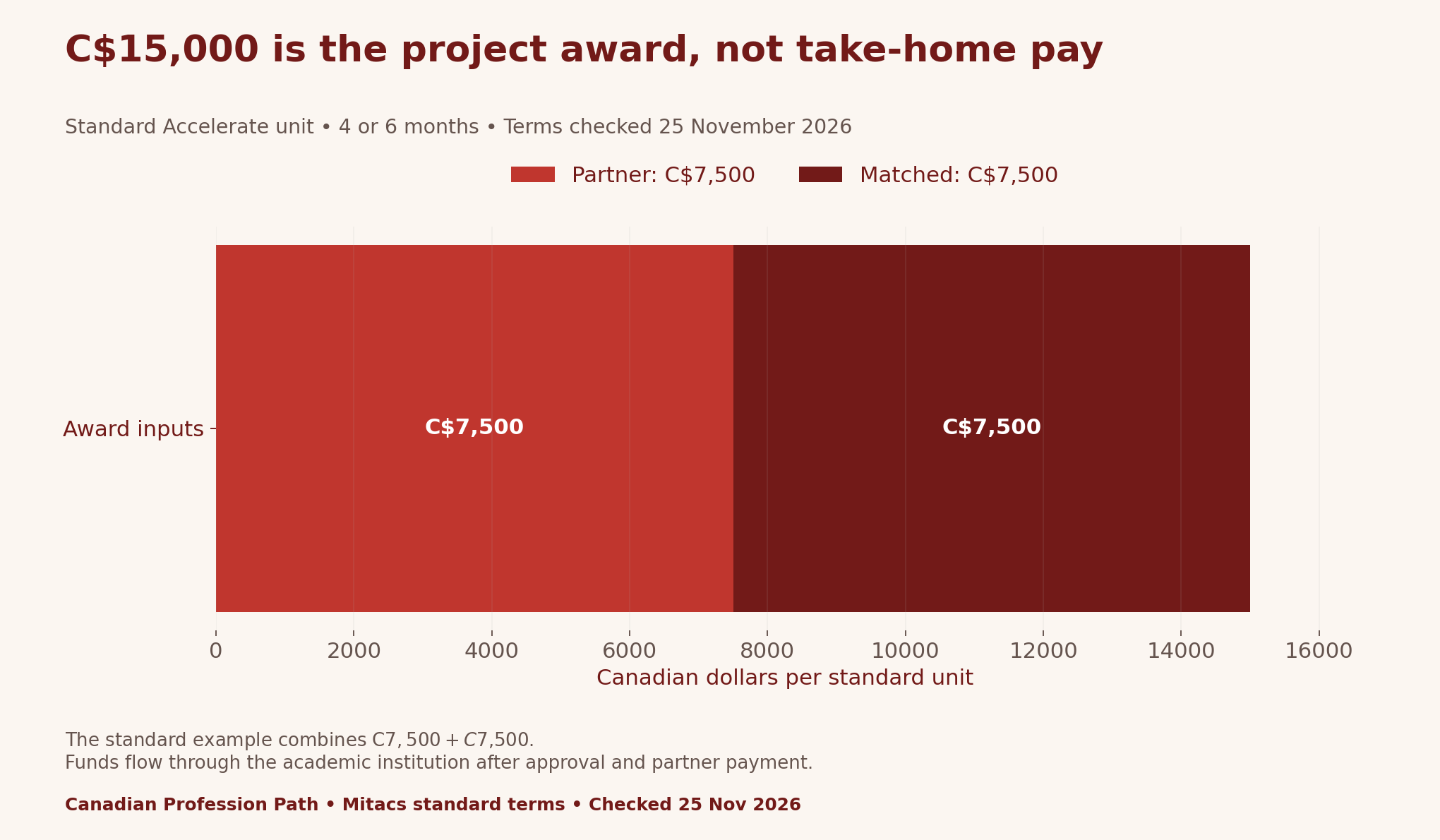
The first reconciliation is simple: C$7,500 + C$7,500 = C$15,000. The second is a boundary: C$15,000 − C$10,000 = C$5,000. That remainder is the maximum available for eligible research costs when the intern receives the minimum. It is not another payment added on top of the award.
Mitacs’ program funding FAQ explains the institution-based flow and research-cost allowance. Special models can use different amounts. Ask which model applies to your project before copying a budget. Do not mix a standard unit with a postdoctoral, cluster or other special arrangement.
Test the budget without inventing a pay schedule
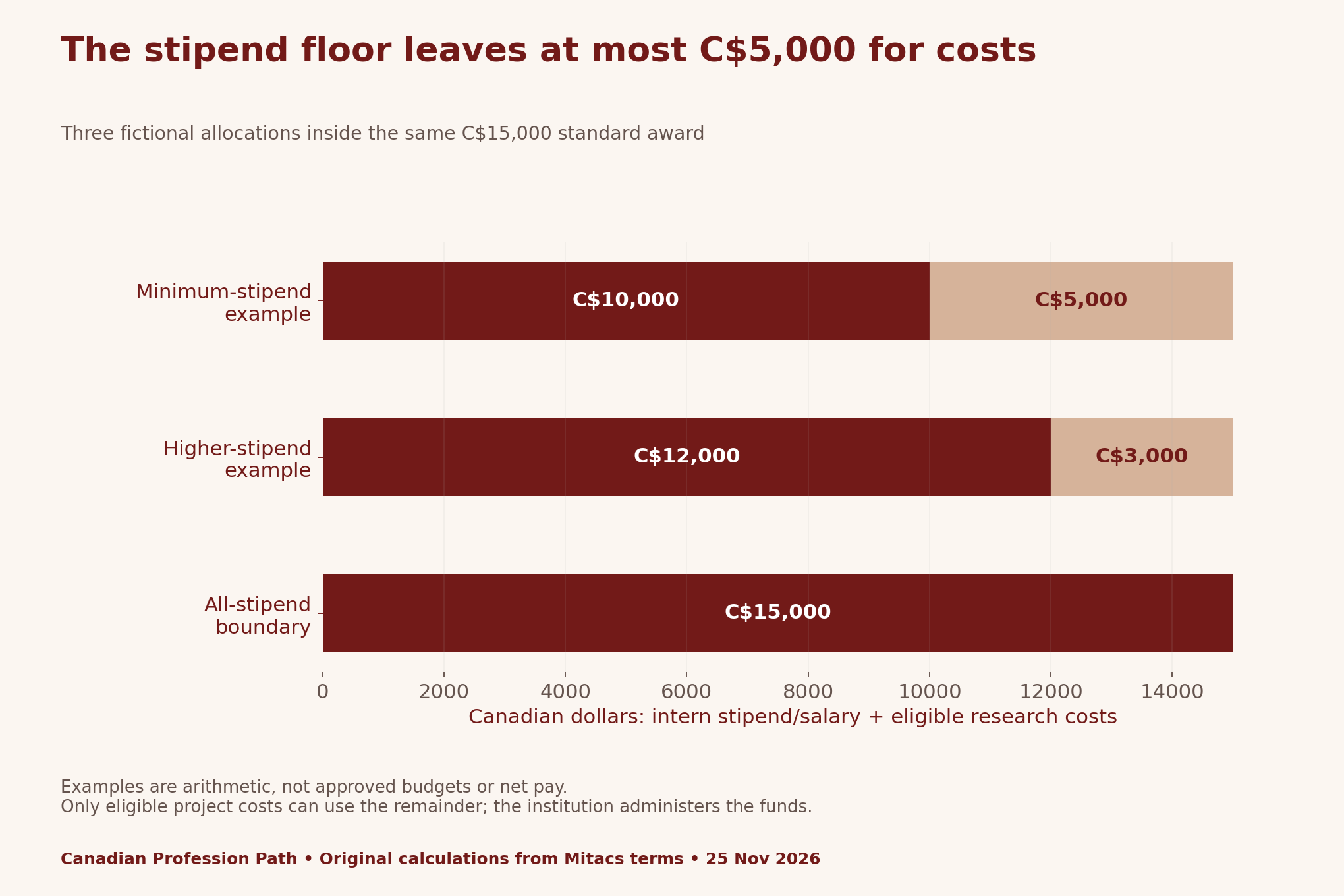
The middle example assigns C$12,000 to the intern and C$3,000 to research costs. Those amounts still sum to C$15,000 and meet the stated floor. However, arithmetic consistency does not approve an expense. The institution must confirm the proposed payment and eligible-cost treatment.
Keep three figures separate in your personal plan: the project award, the agreed gross stipend or salary, and the cash you can actually use. This article does not calculate tax, deductions or payment timing. Ask the institution for those details before deciding that the internship can replace other income.
Find three people who can make different commitments
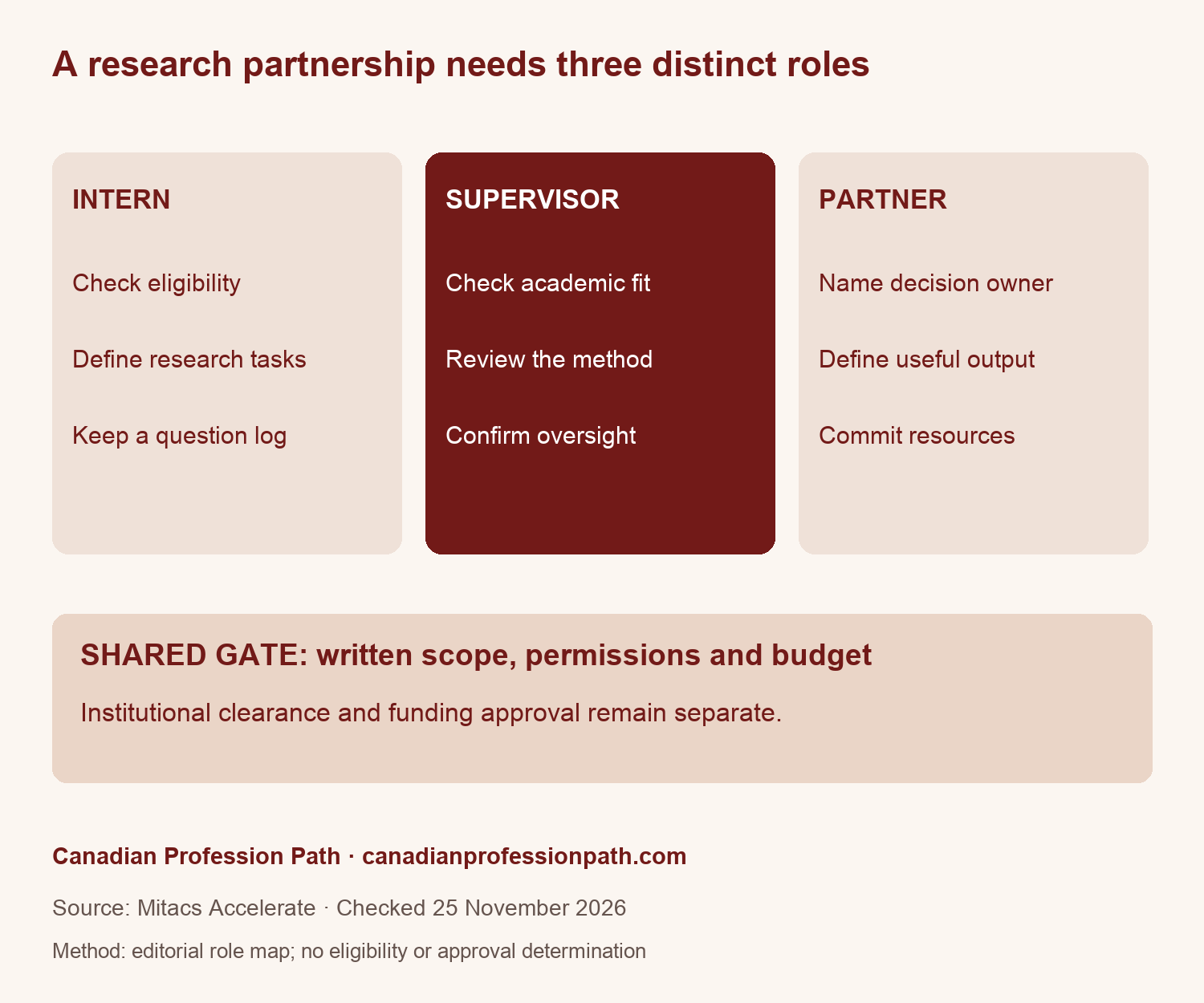
Start your collaborator brief with names and unresolved questions. A willing contact is not necessarily the person who can authorize funds or data access. Likewise, an academic contact may need to confirm that they can supervise this project. Mark each commitment as proposed, confirmed or awaiting a written answer.
The University of Calgary’s 2026 opportunity guidance is a useful institutional cross-check. Ask your own research office which participant category and submission route it can support. A recent graduate or non-degree applicant should resolve institutional support before investing time in a full proposal.
Newcomers should also separate program eligibility from immigration permission. A potential research partnership does not by itself authorize work in Canada. Ask the appropriate institutional adviser about your circumstances. Do not use an award announcement as evidence that a personal status requirement has been satisfied.
A fictional first unit: review maintenance data
Suppose a small equipment company wants to understand why its maintenance records cannot support a reliable comparison. This is a fictional teaching example. The partner names a decision owner and proposes a limited, permissioned dataset. The supervisor reviews a data-quality method. The intern prepares a baseline report and a log of missing fields.
A first deliverable could be a field dictionary and a reproducible summary of record completeness. A later milestone could compare maintenance categories using an agreed denominator. Keep a final review for limitations and next questions. Do not promise reduced downtime, a safety certification or a financial return before collecting evidence.
Use the participant terms to raise ownership and publication questions with the institution and partner. The worksheet deliberately leaves permissions and intellectual-property fields open. It does not substitute a template answer for an agreement. Resolve confidential-data access before sharing sample records or starting analysis.
Separate an invoice from approval to begin
There are two practical gates to track: the funding decision and the conditions for starting work. Record the award letter, partner payment and institutional release as separate evidence. An invoice alone is not an approval. Confirm the permitted start with the institution rather than treating an enthusiastic meeting as authorization.
For another education-planning comparison, read our Saskatchewan allied-health route guide. Its admissions and placement questions differ from research partnership funding. The Research & Reports archive contains other Canadian decision tools.
Method, limits and reusable downloads
We transcribed the standard funding terms, reconciled the inputs and calculated three hypothetical allocations. We did not survey interns, evaluate the award winners or estimate acceptance rates. The Mitacs Accelerate internship tools are planning aids. Confirm the applicable model and institutional requirements in writing before committing money or work.
- Standard-unit source data and accounting bridge (CSV)
- Three fictional budget allocations (CSV)
- Blank collaborator and milestone brief (CSV)
- Fictional equipment-review project example (CSV)
Suggested citation: Canadian Profession Path, “Mitacs Accelerate Internship: Find a Partner and Read the Funding Split”, 25 November 2026. Cite Mitacs for program terms and this article for the accounting examples and original planning tools.


