







Self-employed benefits in Canada need a continuity audit before you leave an employee role. List what you have, confirm when it ends and check any alternative in writing. Keep public health insurance, supplementary plans, income protection and Employment Insurance special benefits separate.
Our research uses July 2026 survey estimates released on 12 November. Four charts and a comparison infographic explain the boundaries. Two blank private worksheets help you organise questions, while source data and a fictional calendar make the analysis reproducible. Checked on 13 November 2026.
Self-employed benefits in Canada: read the coverage measure
Statistics Canada reports supplementary private coverage among self-employed workers of 39.4% for health care, 33.3% for dental care and 22.9% for disability insurance. These July estimates are not seasonally adjusted. They describe coverage, not premiums, eligibility or whether a claim would be paid.
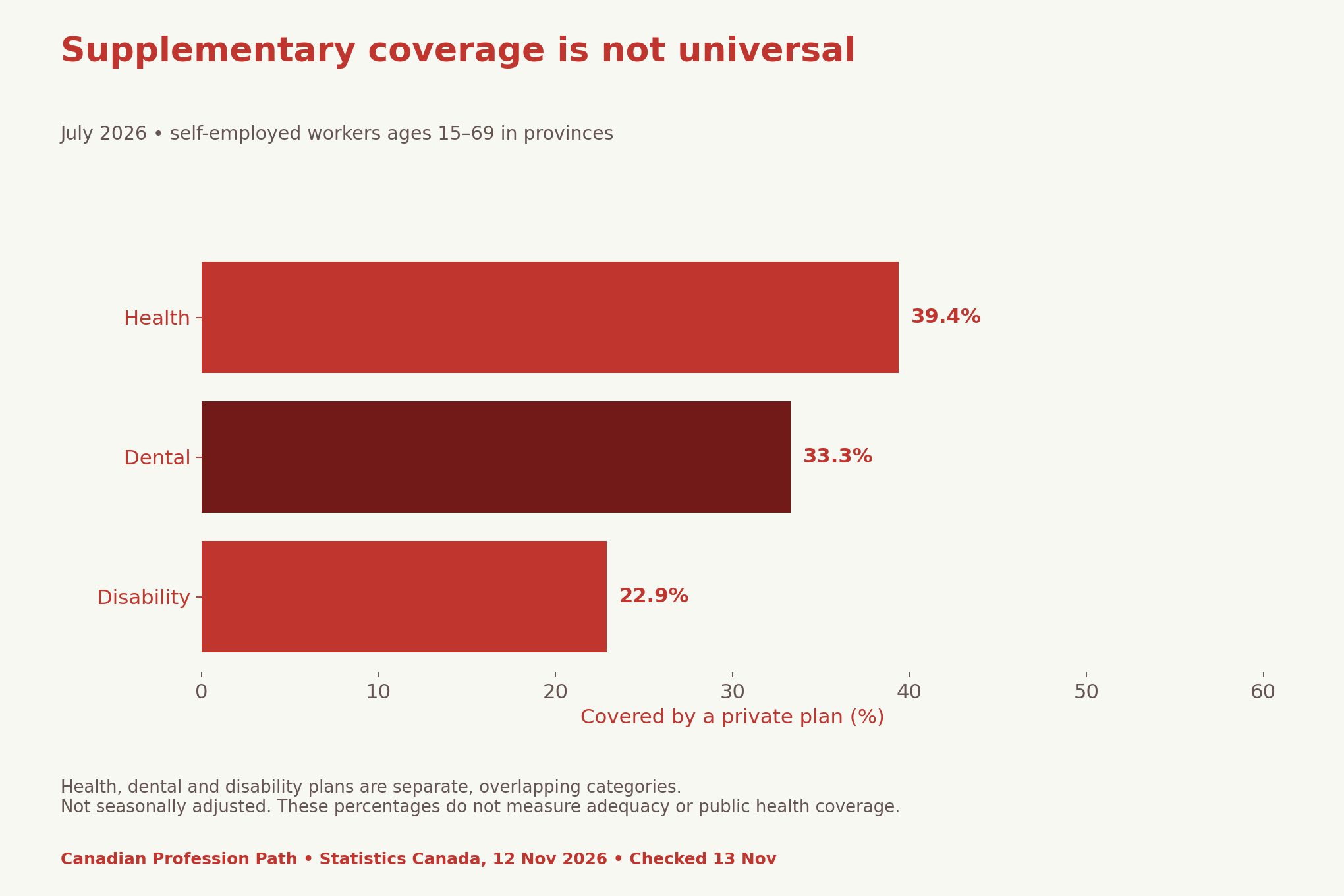
| Measure | Estimate | Comparison boundary |
|---|---|---|
| Self-employed supplementary health coverage | 39.4% | Ages 15–69; private plan |
| Self-employed dental coverage | 33.3% | Ages 15–69; private plan |
| Self-employed disability coverage | 22.9% | Ages 15–69; private plan |
| Employees with access to disability benefits | 52.8% | Employees aged 15+; different question |
The employee and self-employed measures differ in population and wording. Therefore, subtracting them would not tell you what you personally lose. Your audit should begin with your benefit booklet and written answers from the administrator, rather than an assumed national replacement cost.
Public health coverage is a separate layer
Leaving an employer does not by itself establish that provincial health coverage ends. Health Canada explains that each province and territory runs a public health insurance plan, with coverage for insured health services. Check the applicable residency and eligibility rules directly, especially if your status or province is changing.
Meanwhile, supplementary insurance can cover costs beyond a public plan. The Financial Consumer Agency of Canada health-insurance guide advises checking existing workplace coverage before buying additional insurance. A product name alone does not show whether a service, person or expense is covered.
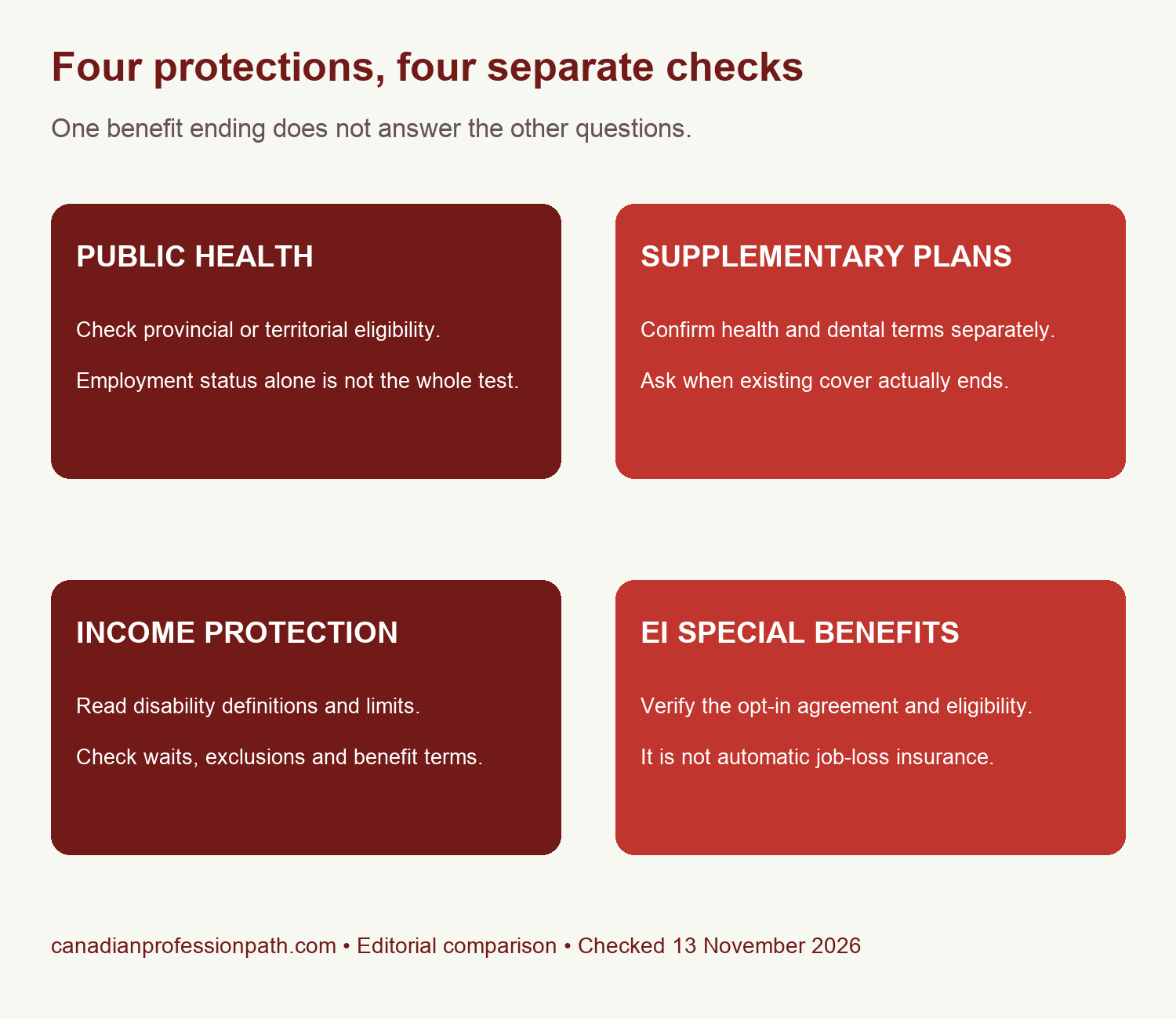
Make an inventory before comparing alternatives
Create one row per benefit or policy. Identify the covered person, provider, policy reference and current terms. Then ask which events end coverage and whether a stated end date applies to the particular benefit. Keep the last covered day separate from the deadline for submitting an existing claim.
For example, an administrator’s answer about dental claims may not settle a disability question. Ask for the relevant wording, not just a general assurance that benefits continue. Record who answered, when they answered and which document supports the reply.
Ontario’s regulator describes different policy types and replacement questions, including asking the administrator about options after employment ends. That guidance does not establish a universal conversion right. Confirm the actual contract, time limits, conditions and province before relying on an option.
Coverage rates differ, but they do not decide your policy
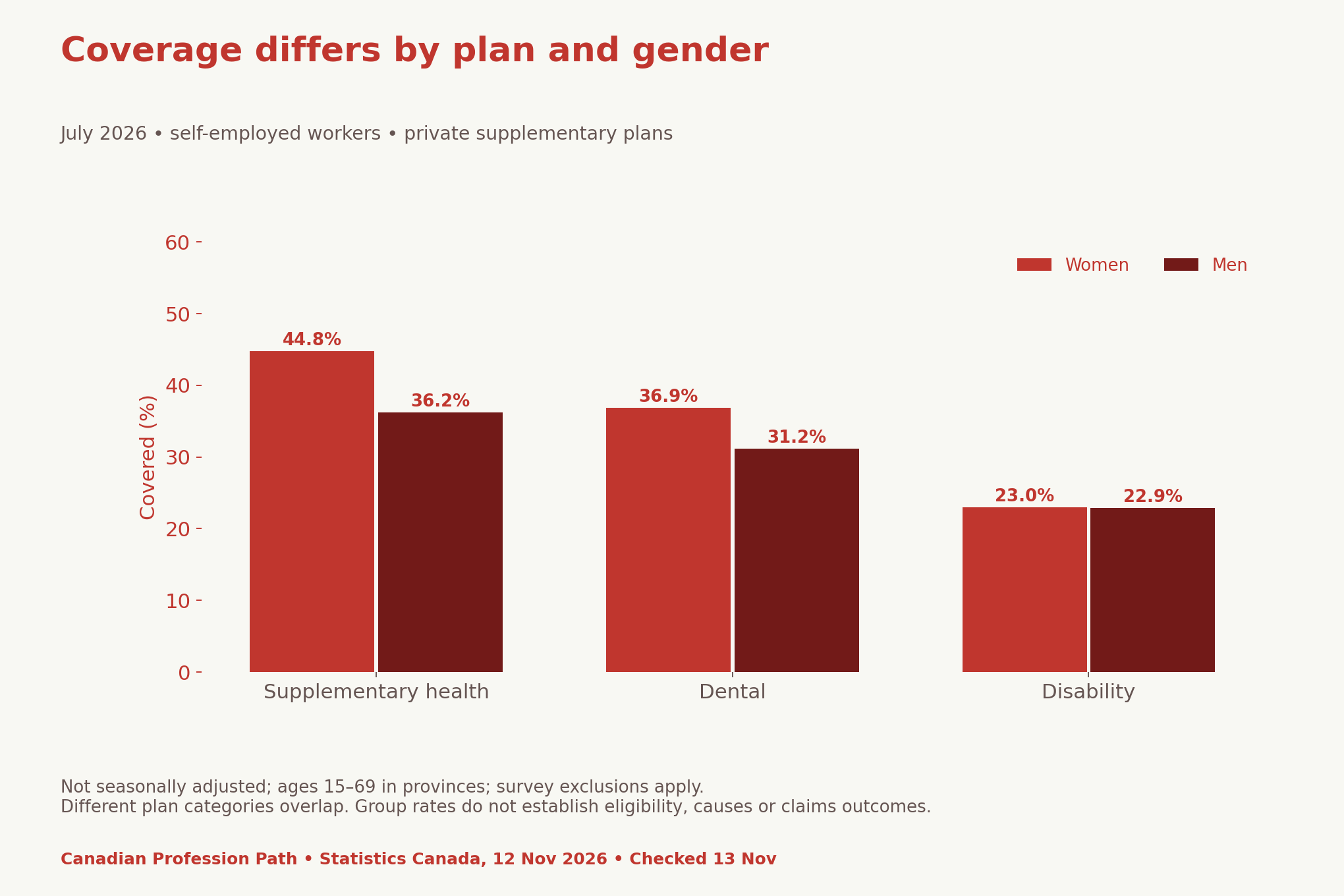
These group figures can prompt useful questions about where coverage comes from. However, they do not value a household’s protection. A family plan can have its own eligibility terms, limits and effective dates. Confirm that a particular person can join before recording the alternative as available.
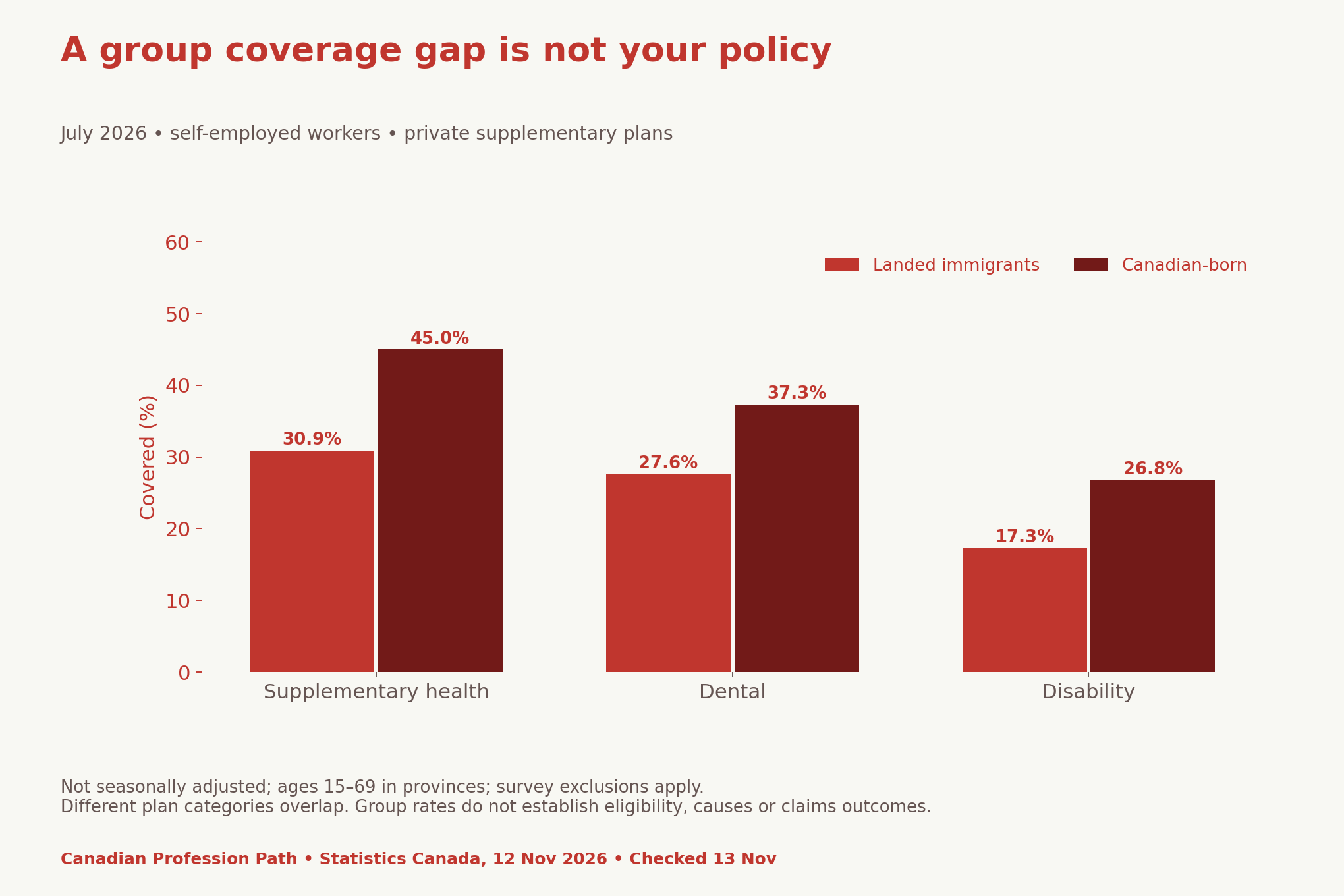
For newcomers, work authorisation, public-plan eligibility, private policy terms and programme eligibility are distinct checks. Avoid assuming one status settles all four. Ask the appropriate administrator or qualified adviser about the precise circumstances rather than applying a subgroup average to yourself.
Put end dates and start dates on one calendar
A new application is not proof that cover has started. Use a dated calendar to distinguish application, acceptance, effective date and any waiting or exclusion period. Keep unknown dates visibly unconfirmed. Do not fill a blank with the date you hope will apply.
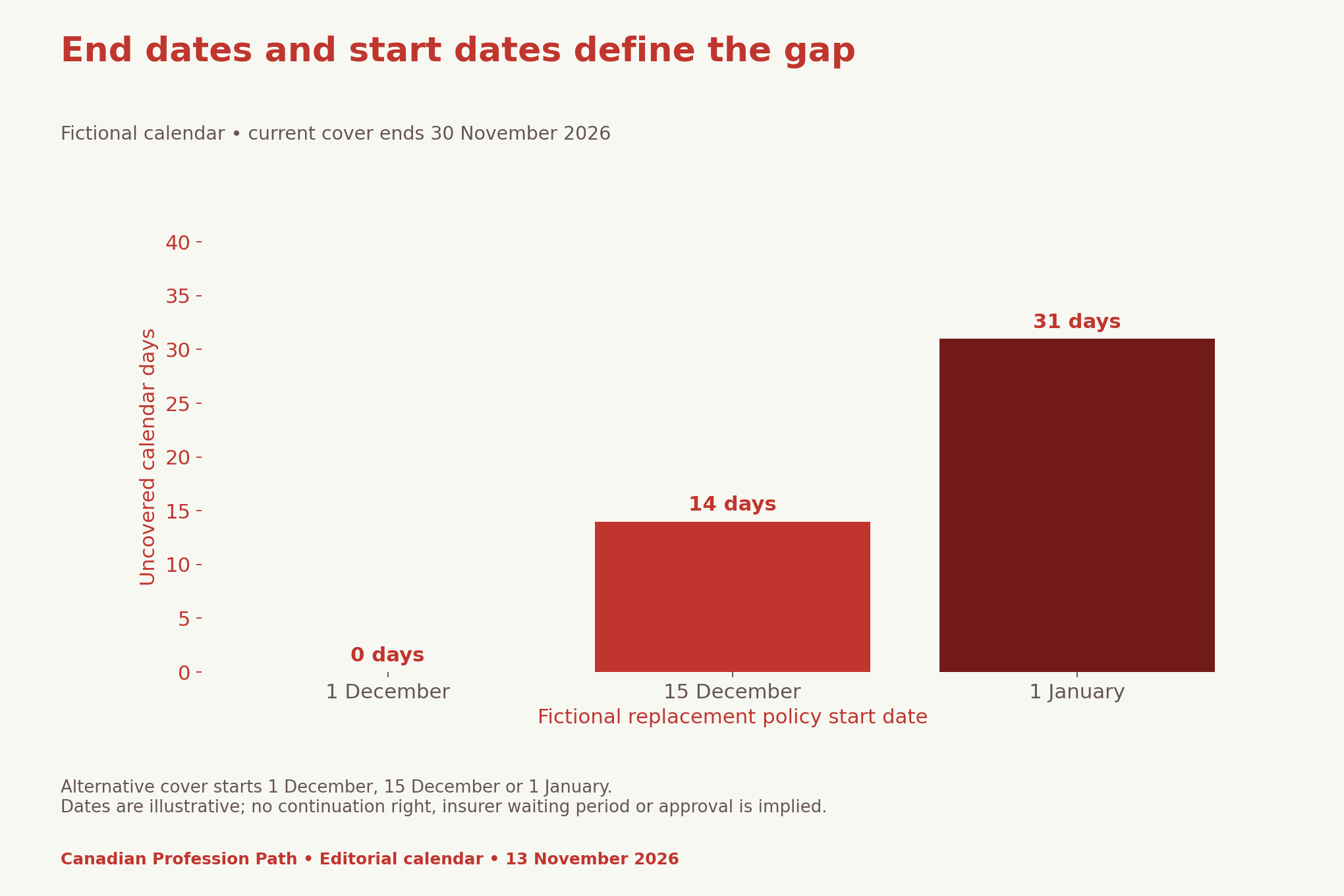
The fictional calendar counts days after the last covered day and before replacement begins. Thus, a 15 December start leaves 1–14 December uncovered in that example. The zero-day scenario says nothing about equivalent protection, exclusions or whether either policy would pay a particular claim.
Check EI special benefits without assuming automatic protection
Service Canada’s self-employed special-benefit eligibility page says an agreement must be active for at least twelve months before benefits can be received. Other conditions apply, including citizenship or permanent residence and the requirements of the specific benefit. A new registration is not immediate cover.
Also read the premium and participation rules before choosing to opt in. Participation can create ongoing premium obligations, particularly after receiving benefits. This special-benefit route is not automatic protection against losing clients. Obtain an individual assessment where employment and self-employment overlap.
Use the free audit and gap calendar privately
The audit leaves policy details for you to complete privately. Record a document reference instead of unnecessary medical information. Do not send us policy numbers, health records or household financial details. The files are organising tools, not insurance applications or recommendations.
- July 2026 coverage estimates and comparison boundaries (CSV)
- Blank private benefit-continuity audit (CSV)
- Blank coverage-gap calendar (CSV)
- Fictional date examples behind Figure 4 (CSV)
For the separate question of finding paying work, see our client-demand research and validation register. If you are comparing a new employee offer, our salary-offer guide separates guaranteed cash, variable pay and costs. Neither replaces a policy review.
Methods and limits
We transcribed published coverage estimates and kept the employee-context measure separate. The self-employed supplement covers ages 15–69 in the provinces, excludes unpaid family workers and has other stated survey exclusions. Estimates have sampling variability. No policy pricing, adequacy assessment or matched employee-to-self-employed transition was measured.
The gap chart counts calendar days using clearly fictional dates. We did not assess a reader’s eligibility, recommend an insurer or calculate a premium. Provincial rules and individual contracts require their own verification. Suggested citation: Canadian Profession Path, 13 November 2026, “Self-Employed Benefits in Canada: Audit Your Coverage”, with the original Statistics Canada release and the stated comparison limits.


