






To practise AML analyst skills in Canada, focus on how you document evidence and uncertainty. Can you explain why two records might refer to the same entity, what remains unverified and what another reviewer needs? The Auditor General’s 29 October 2026 report on FINTRAC provides a case for that learning task.
The audit covered 1 January 2023 to 28 February 2026. Its discussion of entity resolution and network visualization shows why record definitions and traceable decisions matter. This article uses selected published counts and a wholly synthetic exercise with four CSVs. Auditor General’s full FINTRAC report
Reports are a unit of information
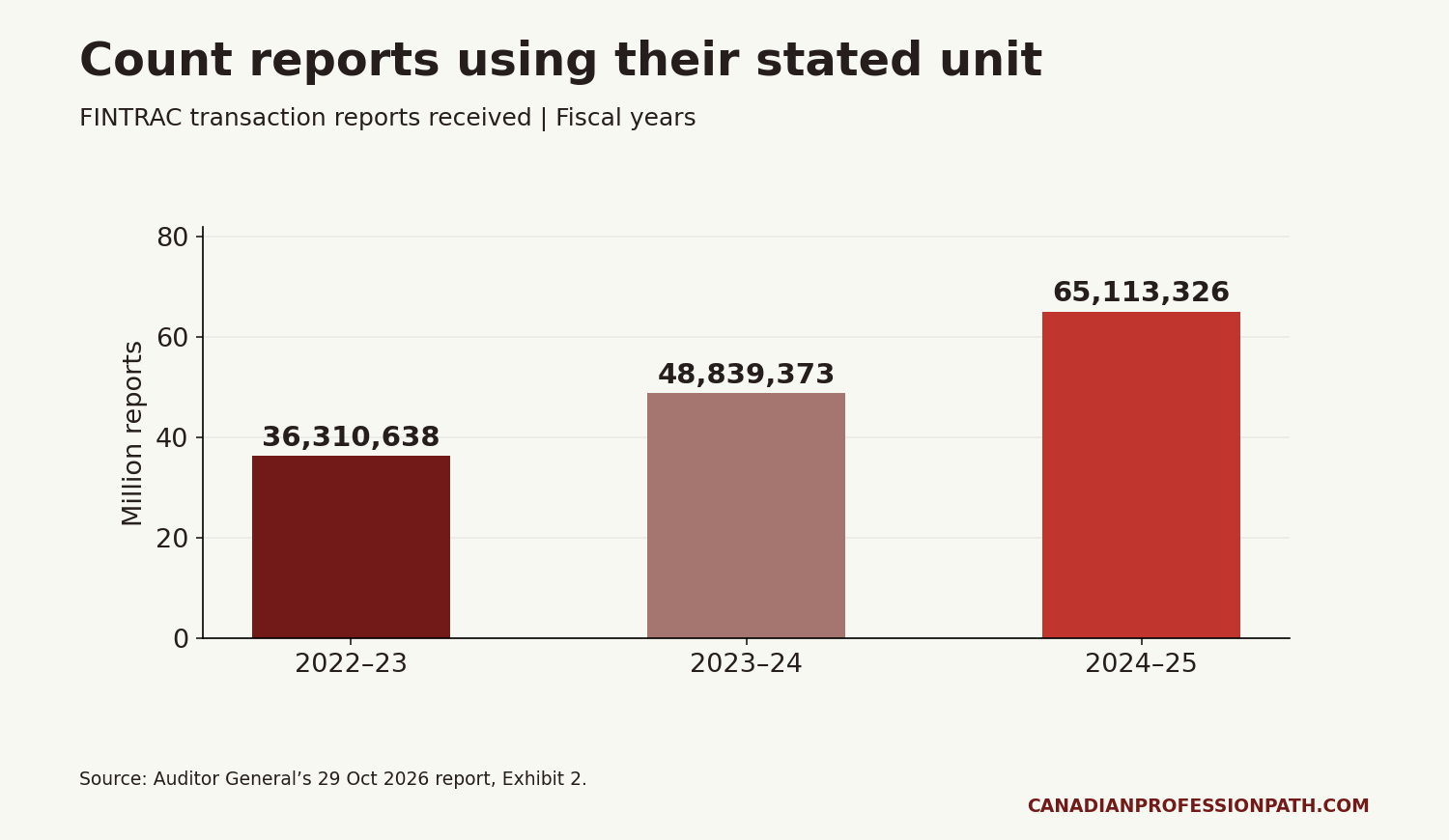
Exhibit 2 lists 36,310,638 transaction reports in 2022–23, 48,839,373 in 2023–24 and 65,113,326 in 2024–25. From the first year to the last, the calculated increase is approximately 79.3%. These are report counts. A count of unique people or proven offences would require a different definition and dataset.
The published measure register (CSV) records the units, periods and source locations. It also includes the two report categories that make up each annual total.
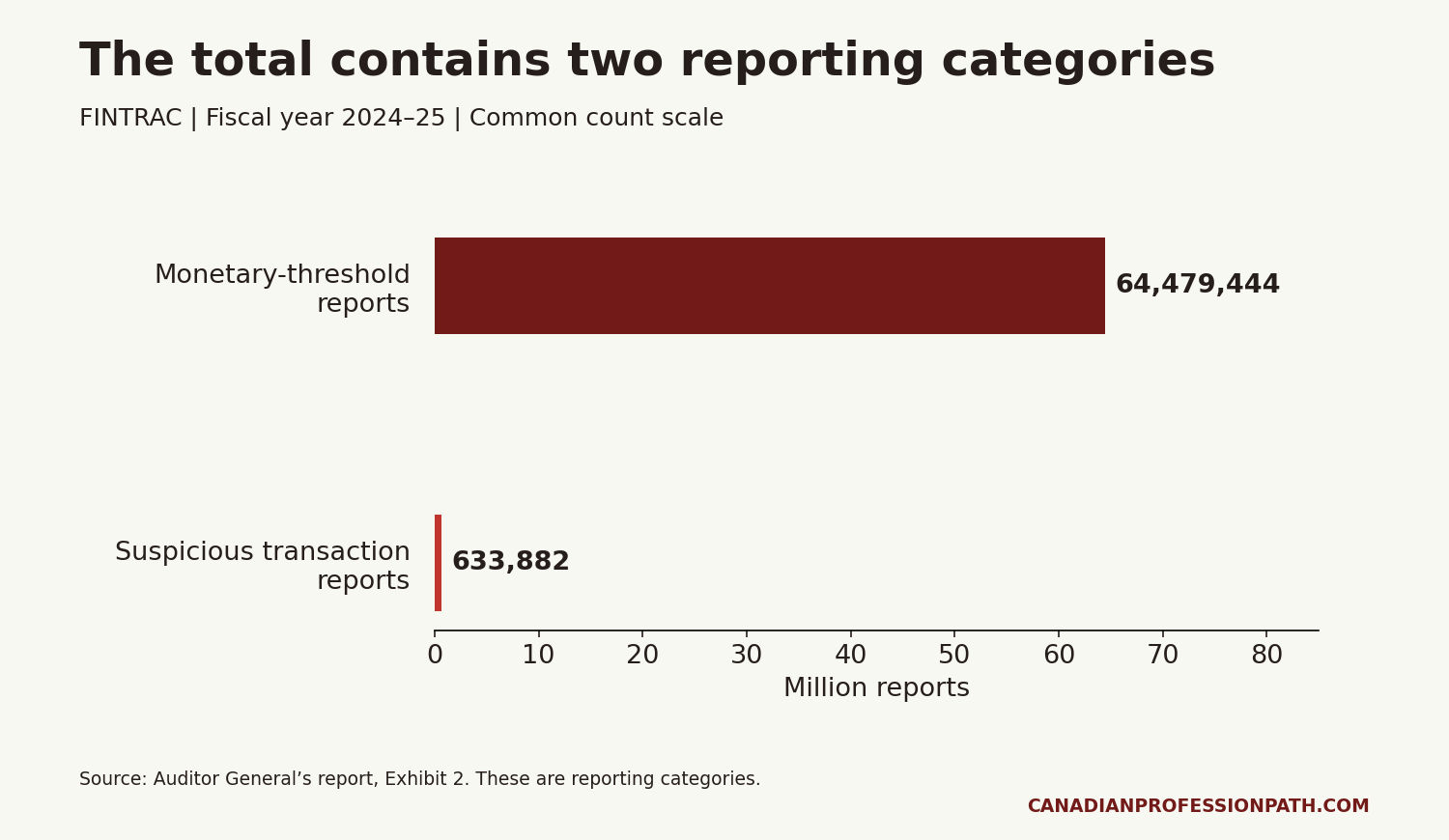
In 2024–25, the exhibit lists 64,479,444 monetary-threshold reports and 633,882 suspicious transaction reports. The total therefore brings together different reporting categories. Its size alone cannot establish the number of crimes or the effectiveness of an investigation.
Keep the later disclosure figures separate
FINTRAC’s 29 October response reports 7,214 disclosure packages based on 3,007 unique disclosures in 2025–26. Those figures use different units and a later year than the report-count series above. They should retain their own labels. FINTRAC’s response
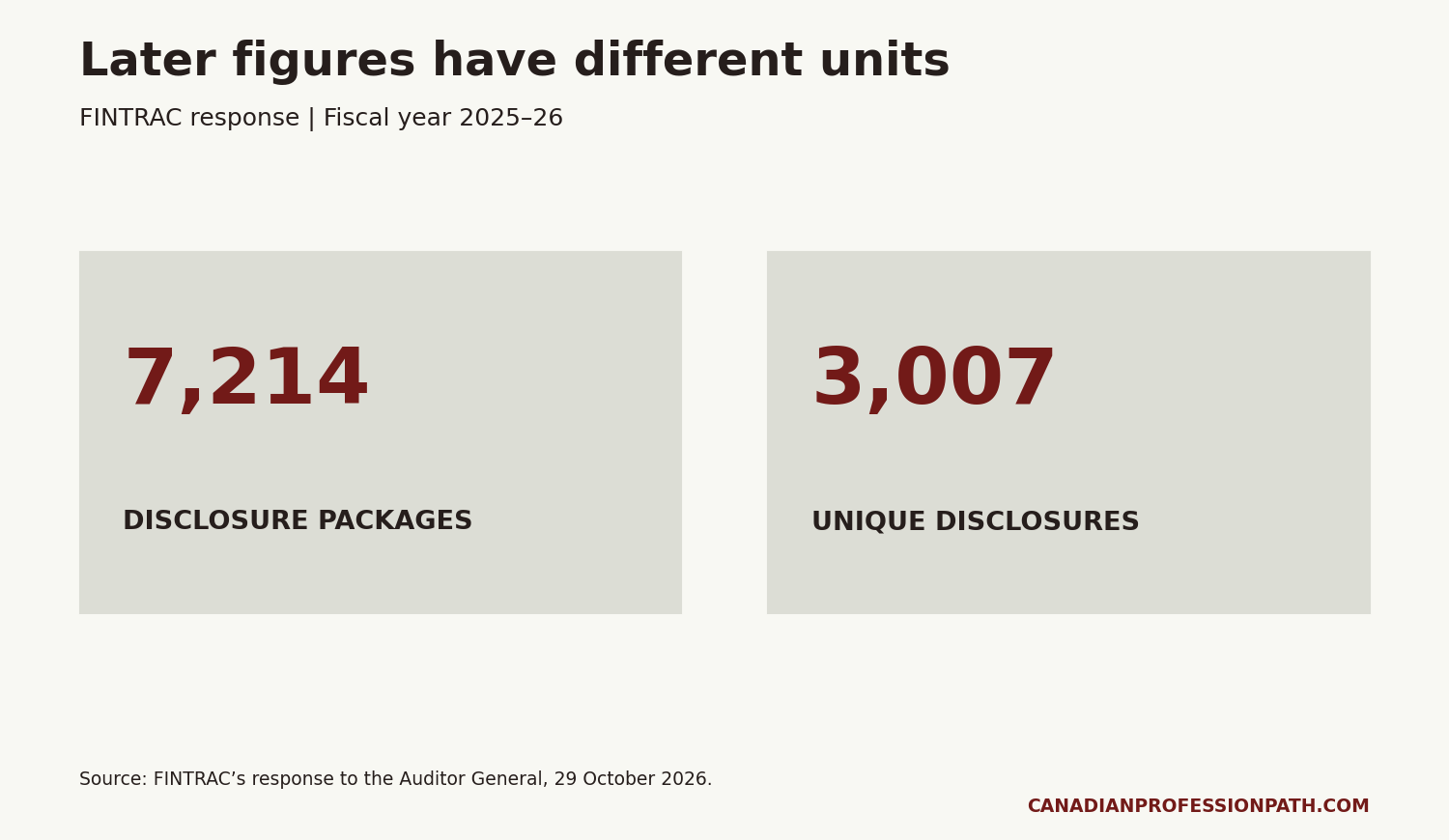
For a presentation, write the unit into the heading before adding the value. Then state the period and the population. This small step makes it easier for a reader to see when two figures cannot be directly combined.
Practise AML analyst skills in Canada on fictional records
The synthetic record set (CSV) contains five invented records. Every name, identifier and address is a classroom placeholder. The exercise asks you to compare spelling variants, address formats and a synthetic reference field.
Start by preserving each original field. If you create a normalized version for matching, keep it beside the original value and describe the transformation. For example, removing punctuation changes how a label looks. It does not independently establish who the label represents.
Next, choose a pair of records and list the fields that agree, conflict or remain missing. A similar name can be a useful lead, but a defensible decision needs evidence about the particular records.
The matching decision log (CSV) gives you candidate pairs and blank spaces for your reasoning. Use an explicit decision such as “keep separate,” “possible match” or “defer pending evidence.” Explain the reason in words. Avoid assigning an unsupported probability.
Draw a relationship without overstating it
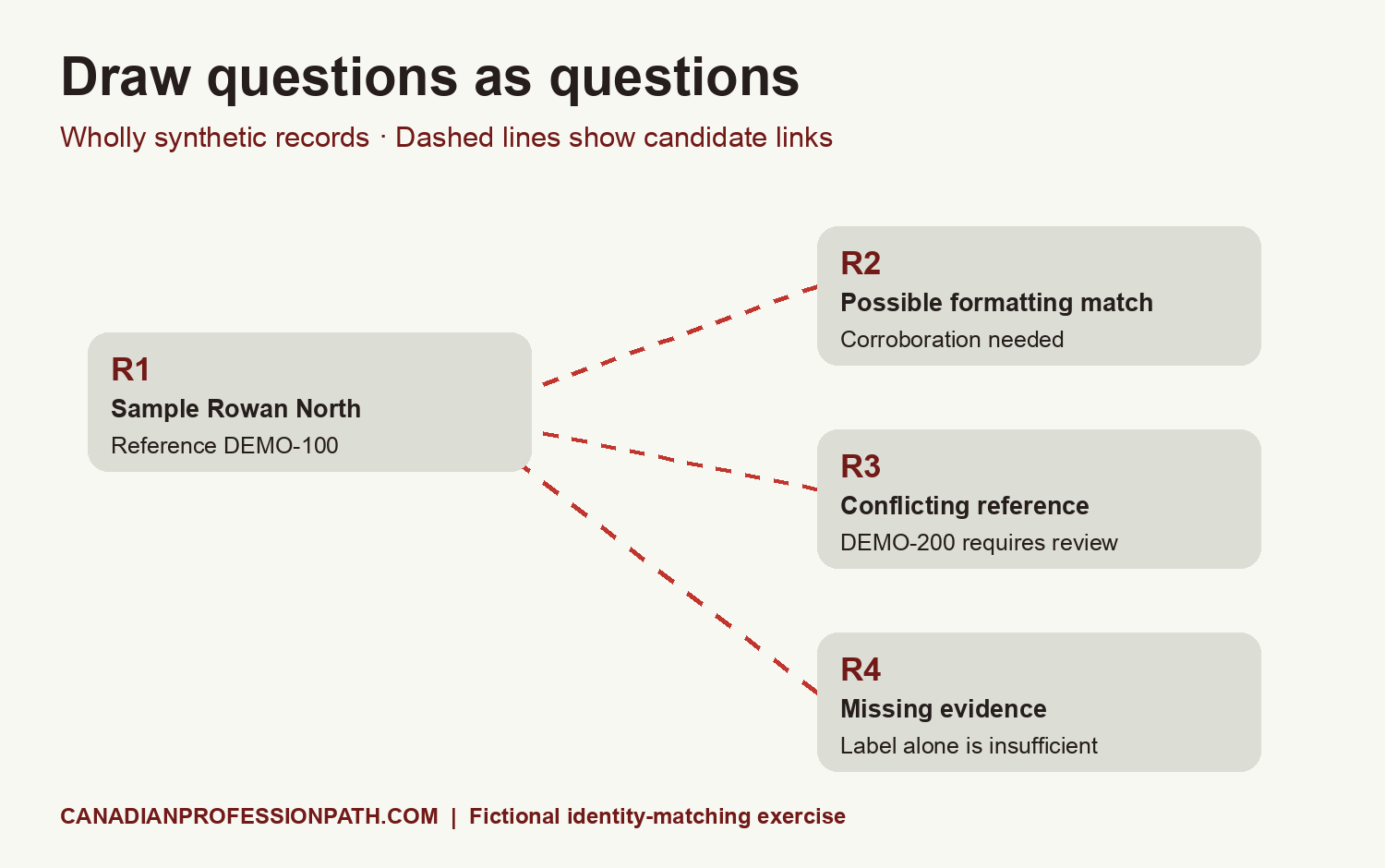
In the diagram, R1 and R2 have labels and addresses that could be consistent after formatting changes. Their relationship remains a question for the learner to document. R3 carries a different synthetic reference, and R4 has missing information. Each comparison needs its own explanation.
For your work sample, keep the record IDs on every line. Add a legend for confirmed facts, proposed links and unresolved questions. Then ask another reader to trace one statement back to the exact source fields.
Do not use ethnicity, nationality or a person’s background as a substitute for corroborating identity evidence. The exercise is about the record and the quality of the match. A connection in a diagram is also separate from any assessment of wrongdoing.
Write a handoff that another reviewer can follow
Use the evidence handoff template (CSV) to separate observations, hypotheses and missing evidence. An observation should identify a field or record. A hypothesis should say what you think might explain it. The missing-evidence field should state what would help resolve the question.
For example, write “R2 abbreviates the label and uses a shorter street suffix” as an observation. A possible-match hypothesis belongs in a separate field. The reviewer can then see which part comes directly from the record and which part requires a decision.
Include the purpose, the record versions, the changes you made and the limits of the exercise. This lets a second reviewer reproduce your steps without guessing how you produced the output.
Present a portfolio exercise responsibly
A work sample of AML analyst skills in Canada can show careful extraction, documented transformations and clear communication. Keep the published statistics separate from your synthetic decisions. Label the exercise on each worksheet and explain which fields are invented.
For readers entering from another profession, these tasks offer a way to demonstrate analysis without sharing confidential workplace material. Our procurement evidence exercise uses the same principle of connecting each decision to a record in a different professional context.
This exercise is for learning. Actual reporting, investigations and compliance decisions require the applicable rules, authorized systems and an organization’s procedures. Use the fictional files offline for the practice task.
Methods and limits
We transcribed Exhibit 2 and calculated percentage growth as the last total minus the first, divided by the first, then multiplied by 100. The figures and diagrams are independently designed. FINTRAC’s later disclosure figures come from its own response and retain their 2025–26 labels.
The synthetic records and worksheets were created for this article. No client data or live investigative material were used. The audit and exercise cannot establish hiring demand, salaries, a real person’s identity or the outcome of any case.


