







Looking for funded apprenticeships in Canada? The new federal training announcement is useful news, but it does not mean you can claim a share of C$430 million. It invites eligible organizations to seek funding. Your decision still depends on a recognized training route, an employer and support you can actually access.
This report translates the October announcement into a practical checklist for Canadian residents, career changers and newcomers. It combines three branded charts with a downloadable provider comparison. Our research date is 21 October 2026; application dates and program rules may change.
What the funded apprenticeships announcement covers
On 15 October, Employment and Social Development Canada announced more than C$430 million over five years for the Union Training and Innovation Program, or UTIP. Its three stated amounts are C$197.2 million for infrastructure, C$135 million for innovation and C$100 million for training. Together, they total C$432.2 million.
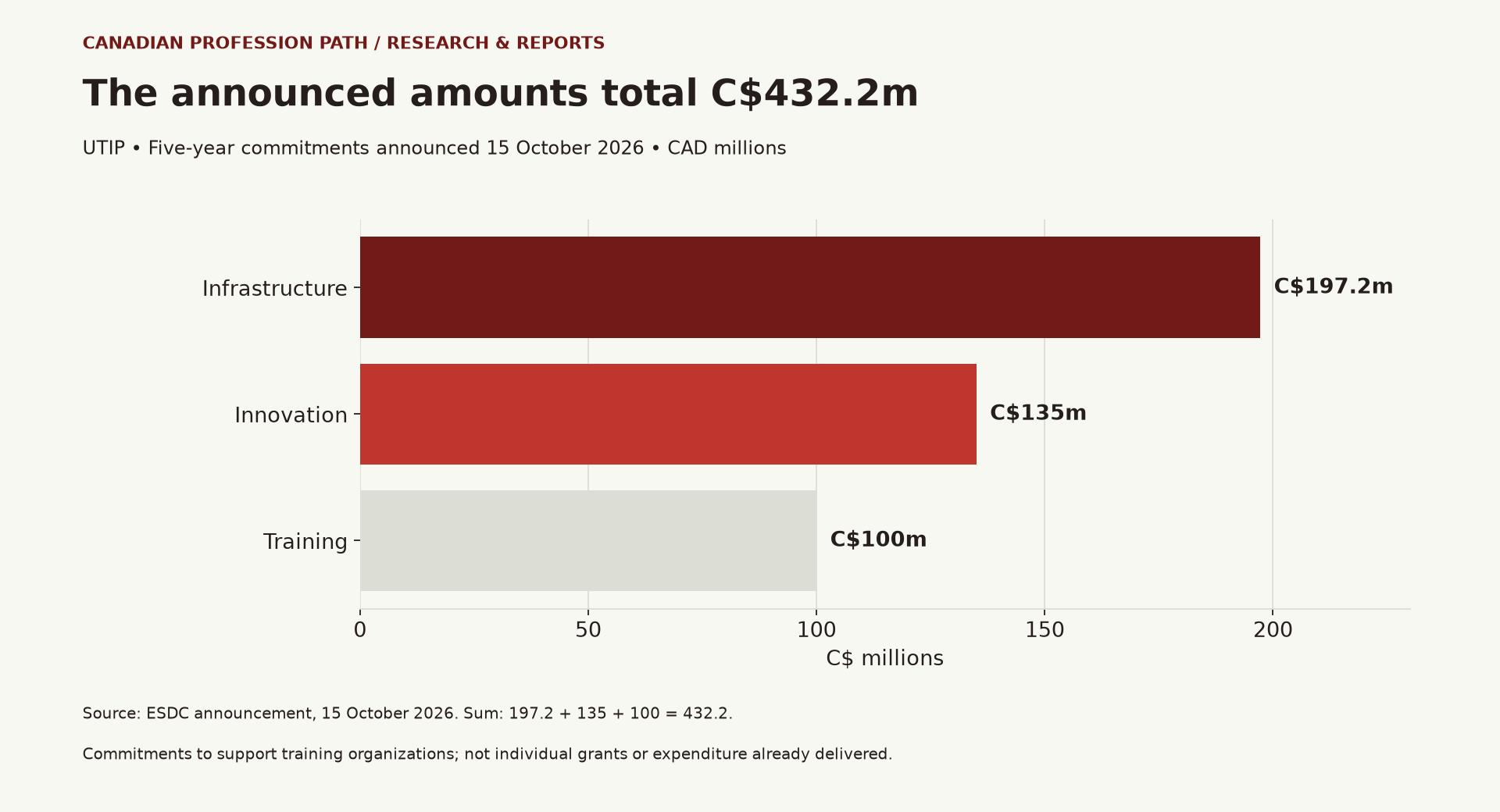
Read the original funding announcement for its scope. These amounts describe intended investment, rather than audited spending already delivered. Nor do they establish how many new learner places exist in your town today.
Three funding routes, three different questions
The UTIP program overview separates infrastructure, innovation and equipment. Eligible applicants differ by stream. They include unions, organizations managing union training funds and, for some streams, other training or community organizations. An individual seeking a place should contact a provider, rather than submit an organizational funding application.
- Infrastructure: expressions of interest close on 12 November 2026. The announcement says projects could begin in spring 2027. Ask when a specific facility will accept learners, rather than treating an application deadline as a course start date.
- Innovation: applications close on 17 December 2026. Ask which approved project would support you, what it offers and how it selects participants.
- Equipment: intake is ongoing. Ask whether the proposed equipment is already available and how it relates to the technical training you need.
The infrastructure page concerns facilities such as renovations, expansions and new builds. The innovation page focuses on helping people enter, progress through and complete apprenticeships. Those are related aims, but each requires a different learner-facing check.
What the equipment change means in dollars
The updated equipment program lowers the minimum organizational cash contribution from 50% to 30%. The announced maximum federal contribution rises from 50% to 70%. This changes project financing for eligible equipment; it does not set apprentice tuition.
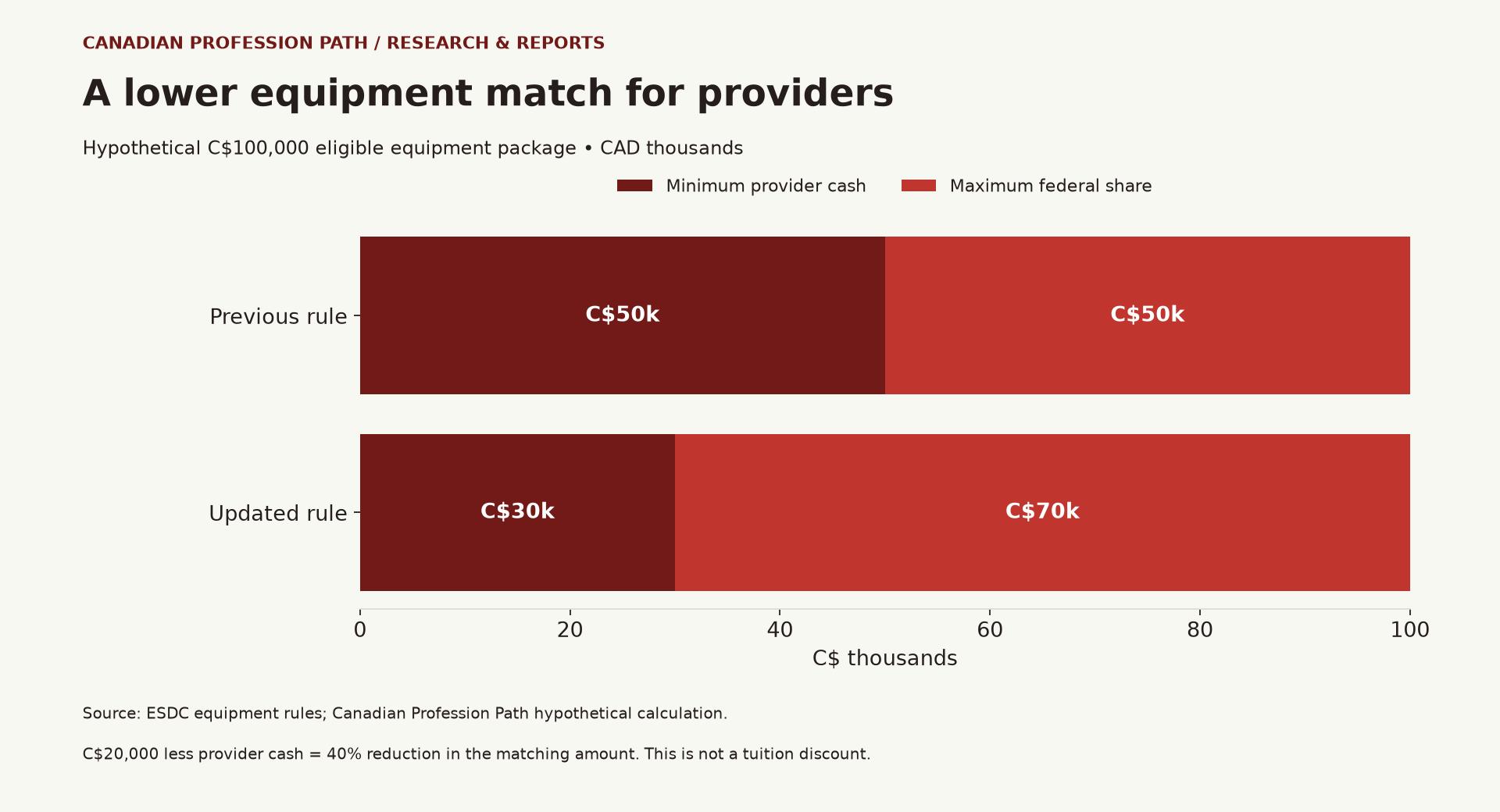
For a hypothetical C$100,000 eligible equipment package, the minimum provider contribution falls from C$50,000 to C$30,000. That is C$20,000 less, or a 40% reduction in the matching amount: 20,000 divided by 50,000. It is not a 40% discount on your course fees.
Our example assumes the full C$100,000 is the relevant eligible equipment cost after applicable rebates. It leaves out separate reporting costs. The eligibility page gives the detailed rules. On our research date, its updated text and examples use 30%, while one calculator label still says 50%. Providers should clarify that inconsistency with ESDC before relying on the calculator.
That same page excludes participant costs from the equipment stream. Therefore, a workshop buying better tools does not establish that your transport, childcare or living costs will be paid. Ask for the actual learner support terms separately.
Funded apprenticeships still need a route to certification
Statistics Canada provides useful context beyond the funding headline. New apprenticeship registrations reached 101,541 in 2024, up 5.9%. For the cohort evaluated at its expected program duration in 2024, 19.9% had certified, 49.2% were continuing and 30.9% had discontinued.
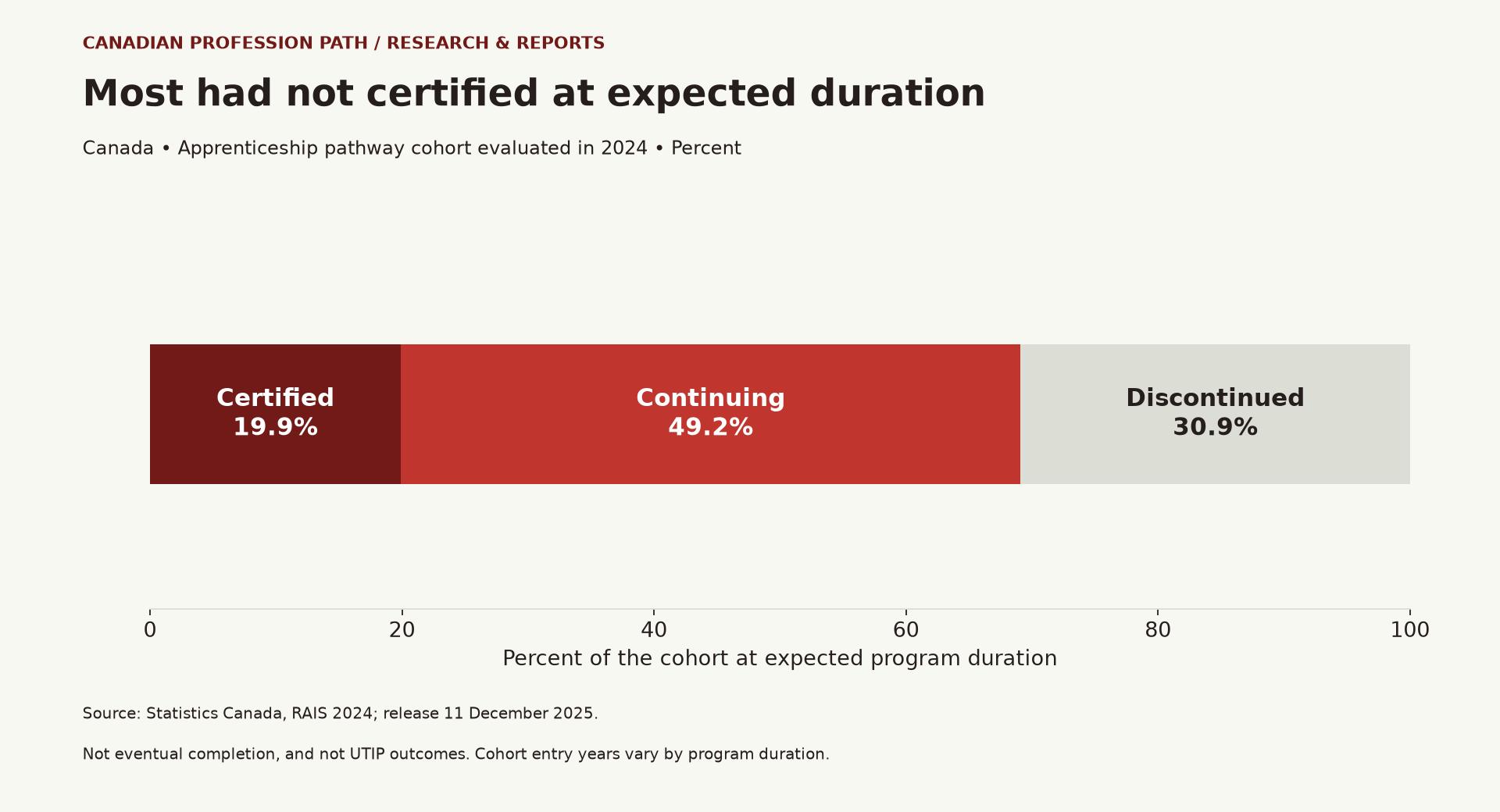
The Statistics Canada release defines a cohort using the expected duration of each program. Entry years therefore vary. The 19.9% figure is not the eventual completion rate; apprentices still registered may finish later. These data cannot measure the effect of funding announced in October 2026.
For your own decision, the lesson is to examine support through the whole route. A modern classroom is valuable, but you also need opportunities to build workplace experience, complete required training and meet certification requirements. Ask a provider how it handles delays, interrupted employment and the transition between training blocks.
Start with the provincial or territorial pathway
The federal step-by-step apprenticeship guide describes finding a trade, locating an employer for on-the-job training and registering an agreement with the relevant authority. It also links to provincial and territorial programs. Quebec follows a different sequence, with classroom training first in the route described by the guide.
Before paying a deposit, confirm the exact trade and level with your jurisdiction. Ask whether the course is recognized technical training, introductory pre-apprenticeship or another form of preparation. Those labels can lead to different credit and employment outcomes. Get the answer in writing from the authority or approved provider.
For background on individual occupations, explore our mechanic apprenticeship overview and carpentry pathway guide. Use current provincial sources to confirm requirements and funding; older role guides should not determine your present eligibility.

Check the support you can actually receive
The innovation eligibility rules allow eligible project costs such as participant accommodation, childcare and transportation. That gives providers possible ways to reduce barriers. It does not give every apprentice an automatic entitlement to those payments.
- Ask whether funding has been awarded, is awaiting a decision or is only a planned application.
- Get the eligibility rules, amount, duration and payment schedule for each learner support.
- Check whether you must pay first and claim reimbursement later.
- Confirm what happens if a course date changes, an employer placement ends or funding runs out.
- Separate a grant from a loan, a wage subsidy paid to an employer, and a discount on fees.
Equipment and innovation funding use separate arrangements for Quebec. If you live there, follow Quebec’s training and support routes. For all residents, compare a confirmed offer with your own circumstances; the national headline cannot establish your local access.
Newcomer guidance for funded apprenticeships
If you have trade experience from another country, ask the provincial or territorial authority how it assesses that experience before assuming you must restart. The federal skilled-trades resource describes a possible assessment route for experienced workers who have not completed an apprenticeship. Requirements differ by jurisdiction and trade.
Bring a list of your qualifications, work history and the tasks you performed to that discussion. Ask which records or translations the authority needs. Also check workplace language support, technical vocabulary, safety training and who can help you understand an employment agreement. Recognition of experience and access to funding are separate decisions.
Download the funded apprenticeships comparison checklist
Use our two-page provider checklist (PDF) to compare two routes. Record the authority that recognizes the training, credit earned, employer responsibilities, remaining costs and evidence of funding. The chart data and worked equipment example (CSV) let advisers reproduce our figures.
For a career change, make a schedule as well as a budget. List training dates, travel time, work hours and care responsibilities. Then identify the largest unresolved question and the person who can answer it. A documented route with manageable gaps is more useful than an impressive funding headline.
Method, limitations and citation
We checked federal program pages on 21 October 2026 and used the latest annual apprenticeship release identified in this review, covering 2024. Funding amounts are nominal Canadian dollars. The equipment comparison is hypothetical. Cohort percentages total 100%; we did not divide annual certifications by new registrations to estimate completion.
This report does not verify a directory of newly funded providers, current learner intakes, individual eligibility or program effectiveness. The comparison checklist is an original decision aid, not a provider ranking. Confirm deadlines and terms at the linked sources before acting.
Suggested citation: Canadian Profession Path (2026), “Funded Apprenticeships in Canada: What the $430m Plan Means,” research edition 21 October 2026. Please link to this report when reusing its analysis, and credit the underlying ESDC and Statistics Canada sources.
Unlock Your Career Potential
Visualize a clear path to success with our tailored Career Consulting service. Personalized insights in just 1-3 days.
Get Started


