






This Canada research training awards comparison connects funding amounts with time, application routes and your next planning decision. Current terms provide $27,000 for a master’s award, $40,000 annually for doctoral support and $70,000 annually for postdoctoral support. However, these awards serve different stages. The largest annual amount is not a funding option every applicant can choose.
Checked 28 October 2026. All amounts are Canadian dollars. Five figures and four downloadable tools separate published rules, our calculations and hypothetical budgeting examples. Awards are competitive; this guide does not determine anyone’s eligibility.
What the October announcement actually funds
The 22 October CIHR announcement reports more than $480 million through the Canada Research Training Awards Suite, supporting 6,485 master’s, doctoral and postdoctoral researchers. The wider $880 million package also includes more than $400 million for 439 health research projects.
Therefore, the whole package is not student scholarship funding. Dividing it by trainee numbers would mix different spending purposes and periods. It would not produce an annual stipend. Similarly, announcing recipients does not reopen a closed application round.
Canada research training awards comparison: amounts and duration
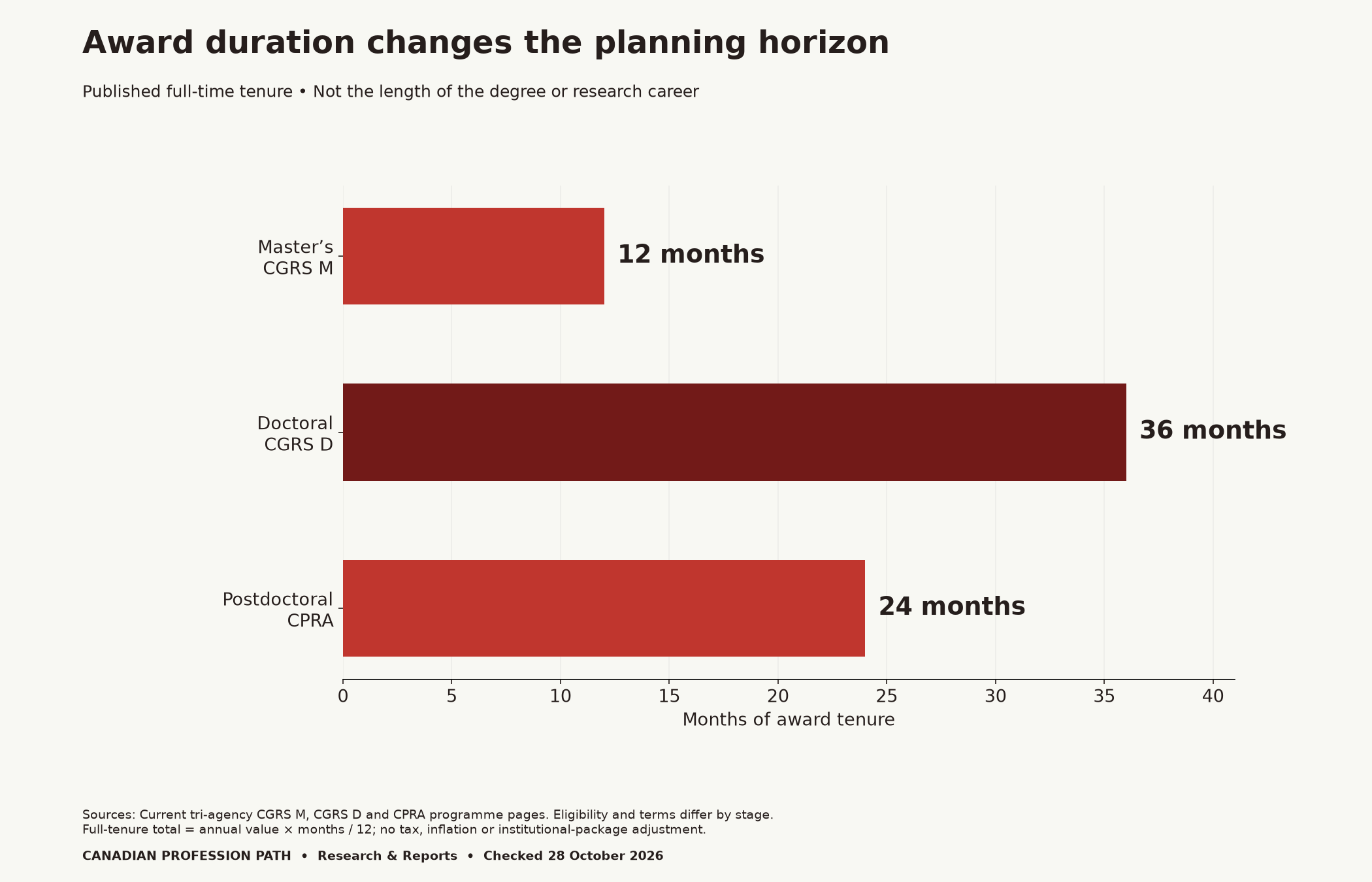
The master’s programme guidance states $27,000 for 12 months. The doctoral programme provides $40,000 per year for 36 months. Meanwhile, the postdoctoral programme lists $70,000 per year for 24 months. These are programme terms checked today, rather than new values created by the October announcement.
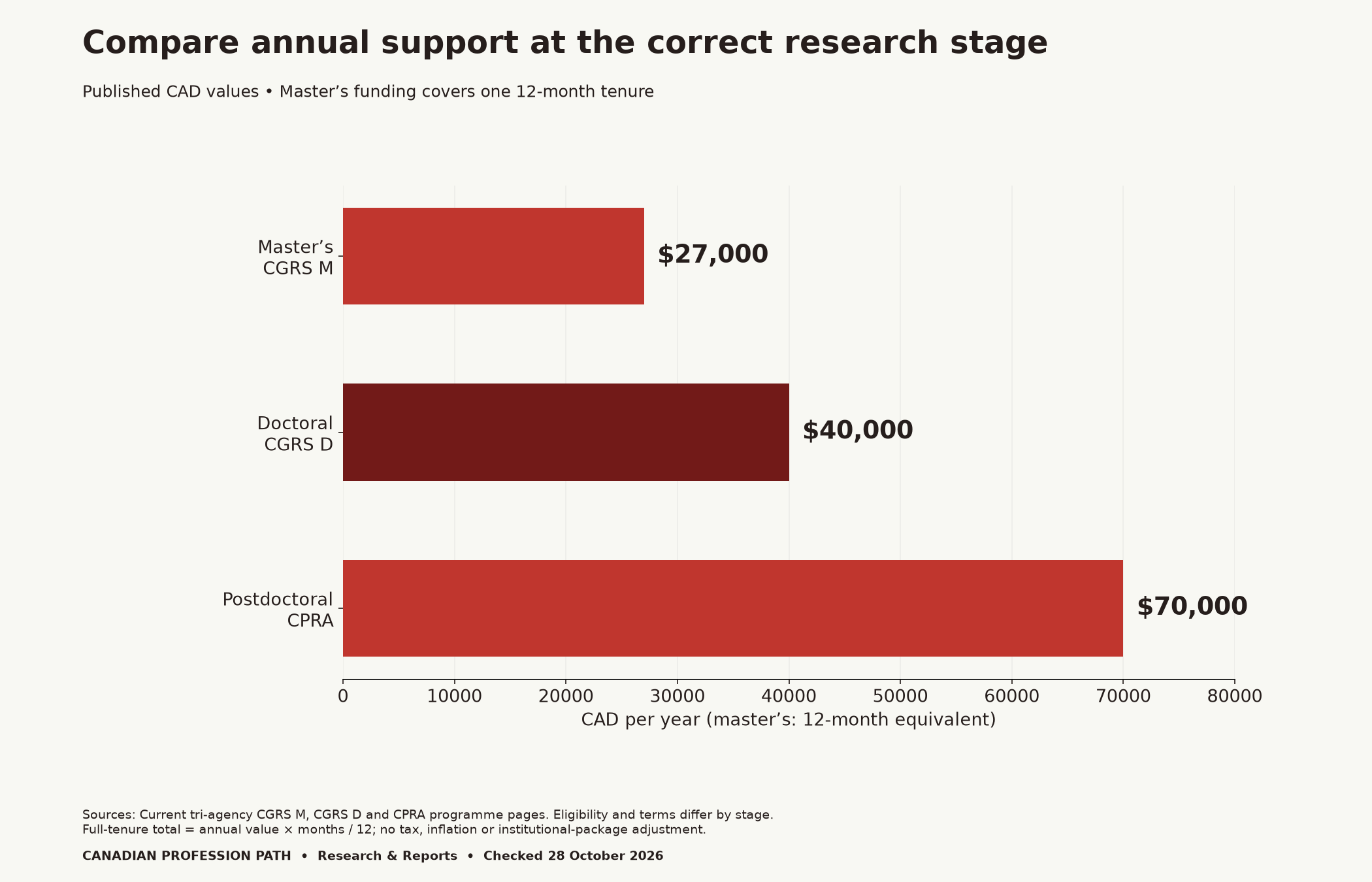
| Programme | Stated support | Duration | Calculated full-tenure total |
|---|---|---|---|
| CGRS M | $27,000 for 12 months | 12 months | $27,000 |
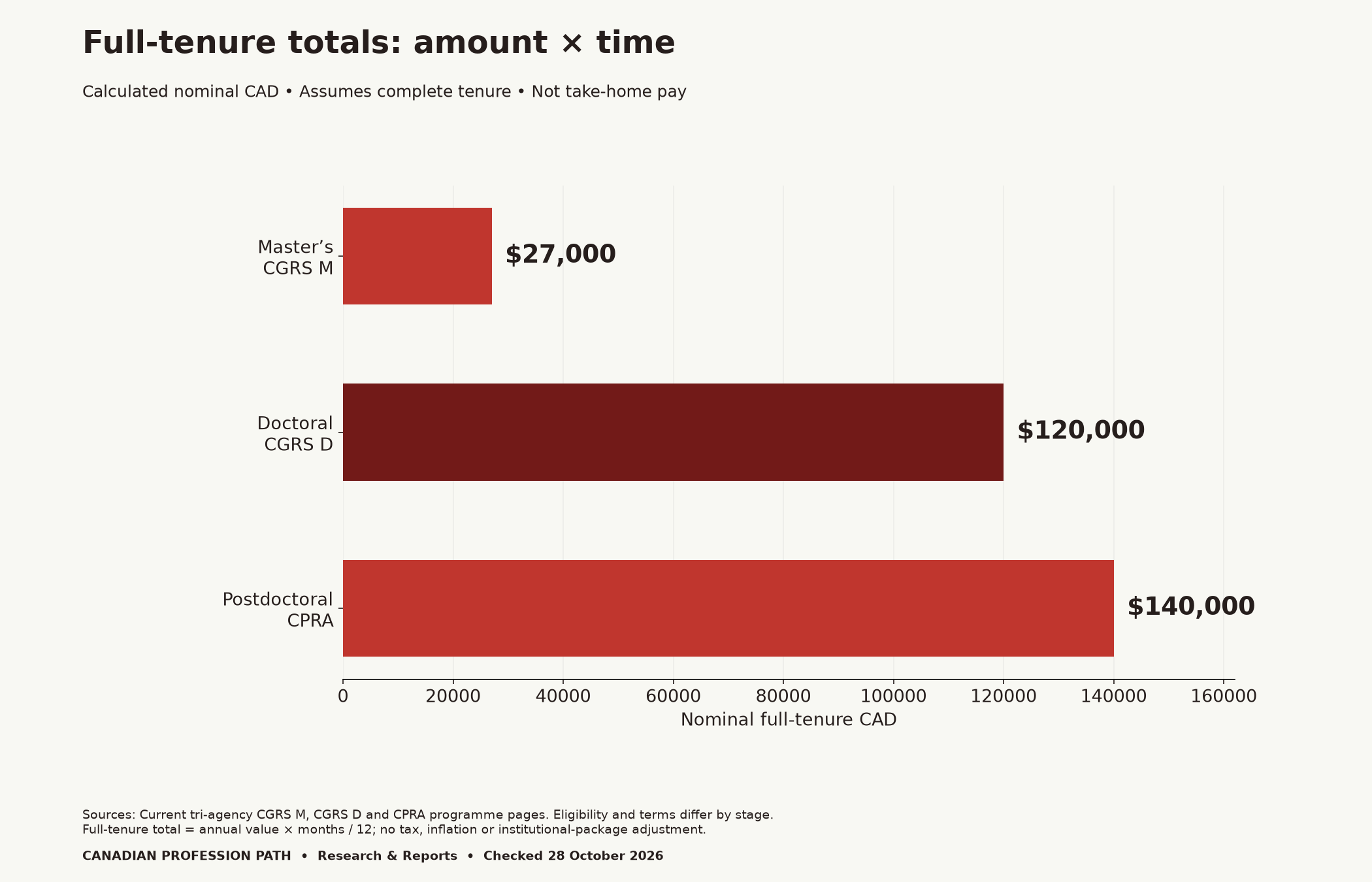
| CGRS D | $40,000 per year | 36 months | $120,000 |
| CPRA | $70,000 per year | 24 months | $140,000 |
Read the amount and duration together. A doctoral award has a longer stated tenure than a postdoctoral award, despite its smaller annual value. Neither duration tells you how long your degree, project or job search will take.
Our calculation multiplies the annual amount by months divided by 12. Thus, $40,000 × 36 ÷ 12 equals $120,000. Likewise, $70,000 × 24 ÷ 12 equals $140,000. These totals assume full tenure. They do not estimate take-home pay, tax treatment, inflation or the amount remaining after university charges.
Choose the right stage before comparing money
For CGRS M, applicants must meet the published Canadian citizenship, permanent-resident or protected-person condition at the deadline. The programme also requires an eligible research-focused programme and applies study-duration and academic conditions. Coursework-only study is generally outside its intended scope. Check the full rules with the institution before preparing the application.
Doctoral eligibility includes a limit of 36 completed full-time-equivalent doctoral months by 31 December of the application year. International applicants must be registered in an eligible Canadian doctoral programme by the application deadline. Registration history also affects whether an applicant uses an institutional route or applies directly.
CPRA requires the relevant completed or expected doctoral or health-professional degree before the award starts. Its normal completion window is three years before 1 September of the application year, with specified exceptions. International applicants need one of the listed Canadian study or research connections. Read the complete conditions; meeting one requirement is insufficient.
For newcomers, separate three questions: admission, award eligibility and immigration permission. Residence in Canada alone does not answer all three. Keep a written list of uncertain conditions, then obtain answers from the relevant institution or agency. Avoid uploading personal status documents to unofficial scholarship sites.
Which deadlines still matter on 28 October?
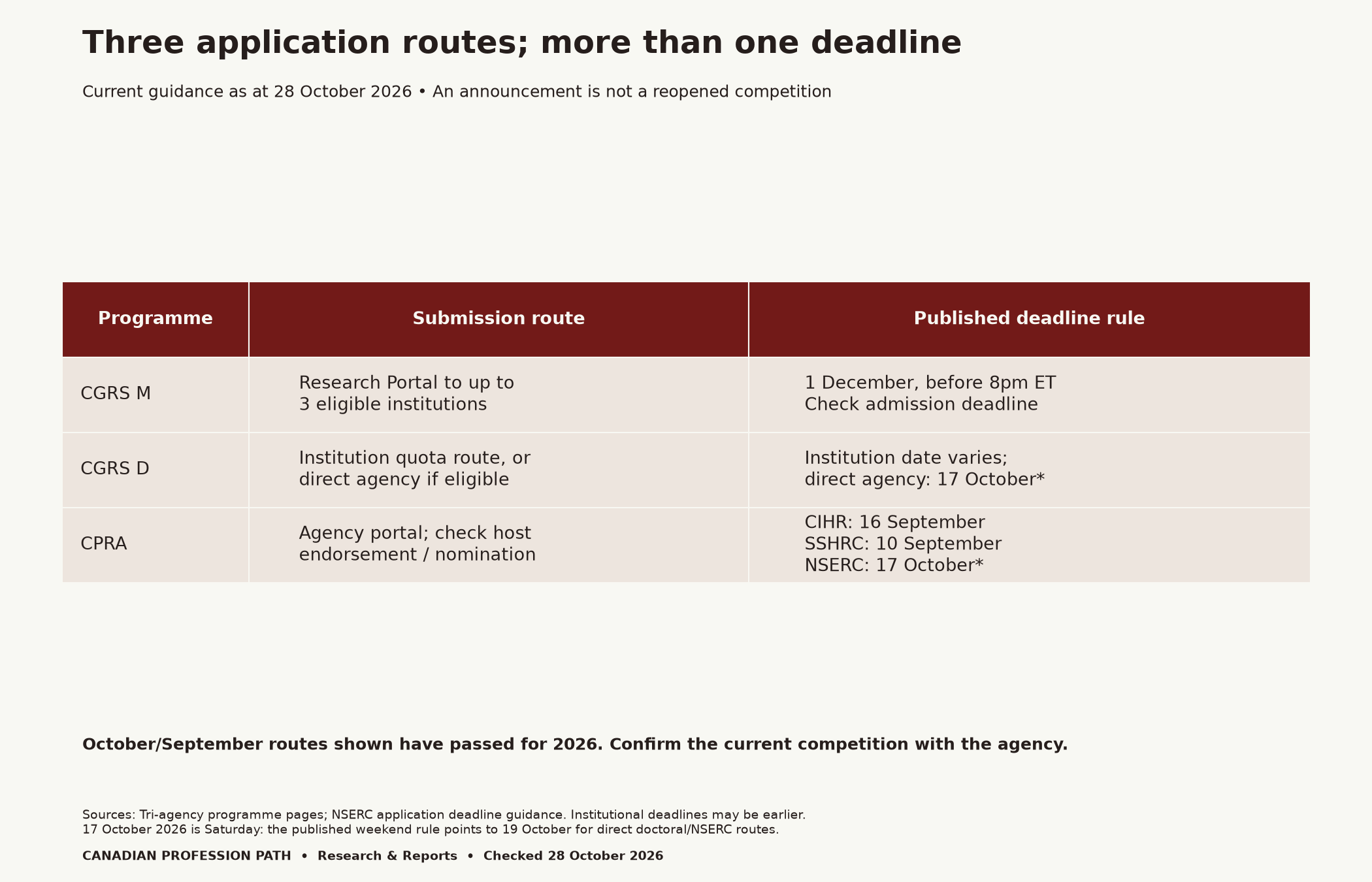
The master’s programme lists 1 December, before 8 p.m. Eastern, through the Research Portal. It allows applications to up to three eligible institutions. Admission deadlines remain separate. The SSHRC competition listing explicitly identifies 1 December 2026.
For direct doctoral applications, the published rule is 17 October before 8 p.m. Eastern, with a following-business-day adjustment when it falls on a weekend. In 2026, that Saturday rule points to Monday 19 October. Institutional deadlines can be substantially earlier. These dates have passed as of this article’s check date.
The current CPRA overview lists CIHR on 16 September, SSHRC on 10 September and NSERC on 17 October. The NSERC deadline rules also move a weekend deadline to the following business day, before 8 p.m. Eastern. Check agency instructions and any host endorsement or nomination deadline. Do not use an older search snippet as your calendar.
Ask what an external award changes in your package
Before adding an award to your budget, request a written explanation of the institutional offer. Which existing support would remain? Which part would reduce or end? Also ask whether teaching duties, research duties, fees or payment dates change. An award headline cannot answer those institution-specific questions.
Next, compare two versions of the same month: the current package and the confirmed package after an award. Count each source once. For example, do not add a supervisor’s original contribution if the revised offer replaces it. Leave uncertain amounts blank instead of treating them as dependable income.

Build a monthly funding-gap plan
Start with dated, documented receipts and user-entered costs. Include tuition, fees, housing, food, transport and research expenses that you must personally cover. Then calculate monthly balance = resources − costs. A negative balance identifies a gap to resolve; it does not tell you which borrowing or employment decision to make.
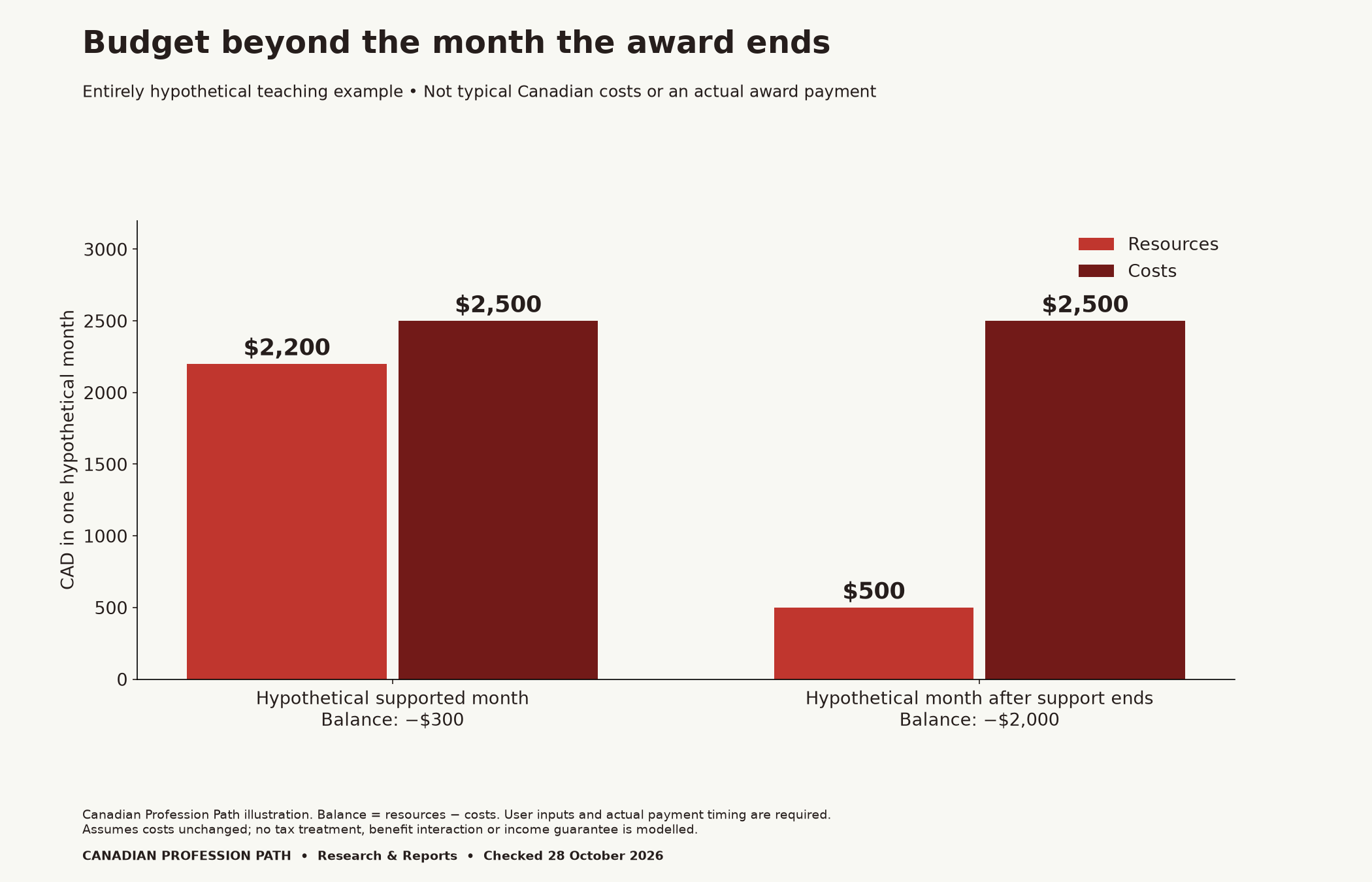
Our teaching example deliberately uses invented values. Resources of $2,200 against $2,500 of costs leave a $300 gap. If resources later fall to $500 while costs remain unchanged, the gap becomes $2,000. Neither scenario represents typical Canadian living costs or a programme’s actual monthly payment.
Finally, map the last funded month against your expected research milestones. Identify who can confirm extension options, remaining institutional support or a revised project plan. For subject-specific planning, our geology study-path guide discusses research fit and preparation. Its general career context does not replace current award rules.
Download the comparison and planning tools
Download the award comparison matrix (CSV)
Use the blank monthly funding planner (CSV)
Get the admission and award deadline tracker (CSV)
Inspect the hypothetical funding-gap values (CSV)
The matrix retains source URLs, amounts, tenure, route and checked date. The monthly planner and deadline tracker are blank tools for your own records. They contain no completed applicant assessment and no automated eligibility decision. Record confirmed dates and submission receipts separately from tasks that remain unresolved.
Methods, limits and citation
We transcribed current official programme terms and archived the pages on 28 October 2026. We calculated nominal full-tenure totals from the stated rates and months, then checked each result against the table and figures. Our date example applies the published weekend rule to the 2026 calendar. Blank worksheets and illustrative budgets are editorial tools, not government forms.
Unlock Your Career Potential
Visualize a clear path to success with our tailored Career Consulting service. Personalized insights in just 1-3 days.
Get StartedThis Canada research training awards comparison does not estimate acceptance rates, future funding or individual entitlement. Rules can change, and institutional packages vary. Recheck official guidance before acting. Cite: Pathfinder Editorial, “Canada Research Training Awards: Compare Master’s, Doctoral and Postdoctoral Funding,” Canadian Profession Path, checked 28 October 2026.


