







For Workforce Retention and Retraining Program employees, a reduced-hours proposal raises three separate questions: what supports the employer, what income the worker may receive, and what training will actually happen. Understanding those differences helps you ask for a clear written plan without assuming a payment or outcome.
This guide explains the programme terms checked on 28 October 2026. It includes five figures and four CSV tools for recording questions, work and training time, and evidence of learning. The tools are blank planning aids. They are not approved agreements, benefit decisions or instructions to accept reduced hours.
What the 22 October launch changes
The ESDC announcement on 22 October 2026 launched an online WRRP application route. It follows the broader $3.5 billion worker-and-employer support investment announced in August. Therefore, the October news concerns access to the programme; it is not evidence that the entire funding package was newly announced or already paid out.
The programme combines Work-Sharing retention support with retraining support. It is intended to help eligible employers retain staff while adapting to economic pressures. The announcement says existing Work-Sharing or Worker Retention Grant participants will transition without applying again. Workers should ask which agreement their employer actually holds and what dates apply.
Workforce Retention and Retraining Program: employees’ first checks
The headline amount is up to $1,000 per participating employee for eligible employer training and administration costs. It is not an automatic $1,000 cheque for each worker. Employee income support has separate conditions, including assessed EI Work-Sharing benefits and a training-related top-up for eligible participants.
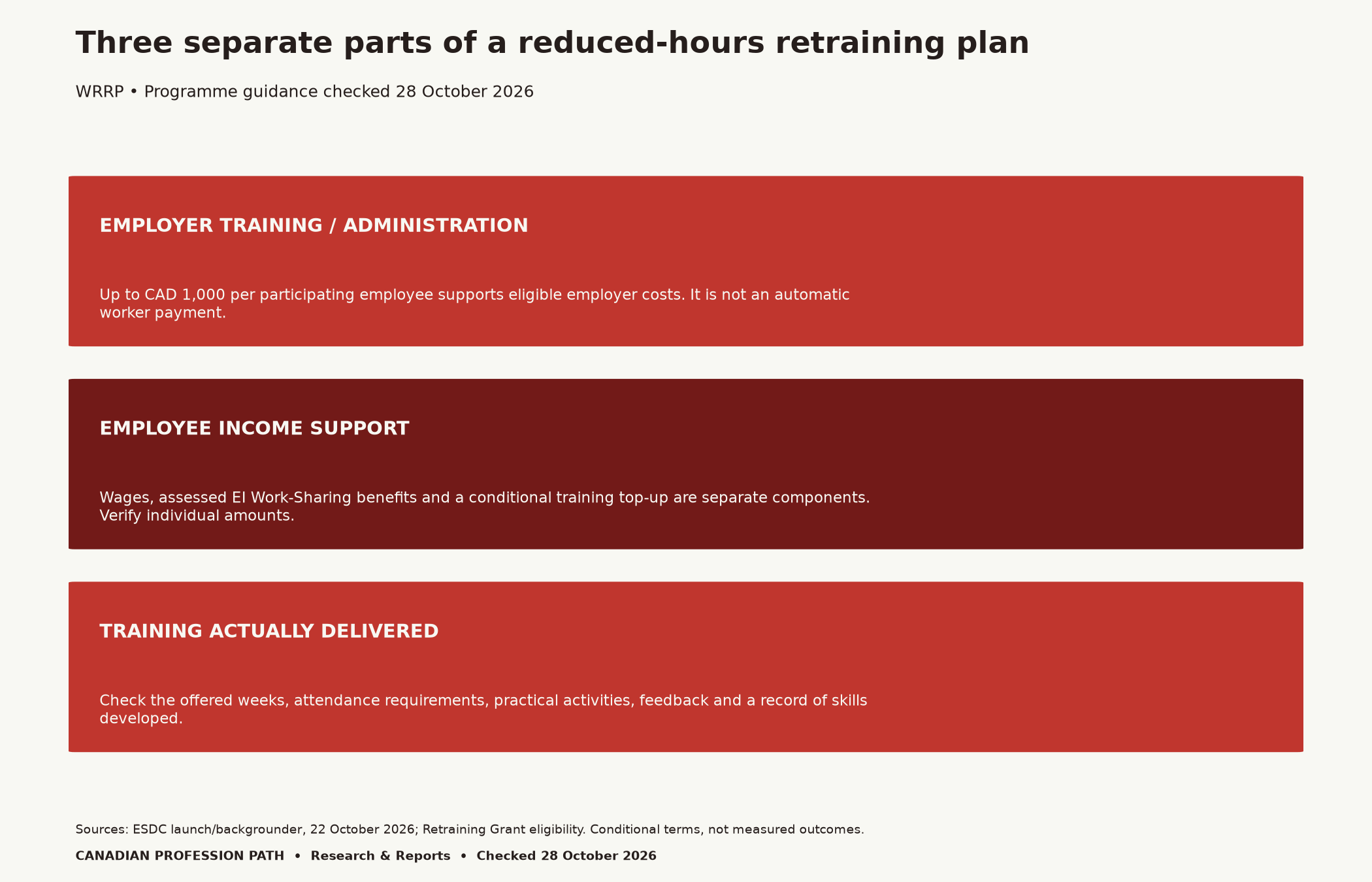
The Retraining Grant eligibility page says an employee must receive EI Work-Sharing benefits to be eligible for the income top-up. It also lists weeks when the top-up is not payable, such as non-Work-Sharing weeks involving a shutdown or sick or vacation leave. Ask how your own circumstances will be assessed.
Request a written breakdown of expected employer wages, EI support and any top-up, including the assumptions and payment timing. Individual EI eligibility and amounts require official assessment. This article does not calculate take-home pay or promise that earnings will be restored to their previous level.
Expected reach is not an achieved result
The official backgrounder projects up to 66,000 workers benefiting from WRRP, including approximately 50,000 receiving retraining supports. The second group sits within the first; adding them would double-count part of the expected reach. These are projections, not counts of completed training or retained jobs.
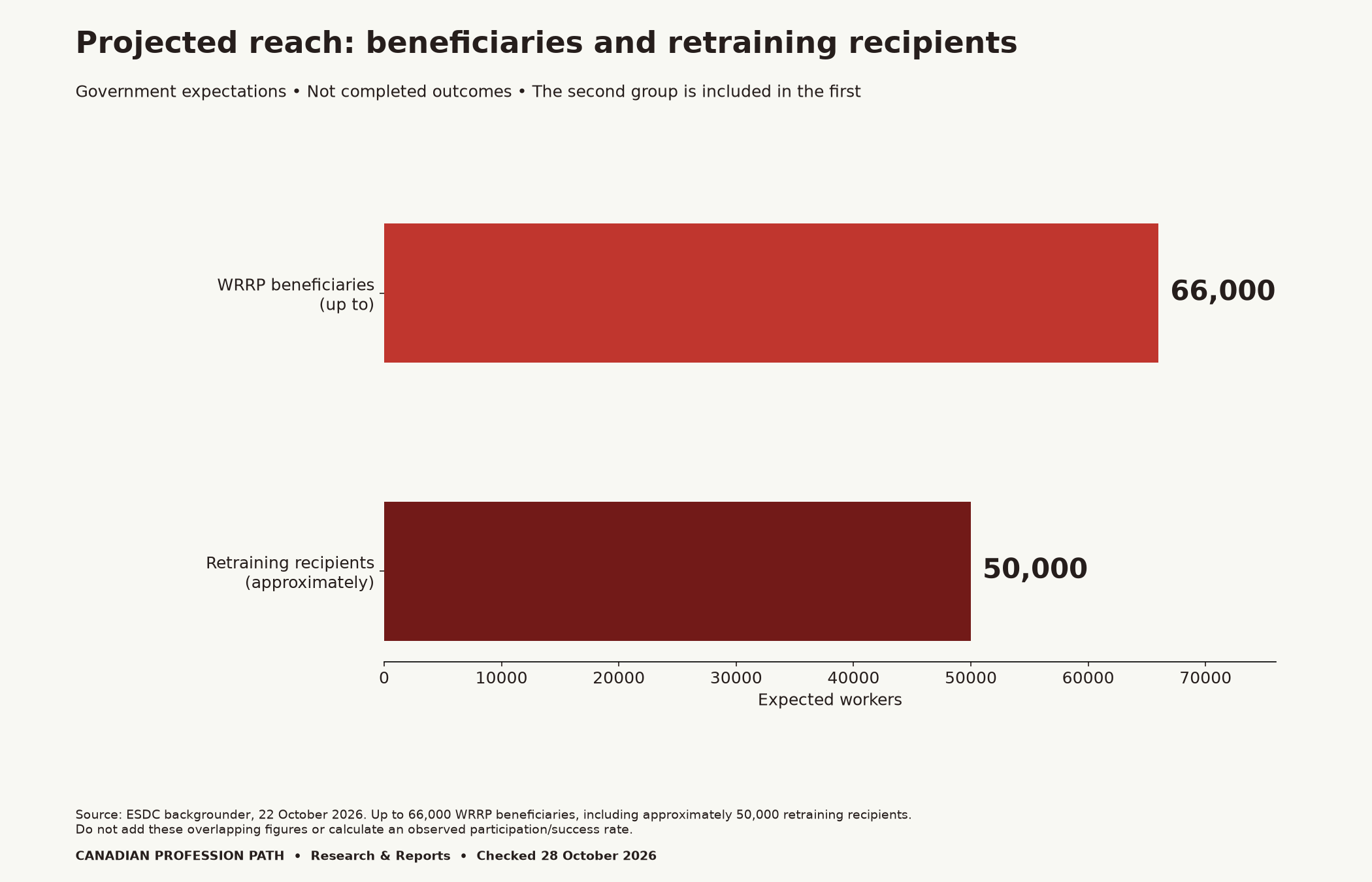
For a worker, the more useful evidence is the proposed arrangement at their own workplace. Ask who is included, which dates are approved, what training is available and who resolves an incorrect payment. National expectations cannot answer those individual questions.
The 40% rule concerns agreement weeks
Detailed grant guidance requires training opportunities for at least 40% of the weeks covered by the grant agreement. It also requires offering training to all eligible employees in the Work-Sharing unit. This does not automatically mean training for 40% of every employee’s weekly hours.
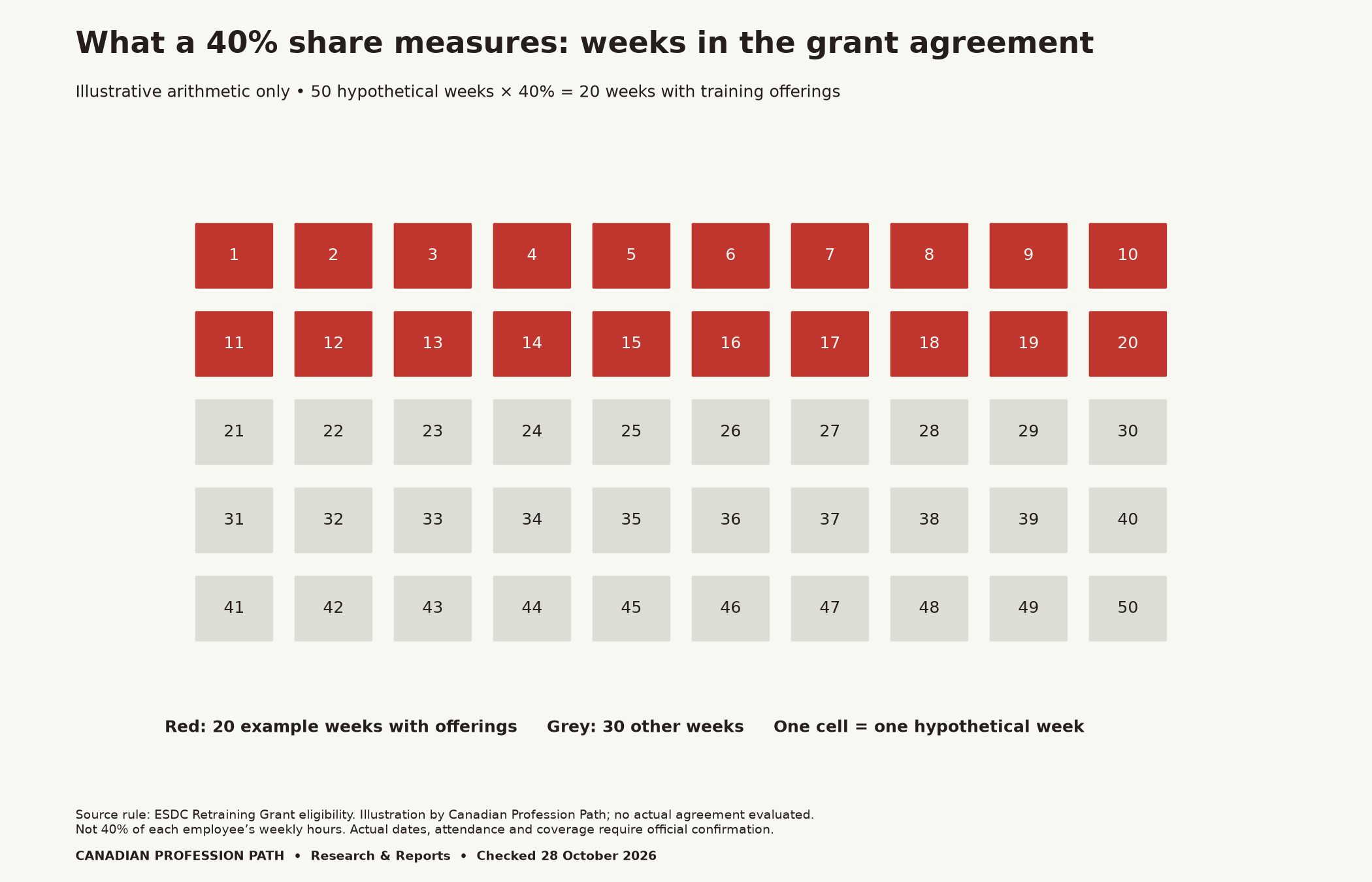
For example, 40% of a hypothetical 50-week period equals 20 weeks. That arithmetic does not establish that a particular timetable is compliant. The employer must confirm the approved plan, attendance expectations, dates and any extension requirements with the programme administrator.
A rounding point needs clarification: the official page gives an example of 30 training-offer weeks in a 76-week agreement while also showing 40% ×76 =30.4. We do not invent a rounding rule from that example. Ask Service Canada how the approved agreement handles partial weeks and record the answer before relying on a schedule.
The backgrounder says employees must participate in training offered during non-working hours. Consequently, a weekly plan should distinguish paid work, training and other non-working time. Our blank worksheet records each separately; it does not label every non-working hour as training or promise that every hour attracts a payment.
Check ordinary rules and temporary tariff measures separately
The Work-Sharing eligibility page presents ordinary conditions alongside temporary tariff measures. For example, the ordinary employer operating-history requirement is at least two years in Canada. Tariff measures allow eligible businesses operating for at least one year. Other conditions still apply, so one threshold alone cannot establish eligibility.
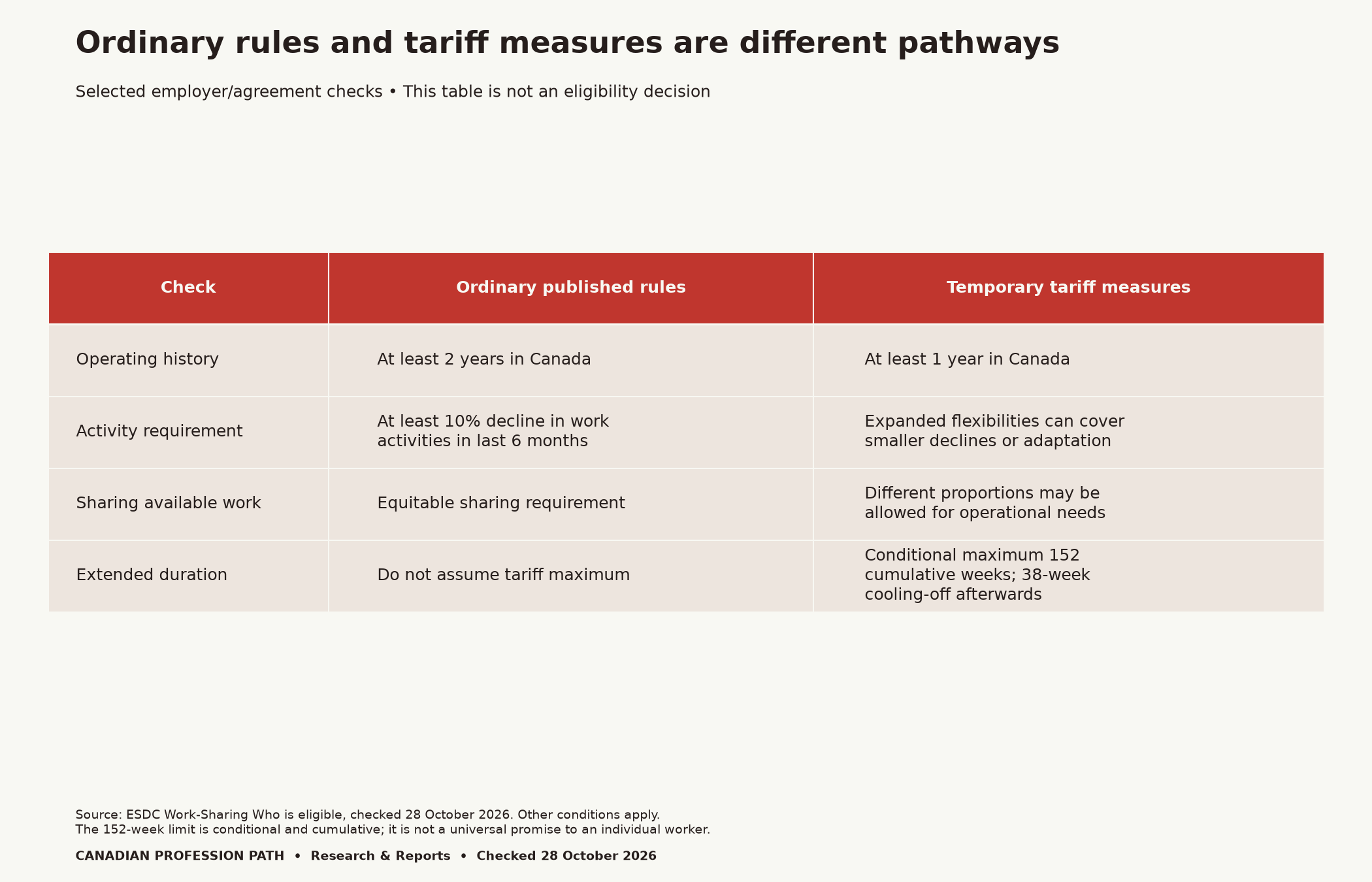
Under tariff measures, approved agreements have a minimum duration of four weeks and may extend to a maximum 152 cumulative weeks if required. After that cumulative period, a 38-week cooling-off period applies. Do not assume a new agreement resets the cumulative clock or that an extension is automatic.
The programme horizon is 31 March 2028. Separately, the detailed Retraining Grant page requires projects to finish by 25 March 2028 and not outlast their Work-Sharing agreement. Confirm the actual end date in writing rather than using a broad programme announcement as your personal timetable.

Make the training useful beyond attendance
Ask which task you will practise, what feedback you will receive and what output demonstrates learning. Training may use online, in-person, facilitator-led or peer-to-peer formats. However, the detailed guidance excludes conferences and training employers are legally required to provide. Check the proposed activity against the actual funding rules.
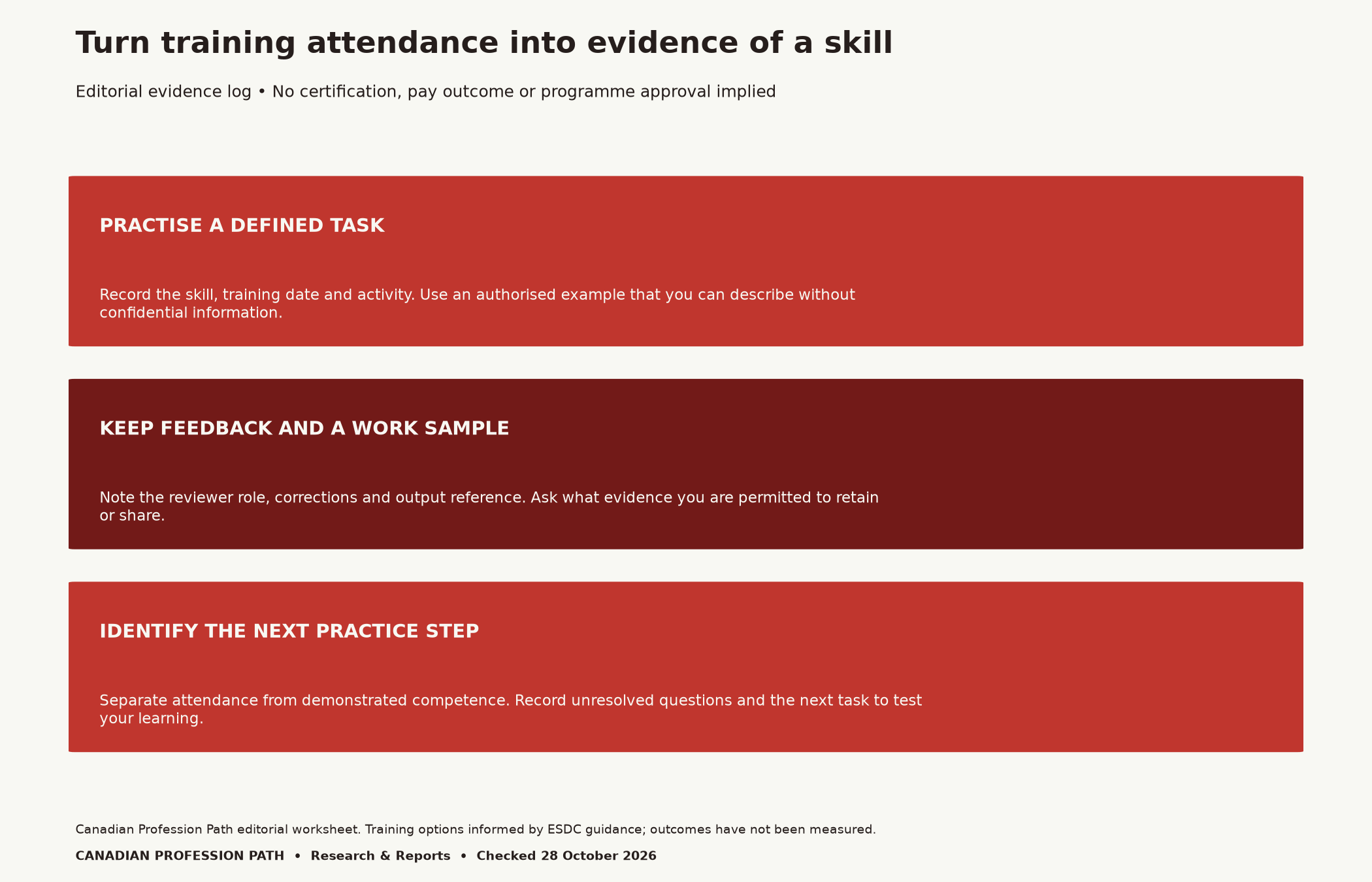
For a digital task, a fictional or authorised work sample may show a method more clearly than a course title. Our defensive portfolio project guide illustrates that approach with dummy data. Use only examples relevant to your role and permitted by your employer; never publish confidential workplace records.
The official Job Bank Training Finder provides a route to explore options. The backgrounder also points to no-cost learning resources. Buying a course does not by itself establish funding eligibility. First ask whether the employer’s approved plan includes the activity and any associated cost.
Newcomers should ask about accessible delivery, language support and whether their current work authorisation covers the proposed arrangements. Programme participation is not an immigration decision. Likewise, ask the employer or employee representative about workplace questions, and Service Canada about benefit assessment or unclear programme rules.
Download the worker tools and check the sources
Our source register uses the 22 October launch and backgrounder plus the official eligibility pages checked on 28 October 2026. The figures separate programme limits, projections, illustrative arithmetic and editorial practice. We have not measured earnings gains, training quality or employment outcomes. Guidance can change, so recheck the linked official pages before acting.
Download the verified programme terms (CSV): five source-linked values with their units, qualifications and checked date.
Use the worker question sheet (CSV): eight areas with blank written-response, source and follow-up fields.
Get the blank weekly plan (CSV): separate work, training and other non-working time; no compliant timetable is prefilled.
Open the training-evidence log (CSV): record practice, feedback, output references and permission to retain evidence.
Unlock Your Career Potential
Visualize a clear path to success with our tailored Career Consulting service. Personalized insights in just 1-3 days.
Get StartedSuggested citation: Pathfinder Editorial, Canadian Profession Path (28 October 2026), “Canada’s Workforce Retention and Retraining Program: A Worker’s Reduced-Hours Checklist.” Cite ESDC for programme rules and projections, and this article for the comparison and blank editorial tools.


