







Choosing AI skills in Canada starts with a task you need to do better. Before paying for training, measure the time you spend producing, checking and correcting the work. A quick first draft can still become a slow finished result.
This report combines new Canadian survey evidence with an original, reusable training audit. It is for residents improving their current work or preparing for a career change, including newcomers. The research date is 21 October 2026. Our worked examples are hypothetical; we have not conducted a workplace experiment.
What the latest evidence says about AI skills in Canada
In the Bank of Canada’s third-quarter survey, about 40% of workers said they used AI at work. Users typically reported using it three or four days a week, for less than an hour on those days. They estimated that equivalent work without AI would require about five extra hours weekly.
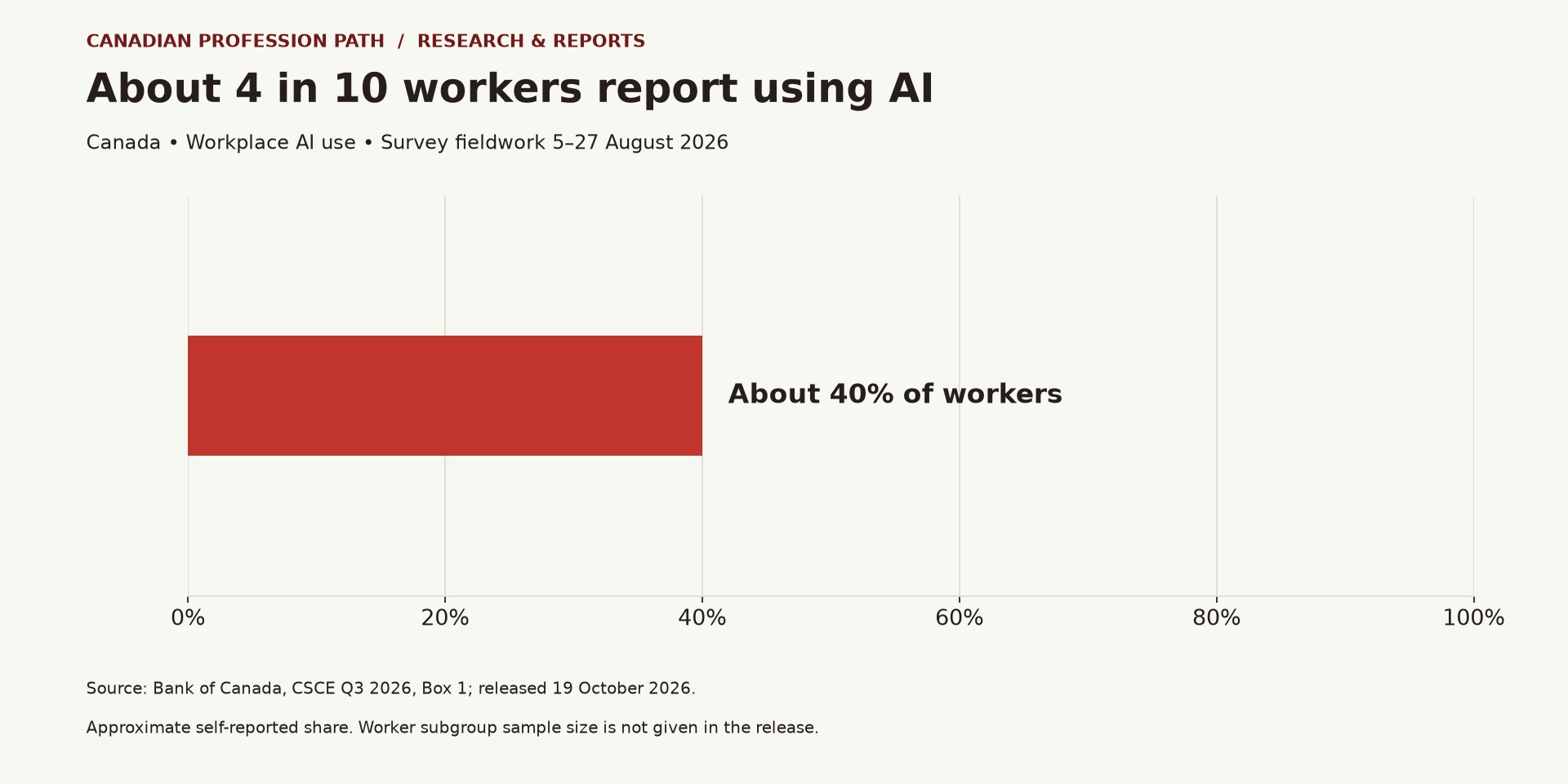
Roughly one-third of users put saved time into learning skills or training others. Separately, just under one-fifth of non-users expected to adopt AI within 12 months. These groups have different denominators. Read the Bank’s report and Box 1, released 19 October. Online fieldwork ran 5–27 August; follow-up interviews ran 24 August–4 September.
These answers describe experiences and intentions. They do not establish that a particular course raises wages, prevents job loss or saves every worker five hours. A useful training decision needs evidence from your own task, tools and required quality.
Start with a recurring task, then identify the skill
Pick a small piece of work with a clear output. For example, you might turn approved public information into a short briefing, draft a routine message from fictional details, or explain a spreadsheet formula using dummy data. Choose something you can check independently.
First, define what “finished” means. List the facts that must be correct, the format the reader needs and any required approvals. Then note how often the task occurs. A small saving on frequent work may matter more than an impressive demonstration you rarely use.
For residents exploring a technical role, our overview of system analysts and AI discusses how analysts connect business needs with systems. Treat that as role background. Verify current qualifications and vacancy requirements directly with employers before choosing a credential.
Measure net time saved, including checking
Use the same quality standard for manual and assisted work. The manual baseline should include the checks you normally perform. For the assisted version, count preparation, prompting, revisions and the time needed to verify the output. Record failed attempts too.
Weekly net minutes saved = repetitions × (manual minutes − assisted-work minutes − checking and rework minutes). Keep one-time setup and learning hours in a separate line so they do not disappear from the comparison.
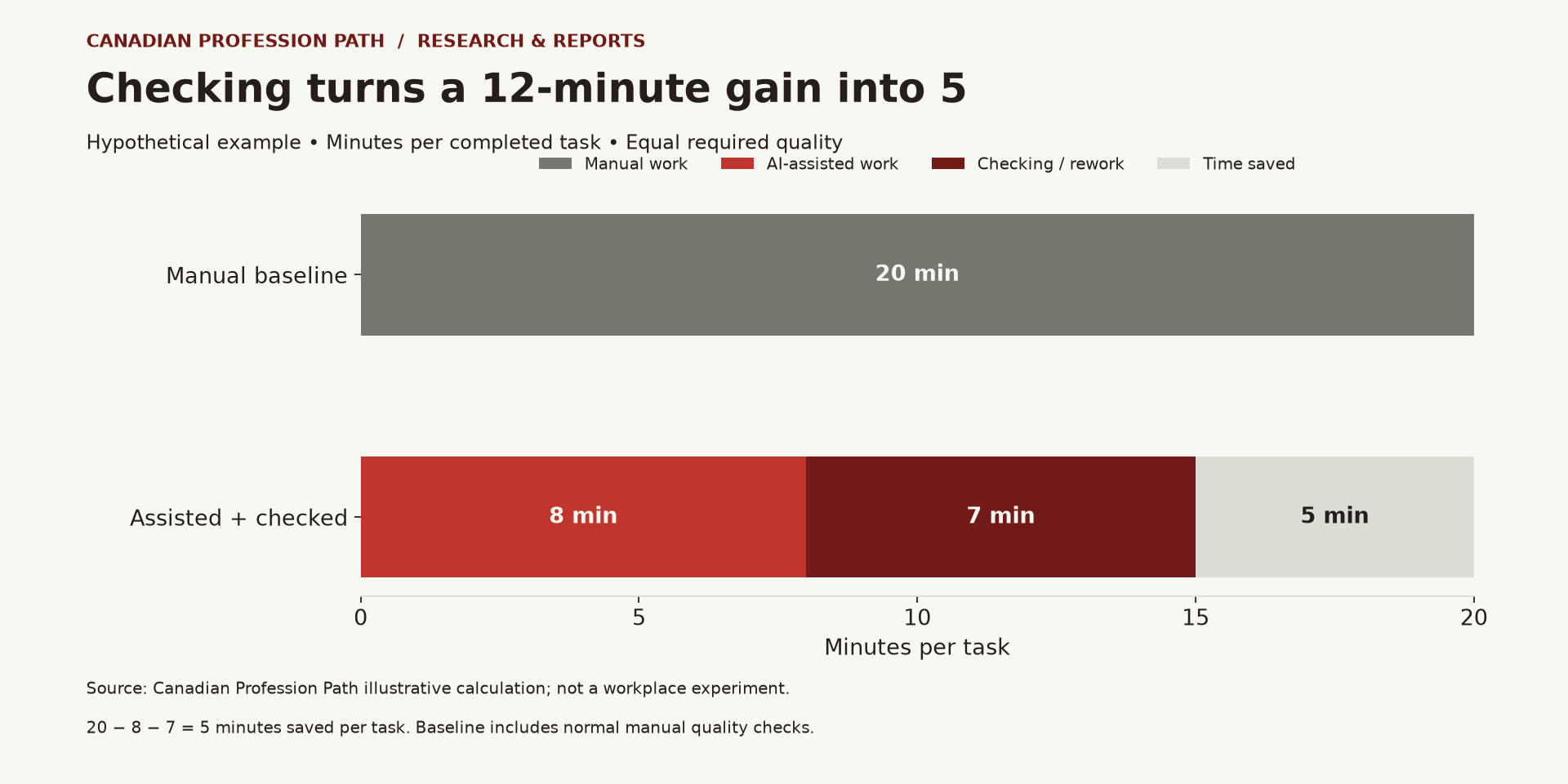
In our example, a task takes 20 minutes manually. Assisted work takes eight minutes, followed by seven minutes checking. The net saving is five minutes per task. At five repetitions a week, that is 25 minutes weekly. Ignoring checking would make the apparent saving 60 minutes.
Across 40 working weeks, 25 minutes a week totals about 16.7 hours. That is time capacity, not extra cash or a promised wage increase. It also excludes initial learning time. Your employer may use any capacity for more work, better quality or another purpose.
Find the point where checking removes the saving
The result changes when either repetition or verification changes. Holding manual time at 20 minutes and assisted work at eight, checking for 12 minutes leaves no time saving. Checking for 15 minutes makes each task take three minutes longer.
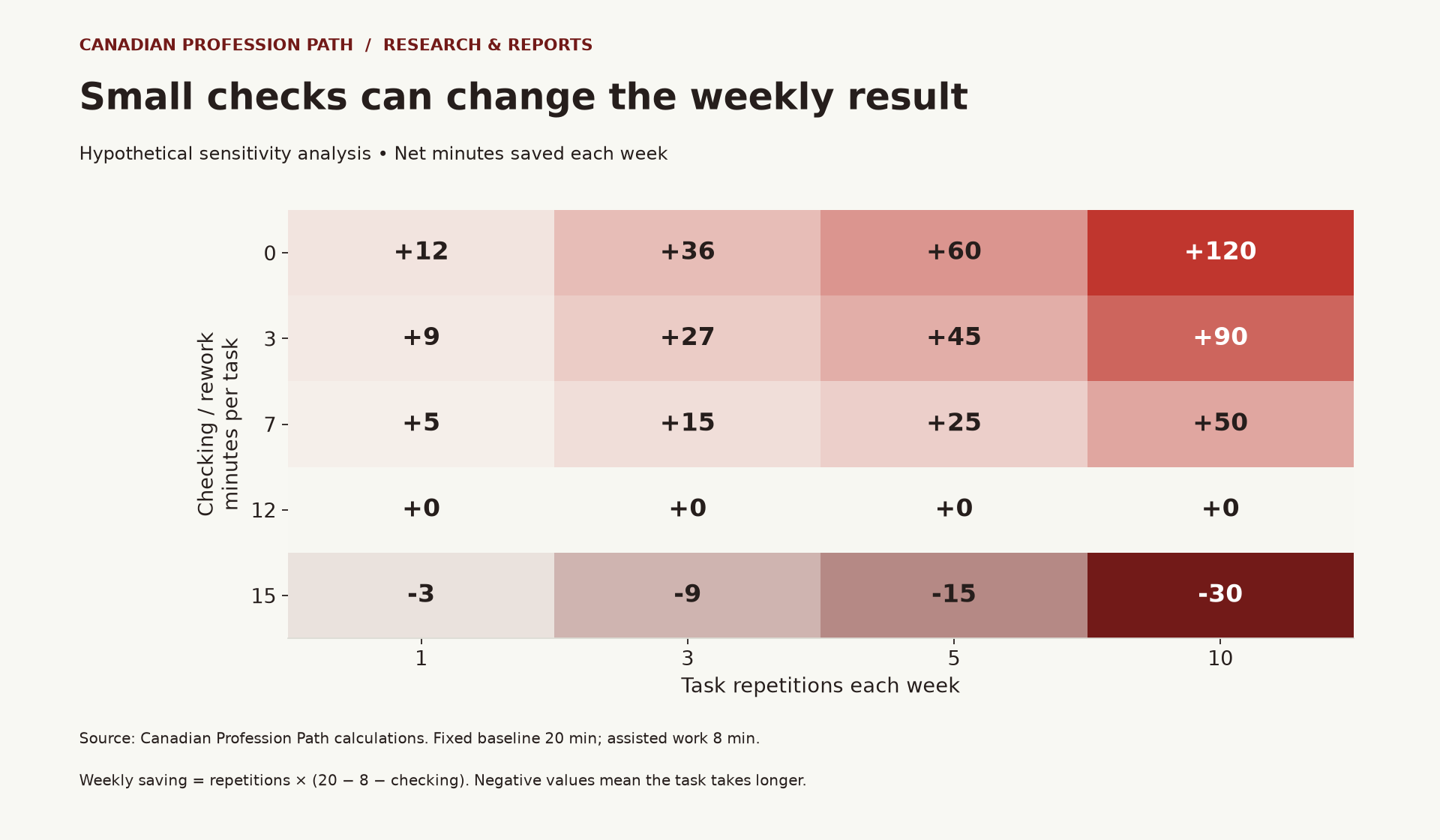
However, a slower process might still improve quality or accessibility. Record that benefit separately and explain how you assessed it. Do not call an output more accurate simply because it sounds polished. Likewise, speed cannot compensate for a result that fails your job’s requirements.
Run a two-week AI training audit
- Before the trial: confirm the employer-approved tool, permitted inputs and the person who can judge the result.
- During the baseline week: log several examples, their difficulty, time and quality checks. Avoid timing only the easiest cases.
- During the assisted week: use comparable work, record every attempt and separate creation from checking and rework.
- At review: compare totals and typical times, identify failures and decide which skill would improve the process.
This is a practical screening exercise rather than a controlled experiment. Different tasks, deadlines or familiarity can change the result. Where possible, alternate methods on similar tasks and repeat the comparison. Keep enough detail for someone else to understand why a result improved or deteriorated.

Which AI skills should you learn first?
Match the learning objective to the weakness you found. If the first draft misses the brief, practise giving context, constraints and examples. If the output looks convincing but contains mistakes, focus on source checking, calculations and error detection. If the tool helps once but not repeatedly, work on a repeatable process.
- Task scoping: break a broad request into an output you can evaluate.
- Evidence checking: trace claims to reliable sources and reproduce important calculations.
- Data handling: understand what the employer permits you to enter and retain.
- Workflow design: define where a human reviews, approves and takes responsibility.
- Clear communication: explain what the tool did, what you checked and what remains uncertain.
The Canadian Centre for Cyber Security’s guidance warns that generated content can be wrong or biased. It recommends verification and clear organizational rules, and cautions against entering personal or sensitive corporate information. For your trial, use approved public material, fictional examples or other inputs your employer has explicitly permitted.
Compare AI training before committing money
Ask the provider to show a practical assignment and the feedback a learner receives. Then map the syllabus to the gap in your audit. A broad introduction may be useful, but a long list of tool names does not demonstrate that the course teaches reliable work.
- Get the total price in Canadian dollars, including compulsory software, taxes and add-ons.
- Check study hours, timetable, access duration and refund terms in writing.
- Ask whether assessments require checked outputs, rather than attendance alone.
- Confirm employer recognition or reimbursement with the employer itself.
- Compare the paid option with support already available through your workplace or learning institution.
Do not assign a cash value to every saved hour unless it creates a realistic paid opportunity or avoids a real cost. For a salaried employee, saved time often changes workload rather than income. A course may still be worthwhile for quality, confidence or future options, but state that reason clearly.
Newcomer guidance: connect the course to your intended role
If you recently arrived in Canada, use examples from the work you want to do here. Check the course’s language, prerequisites, accessibility and support. Ask a target employer what evidence of practical ability it values. A portfolio can show a method, but keep confidential client and employer material out of it.
Also separate AI training from occupational entry requirements. A short certificate does not by itself establish eligibility for a regulated profession. Confirm those requirements with the relevant regulator. Explore our technology career collection to compare role interests before choosing a specialist route.
Download the AI skills audit and decide your next step
Use the two-page printable AI training audit (PDF) to record task times, quality, permission and course costs. The chart data and scenario calculations (CSV) make our examples easy to check or adapt.
Your next step may be targeted training, a small approved trial, existing employer support or postponing the purchase. Choose the option that addresses a documented gap. Keep a review date because tools, tasks and course content can change.
Sources, method and limitations
The survey methodology describes a rotating online panel of approximately 2,000 household heads, targeting adult Canadian residents. That is the overall panel, not 2,000 AI-using workers. The release does not supply the worker or AI-user subgroup sizes, so we do not calculate confidence intervals or precise subgroup counts.
The survey chart preserves the source’s approximate wording. Our other two charts use explicitly hypothetical inputs and ordinary arithmetic. The audit is an original decision aid, not a validated productivity test, course ranking or forecast of earnings. We have not evaluated named providers or confirmed live course prices.
Unlock Your Career Potential
Visualize a clear path to success with our tailored Career Consulting service. Personalized insights in just 1-3 days.
Get StartedSuggested citation: Canadian Profession Path (2026), “AI Skills in Canada: What to Learn Before Paying for Training,” research edition 21 October 2026. Please link to this report when adapting the audit or its calculations and credit the original survey separately.


