







Useful cybersecurity portfolio projects in Canada show how you reach a decision, verify a recovery and pass work to someone else. A list of software names cannot show those habits. This guide offers three defensive exercises, fictional triage cases and an actual local backup-restoration record you can inspect.
The projects suit learners exploring security analysis or IT support for smaller organisations. They use invented messages and dummy files, with no employer systems or real client records. They are editorial work-sample ideas, not measured employer preferences, official qualifications or a promise of interviews.
Prepared 28 October 2026. The new Statistics Canada release measures business activity in 2025. Our restoration exercise was run separately on 28 October 2026. The survey, lab results and fictional scenarios answer different questions; keep their evidence separate.
Cybersecurity portfolio projects Canada: start with the evidence
The 21 October Statistics Canada release reports that 16% of covered businesses experienced impactful cyber incidents in 2025. It also reports employees assigned cyber-risk responsibility at 46%, digital-information backups at 43%, and a consultant or contractor managing risks at 38%. These arrangements can overlap.
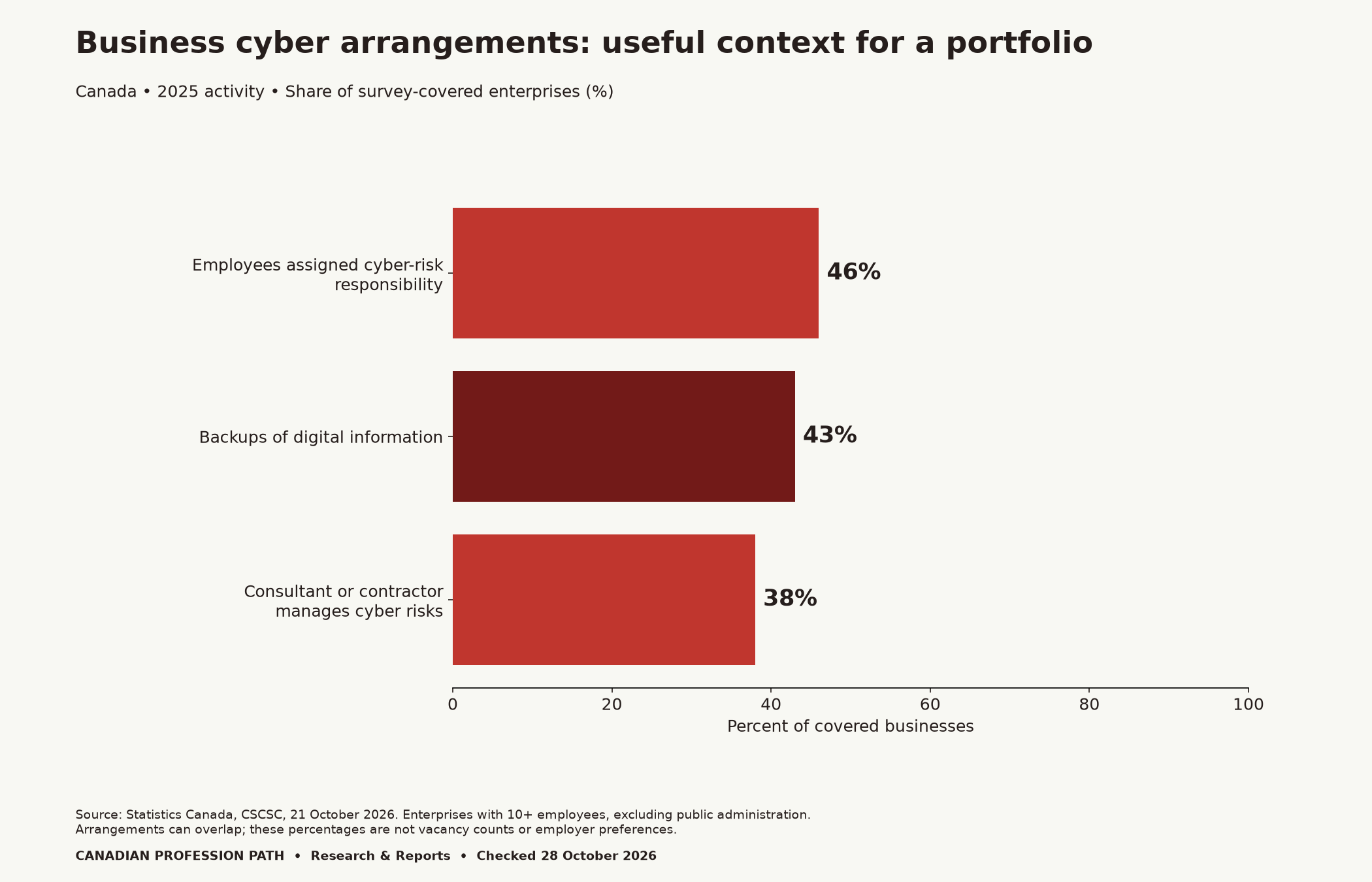
The survey covers enterprises with Canadian operations and at least ten employees, excluding public administration. Its small-business category starts at ten employees, so it does not describe every microbusiness. Data collection ran from January to March 2026, and respondents reported only incidents they considered impactful.
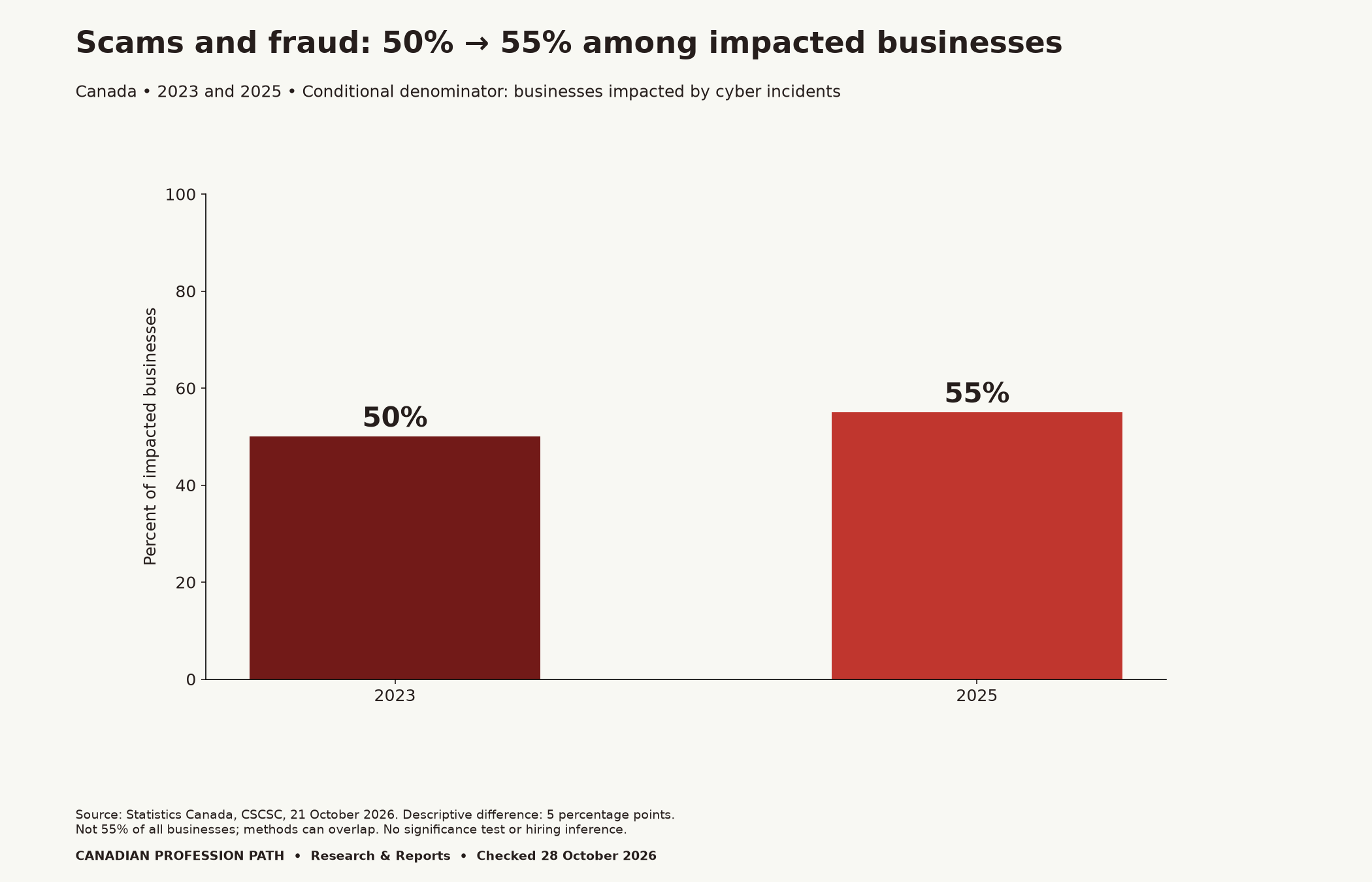
Among impacted businesses, scams and fraud rose from 50% in 2023 to 55% in 2025: a descriptive increase of five percentage points. The denominator is impacted businesses, not all Canadian businesses. We have not tested statistical significance or converted the figures into a labour-demand estimate.
Project one: document a cautious fraud-triage decision
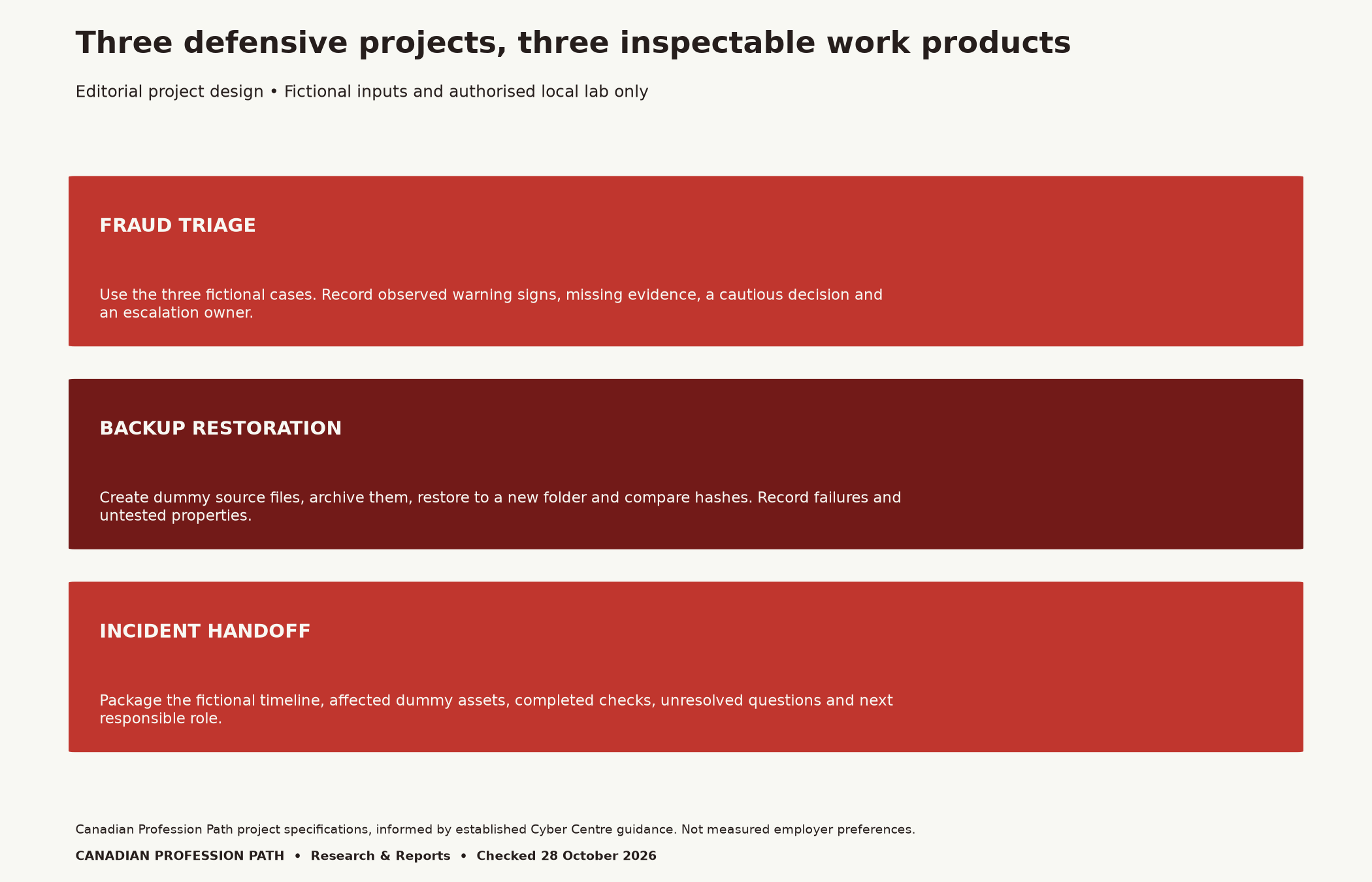
Start with the three fictional cases in our download. One asks for an urgent payment-detail change, another resembles a routine invoice, and a third provides only a screenshot. They contain no live links, actual suppliers or account details. Your task is to explain what the supplied evidence does and does not establish.
For each case, write the observed warning signs, missing information, proposed next action and responsible role. A changed payment request deserves independent verification through an already known route. However, a warning sign alone does not prove fraud. Likewise, a familiar-looking invoice does not prove that a message is safe.
Keep the exercise offline. Describe the verification and escalation you would seek; do not contact invented addresses, send a payment or test anyone’s mailbox. A reviewer should be able to follow your reasoning and identify the point where additional authorised evidence is needed.
Project two: restore dummy files and compare the bytes
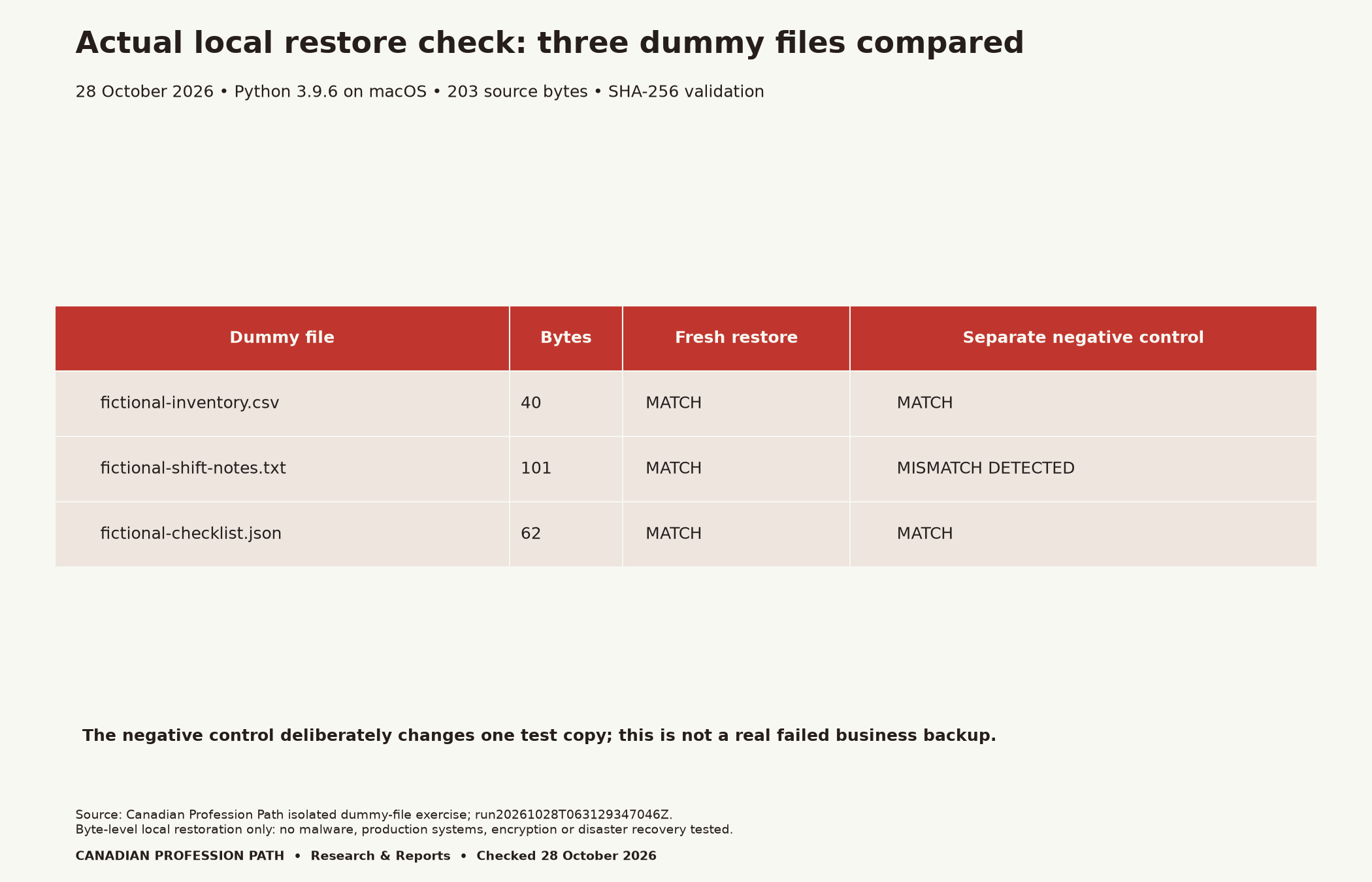
We ran a small local exercise using Python 3.9.6 on macOS. It created three fictional files totalling 203 bytes, stored them in an uncompressed ZIP archive, and restored them to a new folder. We compared each restored file’s size and SHA-256 hash with its source. All three matched.
A separate negative-control folder contained copies of the same restored files. We deliberately changed the dummy shift-note file there. The comparison detected that single mismatch while the other two files still matched. This was a planned check of the comparison, not a real business recovery failure.
To repeat the method, create your own tiny fictional CSV, text and JSON files in an isolated folder. Record their exact bytes and hashes before archiving. Restore into a fresh output directory, compare every file, then deliberately change one separate test copy to confirm the comparison catches it. Preserve the originals and distinguish your results from ours.
Our run started at 06:31:29.347642 UTC and finished at 06:31:29.349120 UTC on 28 October 2026. Those timestamps document execution; this tiny local test is not a recovery-speed benchmark. We did not test encryption, offsite storage, file permissions, application consistency, production availability or recovery after malware.

The Cyber Centre’s established baseline controls discuss written response roles and checking that backup restoration works. They also address secure storage and access. Our limited exercise illustrates one validation habit; it does not demonstrate implementation of the full control set or make a system secure.
Project three: make the incident handoff usable
Turn one fictional case into a short handoff pack. Include an invented timeline, dummy affected assets, checks completed, unresolved questions and the role responsible for the next action. Mark observations separately from assumptions. Use role labels such as exercise owner and IT reviewer, rather than real employees’ names or private contact details.
For example, a screenshot-only report leaves original-message provenance unresolved. The handoff should say that plainly and identify who can supply authorised context. Do not transform a missing fact into a confident incident classification. Clear uncertainty helps the next person decide what needs checking.
Review the portfolio without inventing a certification
Our qualitative rubric asks about six dimensions: scope, provenance, reproducibility, validation, communication and limitations. Record evidence and reviewer notes for each. We do not assign a pass rate, claim industry validation or issue a credential. A documented unsuccessful attempt can be useful when its cause and limits are explained.
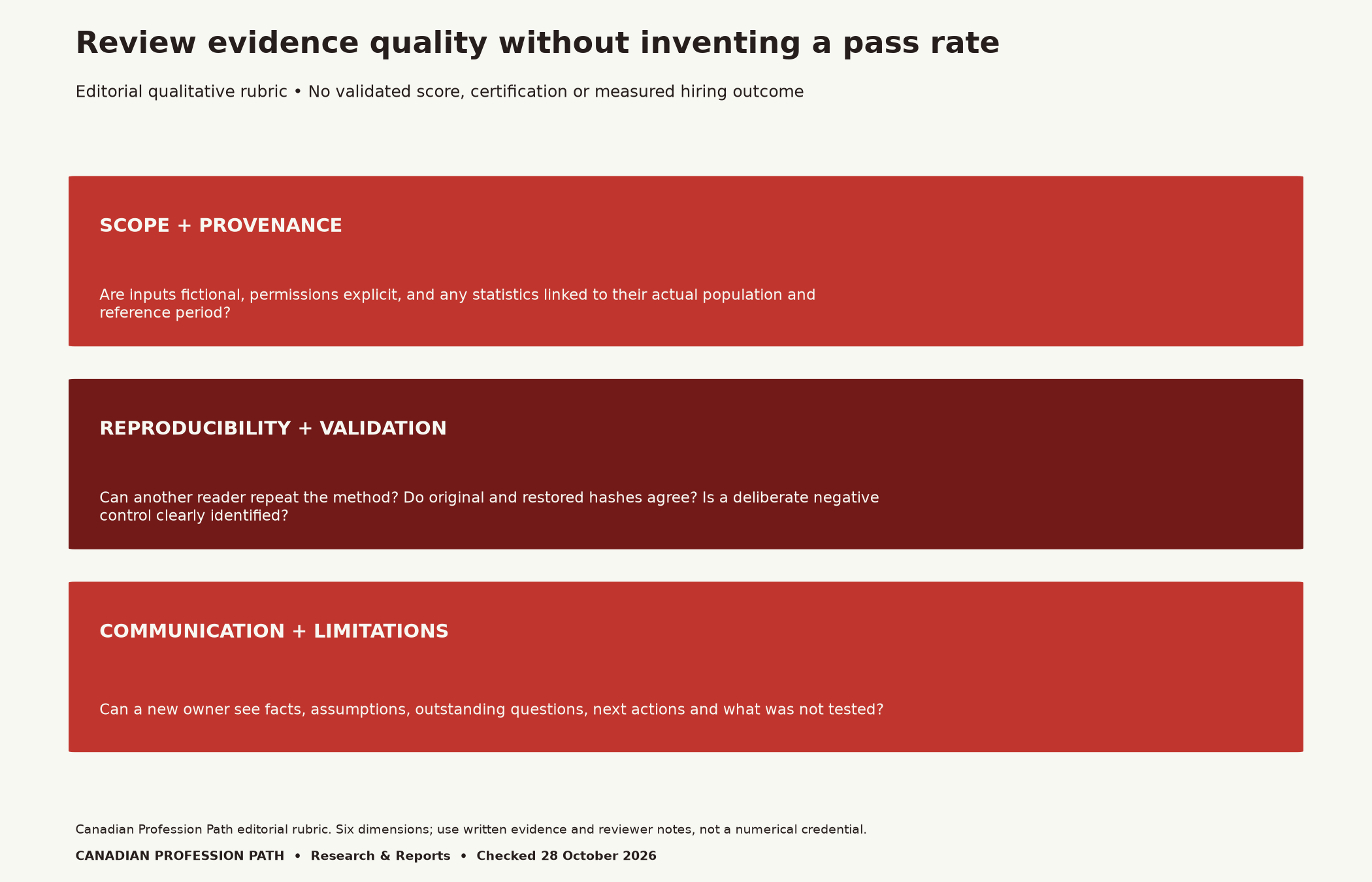
When applying, compare the work samples with an actual vacancy’s duties and required experience. Our cybersecurity interview preparation guide provides broader interview context. These exercises support a concrete discussion of your process; this article has not measured whether they improve job outcomes.
Newcomers can explain relevant prior work while keeping client information confidential. Re-create a small fictional example instead of uploading former employers’ logs. Check course costs against your needs using our training-evidence guide. Purchasing software or a course does not make these projects a recognised qualification.
Methods, downloads and limitations
We transcribed six rounded survey values, calculated the five-percentage-point fraud comparison and retained the separate denominators. We also ran the isolated file experiment described above. No employer interviews, vacancy survey, penetration testing or confidential business records were used. The fictional cases and rubric are our editorial materials.
Download the business-evidence table (CSV): six source-linked survey values with years and denominators.
Download the actual restoration record (CSV): three dummy files, source and restored hashes, negative-control checks and execution timestamps.
Get the fictional triage cases (CSV): three supplied training cases with uncertainty and practice actions; no live systems or real identities.
Get the blank evidence-review rubric (CSV): six qualitative prompts with empty status and reviewer-note fields.
Suggested citation: Pathfinder Editorial, Canadian Profession Path (28 October 2026), “Cybersecurity Portfolio Projects for Canadian SMEs.” Cite Statistics Canada for the business measures and the Cyber Centre for its guidance. Cite this article separately for the editorial exercises and dated local restoration results.
Unlock Your Career Potential
Visualize a clear path to success with our tailored Career Consulting service. Personalized insights in just 1-3 days.
Get Started


