






Special Operations Medical Technician Canada eligibility starts with your current military occupation and qualification. This is an internal specialist pathway. Read the entry route before treating a recruiting headline as a direct civilian opportunity or a guaranteed employment offer.
The National Defence notice published on 16 November 2026 describes the 2027–2028 campaign and an August 2027 training attachment. It distinguishes eligible Paramedics from Combat Medics considering a transfer route. This guide turns those distinctions into a comparison and blank question log.
Special Operations Medical Technician Canada eligibility: compare routes
| Starting position | Route described | Next verification |
|---|---|---|
| Regular Force Paramedic — 00406 | OFP qualified or scheduled to qualify spring/summer 2027 | Check citizenship, medical category and full administrative requirements |
| Primary Reserve Paramedic — 00406 | Application encouraged; Component Transfer required if selected before training | Confirm transfer process and timing with recruiting authorities |
| Combat Medic — 00407 | Explore existing occupational transfer and education routes to Paramedic | Do not treat the notice as direct SOMT entry for this occupation |
The notice requires Canadian citizenship and minimum medical category 333225. Regular Force Paramedics must be at the Occupational Functional Point, or scheduled to qualify in spring or summer 2027. Reserve applicants must accept a Component Transfer if selected, before training. Combat Medics are directed toward existing Paramedic transfer and education routes.
Treat the medical category as an official code, not a self-scoring checklist. Questions about your own file belong with the appropriate service authorities. A public explainer cannot establish an individual medical decision, qualification equivalence or transfer approval.
Start your question log with the occupation and component recorded in your official documents. Then identify the evidence supporting your qualification status and expected completion date. This approach helps you ask a precise administrative question without publishing personal medical or service information in a public worksheet.
Separate eligibility, selection, training and employment

Eligibility answers whether your starting position fits the route. Selection concerns the assessment of applicants. Training then requires successful completion of the relevant requirements. Final unit employment is a further outcome. Keeping these decisions separate prevents one confirmed fact from becoming an unsupported promise about the next.
For example, a scheduled qualification date is not evidence that qualification has already been awarded. Likewise, an invitation or training attachment is not proof that every later requirement will be met. In a personal planning record, retain the document, its date and exactly what it confirms.
The notice names interviews, psychological assessment and practical evaluation as selection components. It also makes fitness standards relevant to arrival at training. Use the official notice for the current standards and assessment protocols. This article does not offer a preparation programme, exercise prescription or workaround for a requirement.
Read the counts as a completeness check
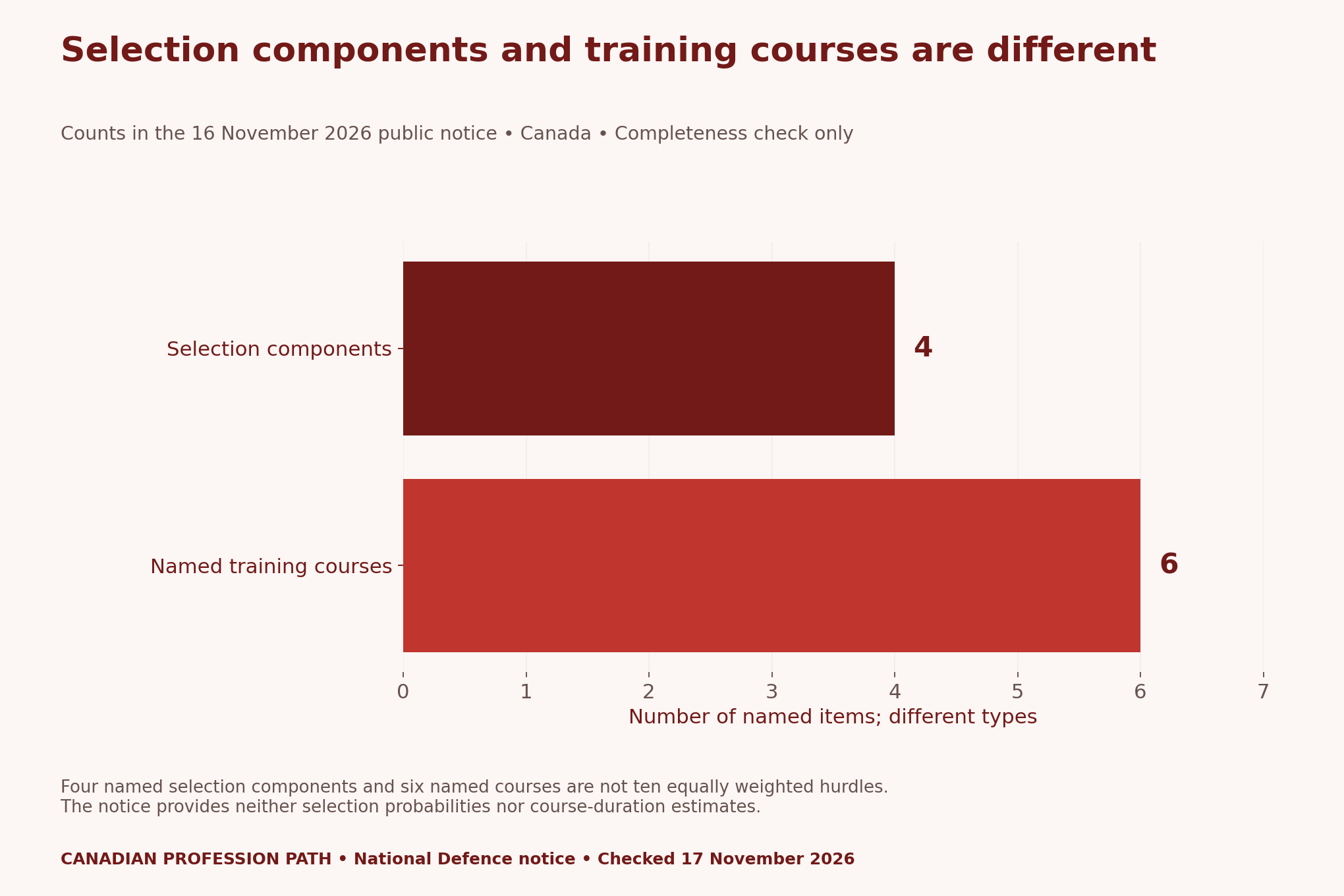
The downloadable register preserves the four selection components and six named courses. Count the items to check that your notes cover the notice. Avoid adding the lists into a supposed ten-part score. No weighting or applicant denominator is supplied, so there is no basis for an acceptance-rate calculation.
Course names also do not establish how long your pathway would take. Scheduling, prerequisites and individual circumstances may affect an administrative answer. Leave an unknown duration blank rather than filling it with an estimate that appears official. Record the source of any later answer you receive.
Training includes environmental and specialist preparation, insert/extract, tactical casualty care, conduct after capture and the specialist medical course. The CSV retains their exact official names. The notice conditions unit employment on completing all training requirements; the list should not be treated as a promise of a placement.
Resolve administrative questions through the official route
Detailed instructions are directed to the recruiting SharePoint. We did not access that internal material. Therefore, this article does not supply an application deadline, available-place count or individual document list. Obtain the current instructions through your authorised service channels and confirm which version applies.
The blank log separates a question, official answer, source, date and unresolved action. Ask one answerable question at a time. For instance, ask how a planned qualification completion date affects your route, rather than asking whether the whole programme is guaranteed for you. Keep sensitive details in the appropriate authorised system.
If a transfer is relevant, ask how it must be sequenced before training. If a date matters, establish whether it concerns an application, attachment, course start or final employment decision. These are different events. A precise event label is more useful than copying a month into an unlabeled calendar.
What this means for civilian readers and newcomers
An interesting specialist role does not make this notice a direct civilian application route. A civilian healthcare qualification alone does not establish the military occupation, component or qualification required here. Readers considering a broader military medical career should use the appropriate official recruiting information for their own starting position.
Citizenship is a stated requirement in this particular notice. Do not generalise its conditions to every Canadian healthcare role or every military occupation. Equally, do not assume a general recruitment rule removes a specific condition from this specialist pathway. Resolve apparent differences with the responsible recruiting authority.
For broader context, our Healthcare and Medical Services archive covers other professional routes. This article focuses on interpreting one public notice, without ranking careers or estimating a personal return from training.
Method, limits and downloadable tools
We reviewed the dated National Defence notice on 17 November 2026 and classified its statements by entry route, selection, training and final employment. The chart counts named items only. The route comparison is an editorial reading aid, while the administrative log remains blank for verified answers.
No applicant volume, success rate, salary, course duration or application deadline was established here. We did not inspect internal recruiting instructions or assess any individual. Recheck the current official notice and authorised administrative guidance before acting. The tools support careful record-keeping and do not replace an official decision.
- Entry route and occupation comparison (CSV)
- Named selection components and exact course register (CSV)
- Blank administrative question and answer log (CSV)
- Notice measures, dates and evidence limits (CSV)
Suggested citation: Canadian Profession Path, “Special Operations Medical Technician Canada: Check the Entry Route First”, 17 November 2026. Primary source: National Defence, 16 November 2026; editorial comparison and tools by this publication.


