






Comparing Ontario auto jobs means looking beyond the best-known assembly plants. Parts suppliers account for a large share of the sector’s payroll employment. Meanwhile, historical pay advantages sit alongside uncertainty about hours, products and plant operations. A useful decision starts with the actual role and written offer, then checks the wider evidence.
This research guide is for Canadian residents considering automotive manufacturing work, including newcomers and experienced workers changing employers. Four charts separate Ontario employment composition from Canada-wide earnings, employment change and export-demand exposure. Our free offer checklist turns those comparisons into questions you can ask before committing.
Ontario auto jobs: what the latest strike vote means
In its 19 October 2026 announcement, Unifor reported 97.3% support for strike authorization following votes on 17–18 October. It also said the union was not then in a legal strike position. The release gives neither a voter count nor turnout. An authorization vote does not establish that a strike has begun.
The union’s 6 October bargaining update described unresolved issues involving Brampton and wider job security. Those are the union’s account of negotiations. We do not use them to predict an agreement, a shutdown date or an individual worker’s employment outcome.
Status check: 21 October 2026. The dated announcement above is the basis for this explanation. Bargaining can change quickly. Before acting on an offer, check a current employer notice and the relevant union update. Ask which plant, role and proposed start date the information actually concerns.
Parts suppliers deserve a place in your search
The Job Bank sector profile reports 148,300 employed people in Ontario’s combined motor vehicle, body, trailer and parts sector in 2024. Ontario represented 84.6% of Canada’s sector employment. Its separate payroll-based Ontario breakdown assigns 66% to parts, 29% to vehicles and 5% to bodies and trailers.
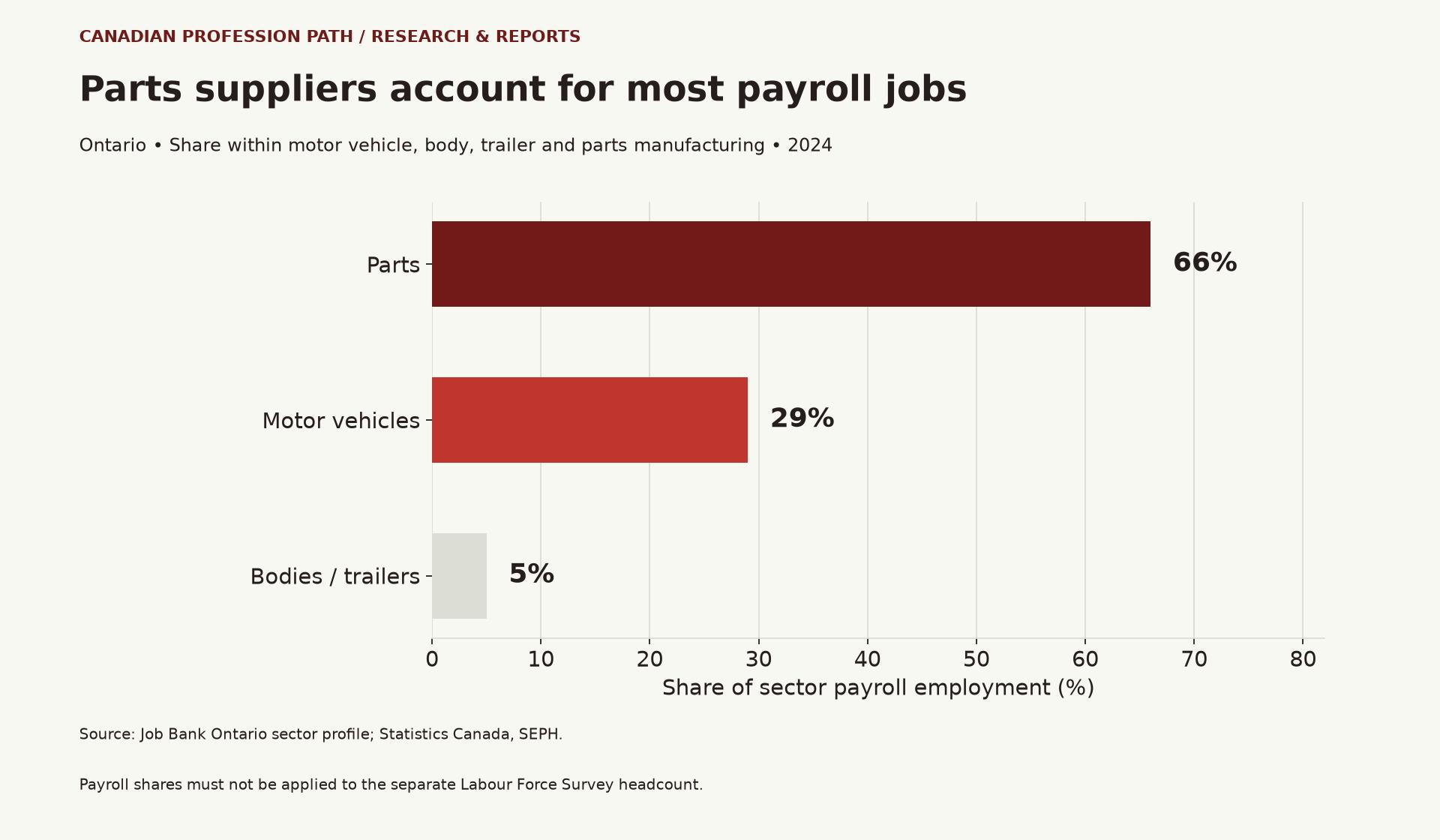
Dividing the two largest shares gives 66 ÷ 29 = 2.28. In this breakdown, parts’ share was about 2.28 times the vehicle-manufacturing share. That is a reason to search more widely. It does not mean any particular supplier is hiring, or that a parts role is more secure.
Do not multiply these payroll shares by the 148,300-person total to produce subsector headcounts. The total comes from the Labour Force Survey, while the shares use a payroll survey. Different coverage and measurement mean those figures are not interchangeable.
What the historical pay premium does—and does not—show
The same profile gives Canadian average weekly earnings of C$1,468 for the combined auto sector in 2024, compared with C$1,327 across manufacturing. These national averages are historical benchmarks. They are neither Ontario entry wages nor October 2026 job offers.
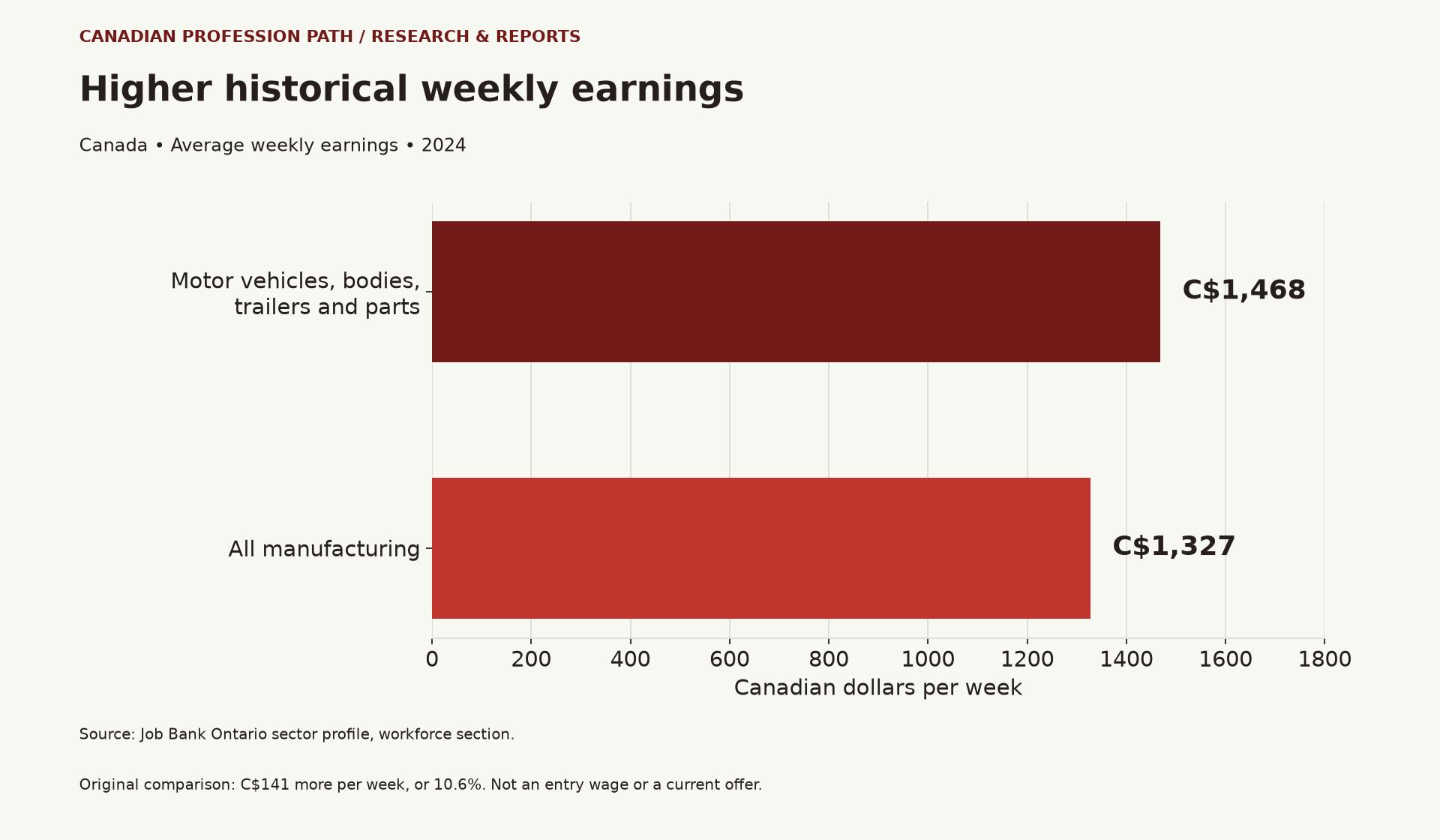
Our calculation is C$1,468 − C$1,327 = C$141 per week. Relative to manufacturing overall, the difference is C$141 ÷ C$1,327 × 100 = 10.6%, rounded. We have not converted it into a guaranteed annual income or a return on training.
For an actual offer, begin with base pay and the hours the employer commits to provide. Then list shift premiums, overtime, benefits, travel and childcare costs separately. An attractive weekly total based on optional overtime can answer a different question from dependable base earnings. Ask for the assumptions behind any recruiter’s estimate.
The profile also reports that 97.4% of Ontario sector employment was full-time in 2024. Full-time describes hours; it does not establish permanent status, guaranteed shifts or uninterrupted work. Ask about each of those terms directly.
Ontario auto jobs and the wider employment picture
A Statistics Canada study released on 4 May 2026 reports that Canadian parts-manufacturing employment fell 9.3% between December 2024 and December 2025. Motor vehicle manufacturing fell 1.3%. This comparison describes Canada, not an Ontario-only result.
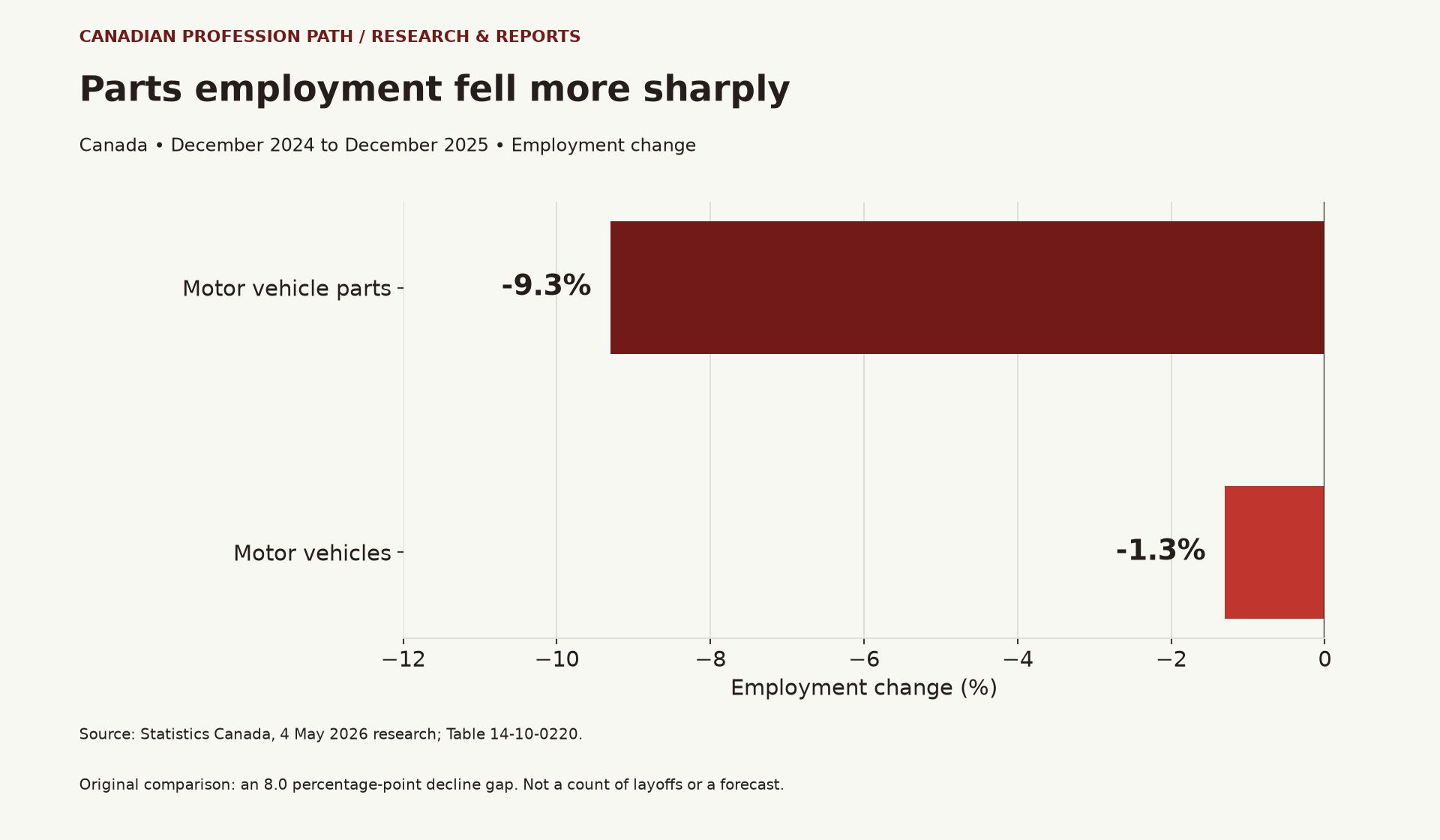
The decline gap is 8.0 percentage points: 9.3 − 1.3. It is not eight percent more layoffs, and it cannot identify which employer is safer today. Employment changes can reflect multiple developments; these two observations do not isolate the effect of tariffs, automation or electrification.
Use this signal to ask better questions. What is the facility currently producing? Is the vacancy a replacement, an expansion or a temporary assignment? Which customer or vehicle program supports the work? Where a business cannot disclose commercial details, record that uncertainty rather than filling the gap with an assumption.
U.S. demand is exposure, not a layoff probability
The same Statistics Canada research attributes 76.4% of Canadian automobile and light-duty vehicle manufacturing payroll jobs in 2024 to U.S. demand. The corresponding share across manufacturing was 41.0%. This narrower vehicle group is different from the combined sector used in the earnings comparison.
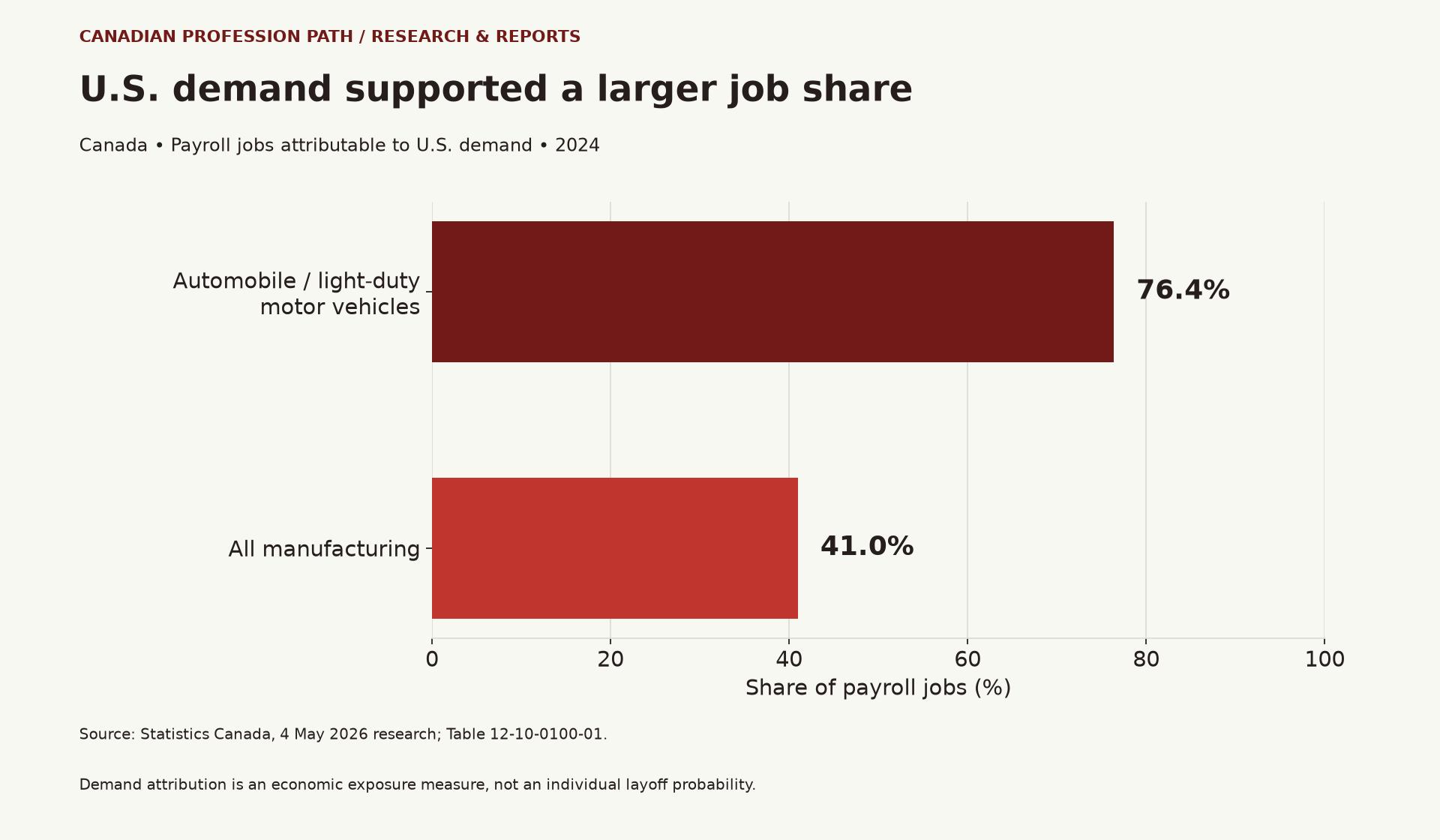
The difference is 35.4 percentage points. That helps explain why cross-border demand belongs in a career conversation. It does not mean a worker has a 76.4% chance of losing a job, or that every plant has identical customers and exposure. A national estimate cannot replace current evidence about an employer.
Compare Ontario auto jobs with a practical offer checklist
- Employer and status: identify the legal employer, work location, direct or agency arrangement, and permanent or temporary terms.
- Pay and hours: separate guaranteed base hours from overtime, premiums and performance-dependent amounts.
- Plant evidence: record the date and source of the latest operating-status or hiring information.
- Product and customers: ask which program supports the role and what the employer can disclose about its duration.
- Training: establish who pays, when it happens, what supervision is provided and what skill you gain.
- Household fit: test shift times, travel, childcare and the costs of changing employer.
Keep “confirmed,” “not yet known” and “dependent on a future event” in separate notes. This is more useful than awarding a company an unsupported safety score. Two offers may suit different households even when their hourly rates look similar. Decide which unresolved question matters most before choosing your next step.

Newcomers and career changers: start with the occupation
Assembly, maintenance, quality, engineering and supervision involve different work. Before buying a course, compare the exact tasks in current advertisements with skills you can already demonstrate. Ask employers how they assess relevant overseas experience and what documents or practical evidence they need.
Check the specific trade rather than assuming every factory role has the same certification rule. For example, Skilled Trades Ontario describes Industrial Mechanic Millwright as a non-compulsory trade with an apprenticeship and certifying examination. An employer may still require qualifications or experience. Ask the authority about your own route and evidence requirements.
Our funded apprenticeships report provides a provider-comparison checklist if training is part of your plan. For role background, read our guide to mechanical engineers in the auto industry. Use current regulators for professional registration requirements; the background article is not a licensing assessment.
Download the data and offer-comparison worksheet
Use the two-page automotive job-offer checklist (PDF) to compare two options and record the evidence behind your decision. The chart data download (CSV) preserves each measure’s geography, reference period and source. You can reproduce the comparisons without combining incompatible totals.
Method, limitations and update log
We transcribed published official benchmarks and calculated the share ratio, weekly earnings difference and percentage-point gaps. All monetary values are Canadian dollars. The charts use separate panels because their populations, geographies and reference periods differ. No employer ranking, current vacancy inventory or individual risk model was created.
The Job Bank profile is older context, with 2024 observations and a 2025–2027 outlook. We do not treat its plant-status descriptions as live October 2026 notices. The employment and demand comparisons come from the dated Statistics Canada study, not a newly downloaded monthly time series. Subsequent revisions or releases may change the context.
Update log: First research edition, 21 October 2026. Sources and the 19 October bargaining announcement checked before publication. Readers should recheck bargaining and plant-specific information before an employment decision.
Unlock Your Career Potential
Visualize a clear path to success with our tailored Career Consulting service. Personalized insights in just 1-3 days.
Get StartedSuggested citation: Canadian Profession Path (2026), “Ontario Auto Jobs in 2026: Pay, Plant Risk and Parts Suppliers.” Credit the original official sources for their data and link to this report when reusing its calculations or offer checklist.


