






An Ontario social service worker unpaid placement can change the time and money available for paid work. Before choosing a diploma, ask for the placement schedule and build a budget from your own inputs. A course announcement is not enough to tell you whether year two fits around work, travel or caregiving.
George Brown Polytechnic’s C142 programme page describes approximately 600 hours of supervised unpaid field education in year two. Students lead their placement search with school support; placement is not assigned. This article turns that time commitment into an original planning worksheet. It does not assess anyone’s eligibility or recommend taking on debt.
Read C142’s duration and intake labels carefully
The November 27 launch announcement points to a January 2027 first cohort. The programme page’s details describe 16 continuous months over four semesters, while its full description calls it a two-year diploma. Those are not identical calendar descriptions. Confirm the dates, breaks and placement term with the school before arranging work or care.
Do not treat a displayed application button or later-year availability table as a confirmed seat for January 2027. Record the exact programme code, intake and date of the school’s reply. Keep the written timetable with your planning sheet rather than assuming that a generic academic year has a fixed number of active weeks.
Ontario social service worker unpaid placement: model the weekly load
Our central example spreads 600 placement hours over 30 hypothetical active weeks. Dividing 600 by 30 gives 20 placement hours per week. This is arithmetic, not a published C142 roster. It excludes commuting, classes, reading, assignments and time spent finding a placement.
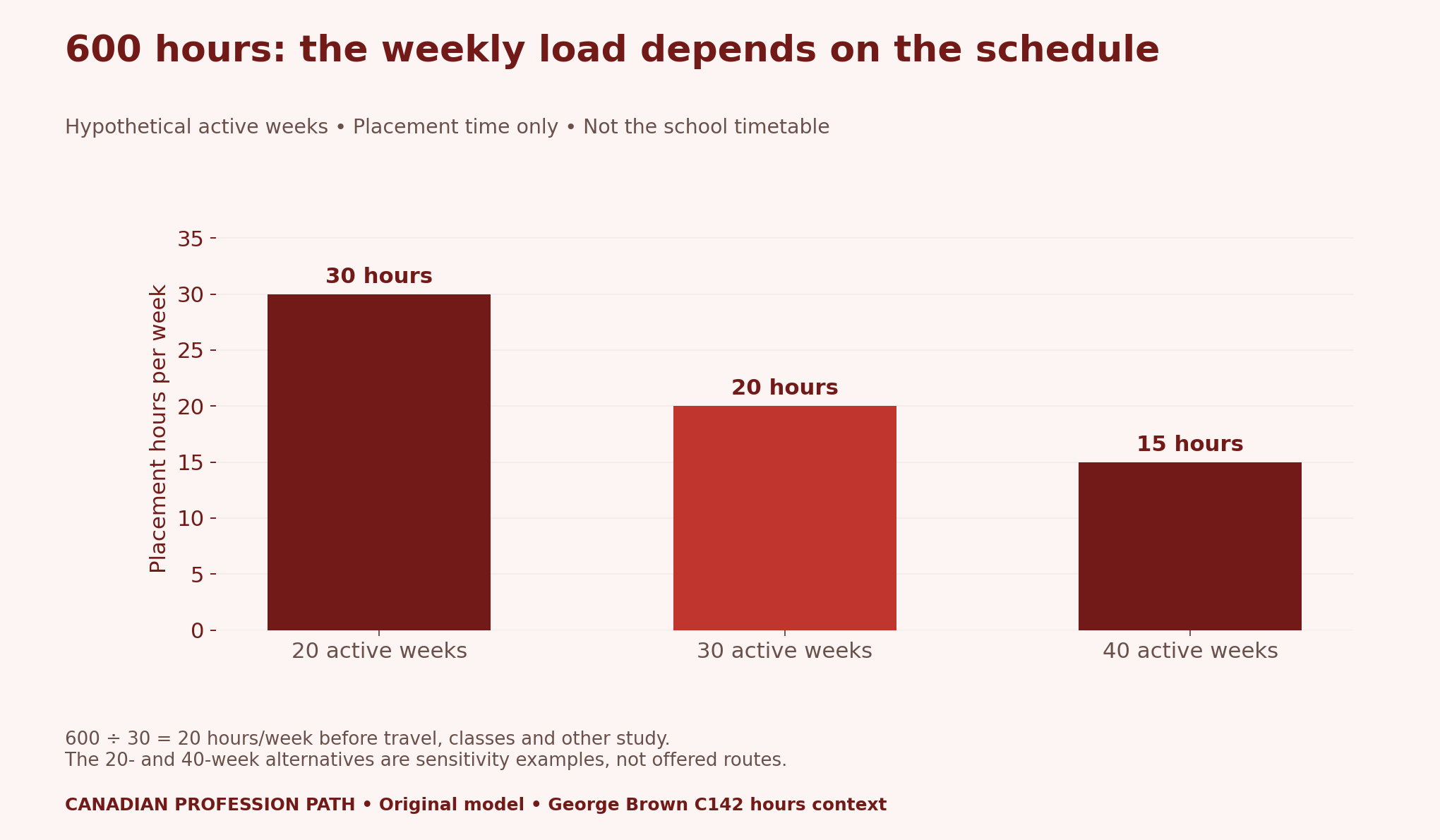
The alternative 20- and 40-week rows show why the denominator matters. A shorter period concentrates the same hours into busier weeks. A longer period lowers the weekly average but extends the commitment. Neither alternative establishes that the school will offer such a schedule. Use the confirmed timetable when it arrives.
| Hypothetical active weeks | Placement hours | Average placement hours/week |
|---|---|---|
| 20 | 600 | 30 |
| 30 | 600 | 20 |
| 40 | 600 | 15 |
Separate expenses from the paid work you might displace
A useful budget has different lines for travel, additional care and paid work displaced. The first two can be cash expenses. The third is a change in possible earnings, not a college charge. Keep tuition and other confirmed programme costs in separate rows. Do not add an unverified scholarship as if it were cash already received.
Consider a deliberately fictional 30-week case. The student assumes 12 paid hours are displaced each week at CAD22 gross per hour. That is CAD264 per week, or CAD7,920 across 30 weeks. These are invented inputs, not wage data or a prediction that every placement displaces 12 work hours.
The same example assumes three return trips a week at CAD5 each: CAD15 weekly and CAD450 overall. Four extra care hours a week at CAD15 produce CAD60 weekly and CAD1,800 overall. These rates and quantities are invented. Replace them with your own evidence; do not treat them as Toronto prices.
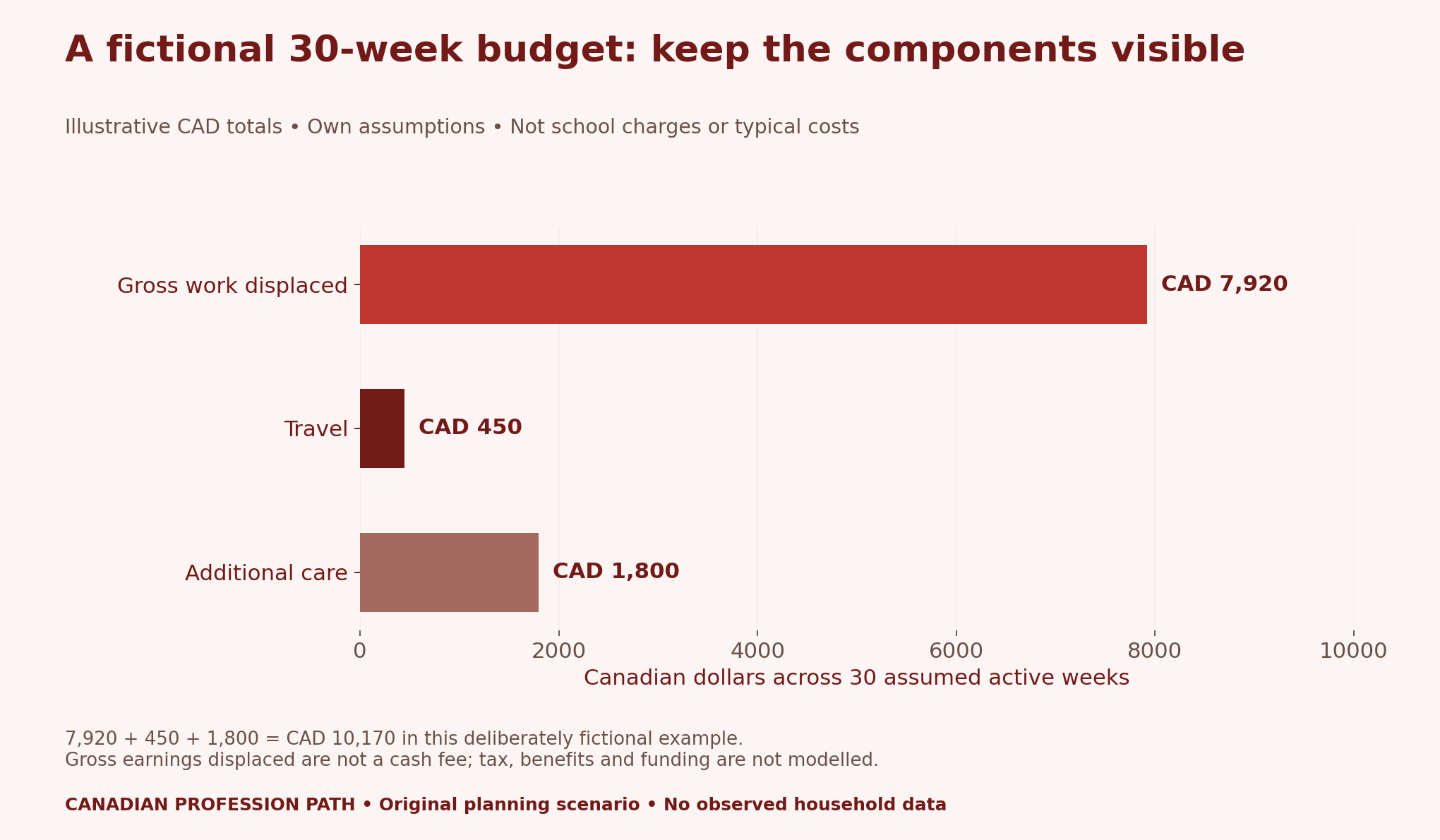
The arithmetic totals CAD 10,170, but the total needs its label. It combines gross earnings displaced with two assumed expenses. It is not a fee invoice and not a measured cash shortfall. For a personal decision, prepare a separate cash calendar showing when actual income and bills occur.
Ask four questions, with four separate kinds of proof
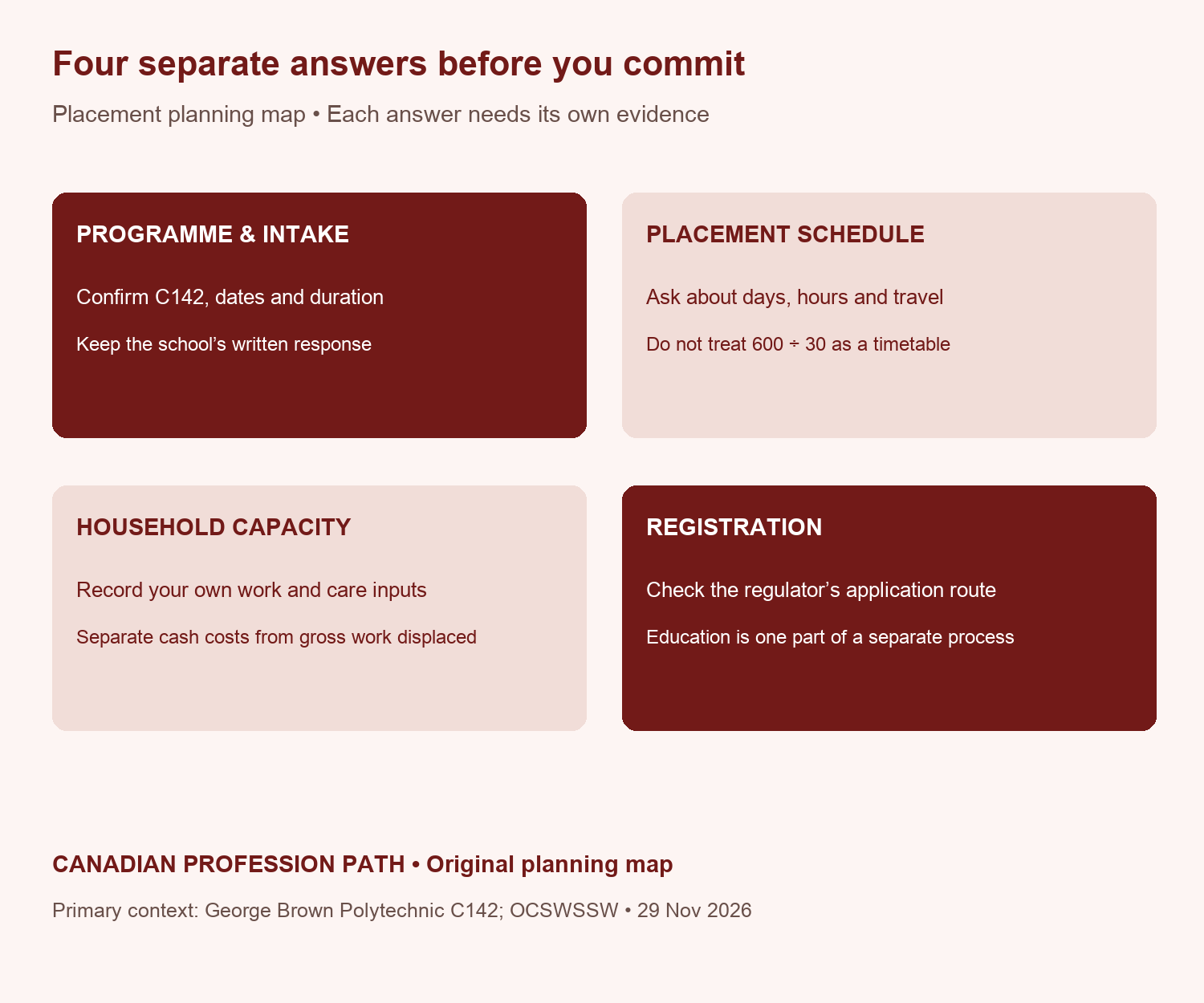
First, confirm the programme and intake. Next, request the expected placement days, location constraints and supervision arrangements. Then test your own work and care calendar against those answers. Keep unresolved fields blank and record who can answer them. A blank is more honest than an estimate presented as an official condition.
Finally, distinguish education from registration. The school states that graduates meet the educational requirement for social service worker registration. OCSWSSW’s Ontario-diploma application route separately requires an application and supporting evidence. Completing a diploma is not itself registration, the separate social worker title, a job guarantee or an immigration pathway.
Use the worksheet without making the assumptions permanent
Save one version before contacting the school and another after receiving written answers. Replace the hypothetical active-week count and personal-cost fields only when you have evidence. Mark each input as school-confirmed, personally estimated or unresolved. This makes later changes visible without implying that a preliminary plan was a promise.
Ask whether a placement day could conflict with an existing paid shift. That depends on actual timing, not just a weekly total. Twenty hours spread over several days can affect travel and care differently from the same hours on fewer days. The worksheet records those questions without guessing what the school permits.
For a related evidence habit, the Canada Summer Jobs mentoring checklist separates a programme announcement from the terms of an individual opportunity. Use the same discipline here: keep the general announcement and your confirmed arrangements in different fields.
Methods, limitations and reusable downloads
Research checked 29 November 2026. We used the college page for programme context and the regulator for the separate registration process. We did not verify an available seat, placement partner, personal financial outcome or future employment. The date and duration discrepancy remains explicit rather than being resolved by assumption.
Canadian Profession Path created the schedule sensitivity, fictional cost arithmetic and blank worksheet. The two charts answer different questions: how active weeks change the time average, and which components make up one fictional planning total. The separate infographic organises evidence. None is a survey or an observed student outcome.
- Hypothetical weekly placement schedules (CSV)
- Fictional placement budget and assumptions (CSV)
- Blank placement schedule and budget worksheet (CSV)
- Source, scope and unresolved-fields register (CSV)
Suggested citation: Canadian Profession Path, “Ontario Social Service Worker Diploma: Budget for the Unpaid Placement”, 29 November 2026. Credit George Brown Polytechnic and OCSWSSW for primary information, and Canadian Profession Path for original models and tools.


