







Choosing LPN vs RN in Canada means weighing two different signals. Practical nursing has the higher national vacancy rate. Registered nursing has the higher historical median hourly wage. Neither number tells you which course you can afford, which licence you can obtain, or which local employer will hire you.
This report helps Canadian residents compare the evidence before committing to training. It also includes guidance for residents who trained abroad. Our research date is 21 October 2026; the vacancy figures describe 2025, while the Job Bank wage benchmarks use 2023–2024 data.
LPN vs RN: the findings at a glance
- Hiring pressure: the 2025 LPN vacancy rate was 12.3%, compared with 5.0% for a broader registered-nursing group.
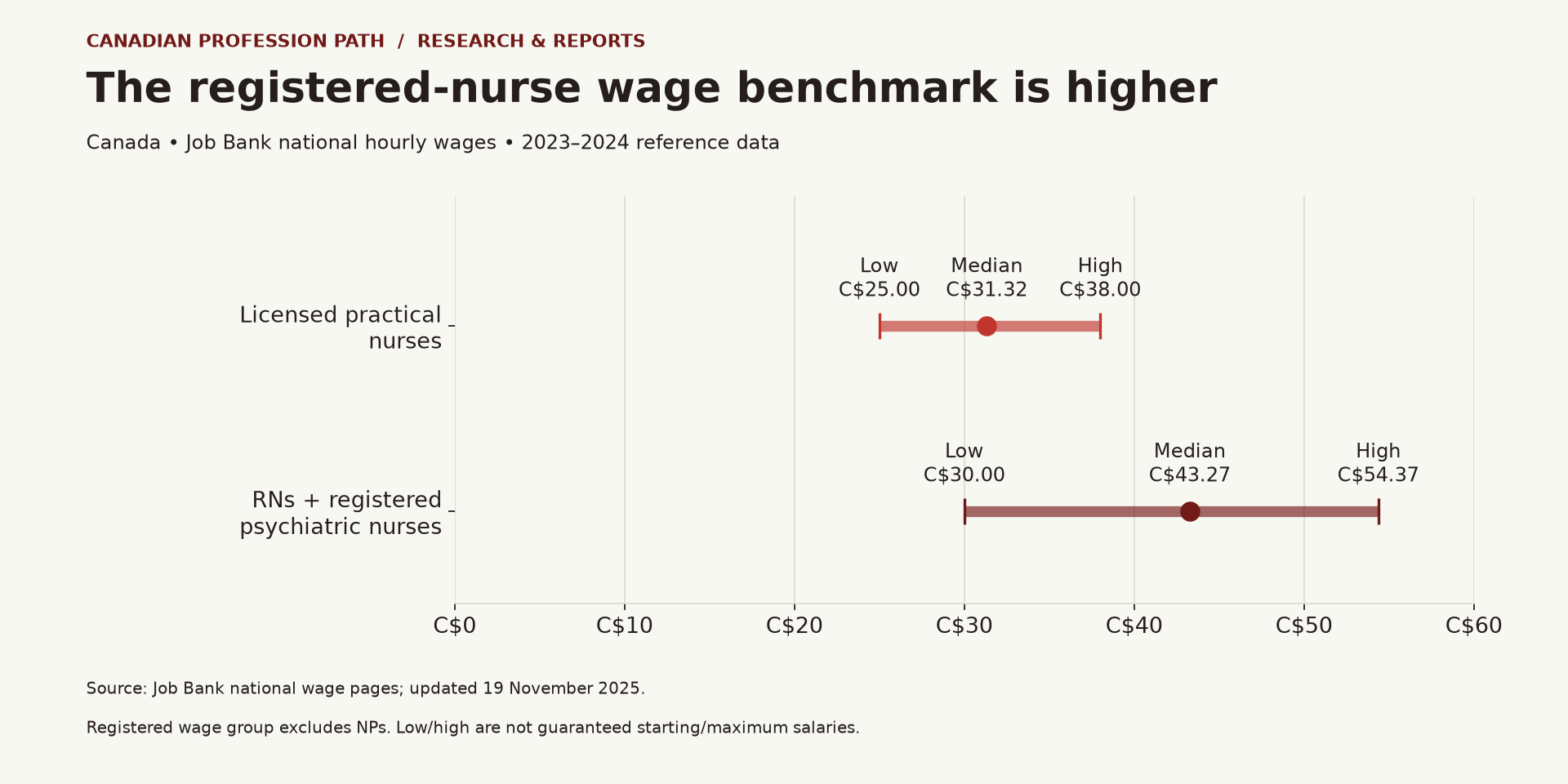
- Pay benchmark: national median hourly wages were C$31.32 for LPNs and C$43.27 for RNs and registered psychiatric nurses.
- Your decision: compare approved training, total study costs, registration requirements and actual local openings before choosing a pathway.
The groups differ. The vacancy comparison includes nurse practitioners alongside RNs and registered psychiatric nurses. The registered-nurse wage benchmark excludes nurse practitioners. Keep that distinction in every comparison. Sources: Statistics Canada’s health-workforce report, Job Bank’s LPN wages and RN wage benchmarks.
Does the higher LPN vacancy rate mean an easier first job?
It signals stronger unmet demand relative to the size of that occupation. However, it does not measure your chance of receiving an offer. A vacancy rate divides unfilled positions by filled plus vacant positions. It says nothing directly about an applicant’s licence, experience, preferred location or availability for shifts.
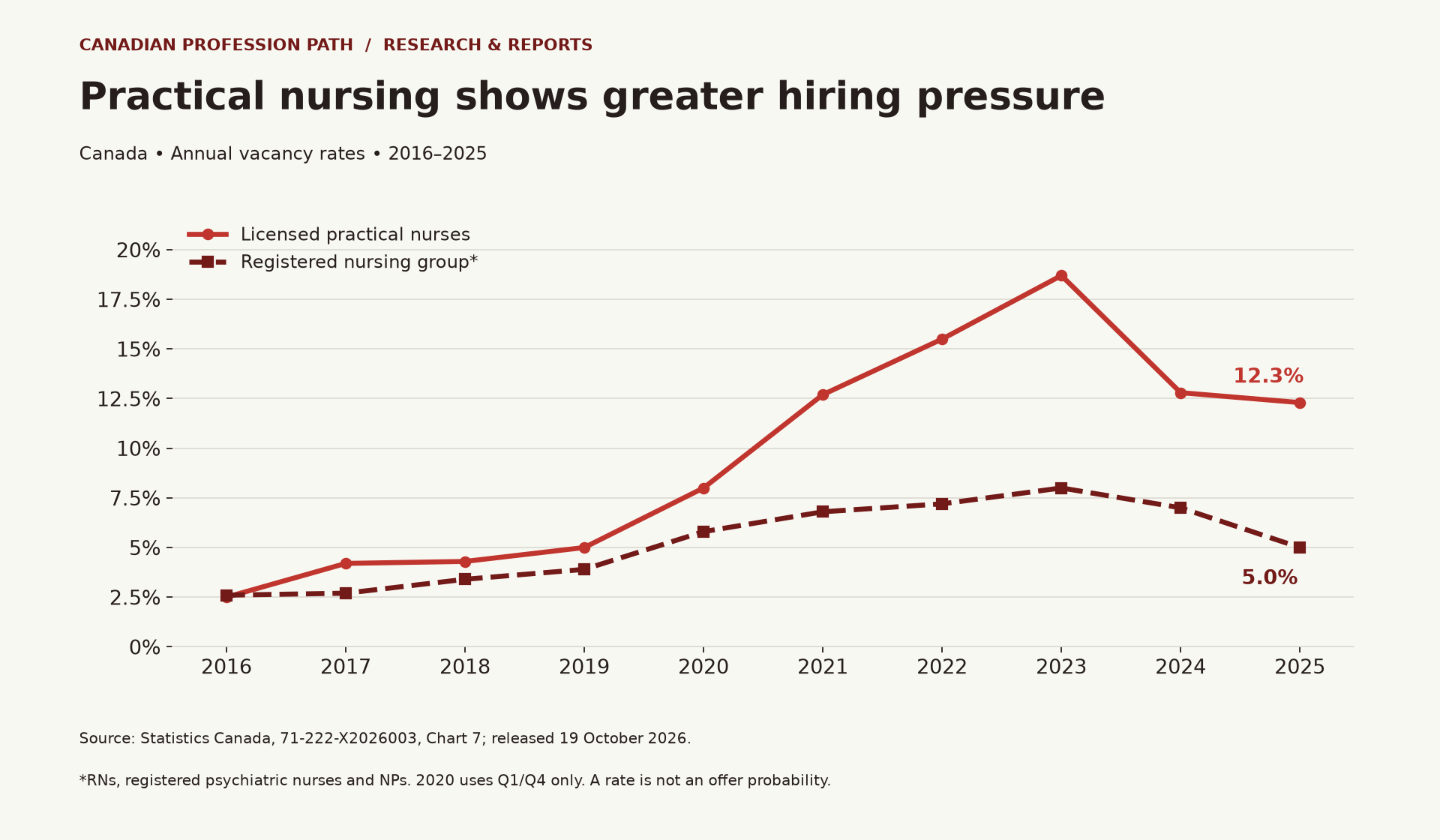
Our calculation puts the LPN rate at 2.46 times the broader registered-nursing rate: 12.3 ÷ 5.0. That ratio compares occupations; it is not a hiring forecast. For a useful local check, collect three recent advertisements for each pathway. Compare the required registration, specialty experience, employment term and guaranteed hours.
Then ask whether you could meet those requirements when your course ends. A nearby vacancy that requires experience may be less relevant than a graduate position farther away. Likewise, a part-time opening may not support the household budget you used when choosing a program.
How much more does the RN wage benchmark pay?
The median gap is C$11.95 an hour, or 38.2% relative to the LPN median. We calculate that as (43.27 − 31.32) ÷ 31.32 × 100. These are historical national benchmarks, updated by Job Bank on 19 November 2025. They are not newly announced 2026 pay scales.
| Occupation group | Low, C$/hour | Median, C$/hour | High, C$/hour |
|---|---|---|---|
| Licensed practical nurses | 25.00 | 31.32 | 38.00 |
| RNs and registered psychiatric nurses | 30.00 | 43.27 | 54.37 |
A median is the midpoint of the wage distribution. Job Bank explains that low and high wages usually represent the 10th and 90th percentiles. They are not guaranteed entry and maximum rates. Its estimates also do not adjust for years of experience. See the official wage methodology.
For your budget, use a current employer pay scale and realistic paid hours. Record benefits, pension contributions, travel costs and unpaid time separately. Avoid multiplying a national median by full-time hours unless you clearly label that result as a scenario. An hourly advantage alone cannot establish the financial return on another qualification.
What long-running vacancies add to the LPN vs RN comparison
In 2025, 50.2% of vacancies in the broader registered-nursing group had been open for at least 90 days. The LPN figure was 48.4%, compared with 46.7% across health occupations. Here, the denominator is vacancies within each group. This is a different measure from the vacancy rate above.
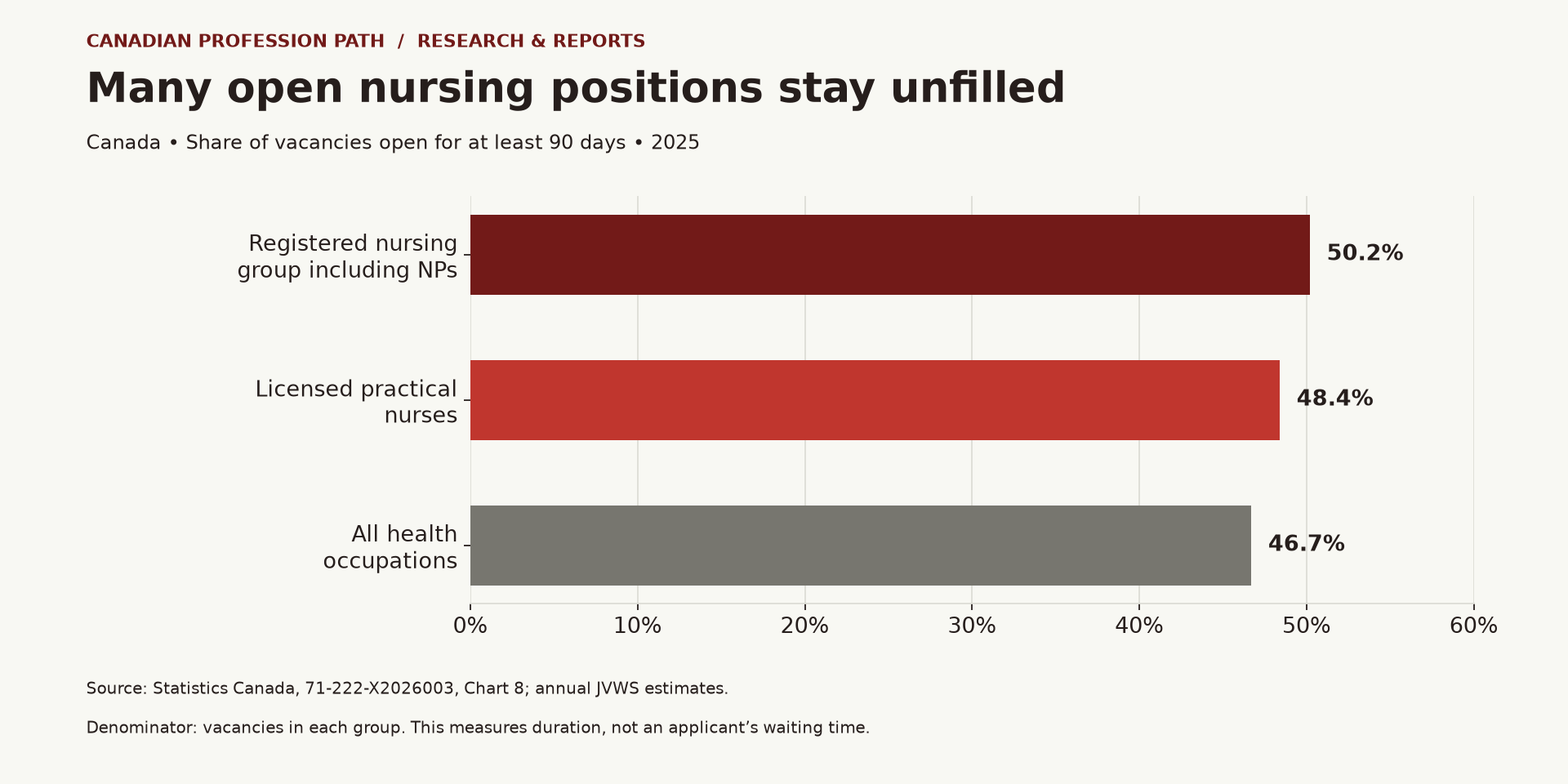
Use this finding to ask better questions. For example, why is a position still open? What orientation does the employer offer? Which shifts need coverage? The national figures cannot answer those questions. They also cannot establish whether a particular workplace has poor conditions or whether a specific applicant is suitable.
Higher nominal pay does not guarantee more buying power
Statistics Canada also reports inflation-adjusted average hourly wages for employees aged 25–54. Between 2019 and 2025, LPN pay moved from C$33.03 to C$32.82 in 2025 dollars. The broader registered group moved from C$46.76 to C$46.10. These are means for a defined age group, not the Job Bank medians.
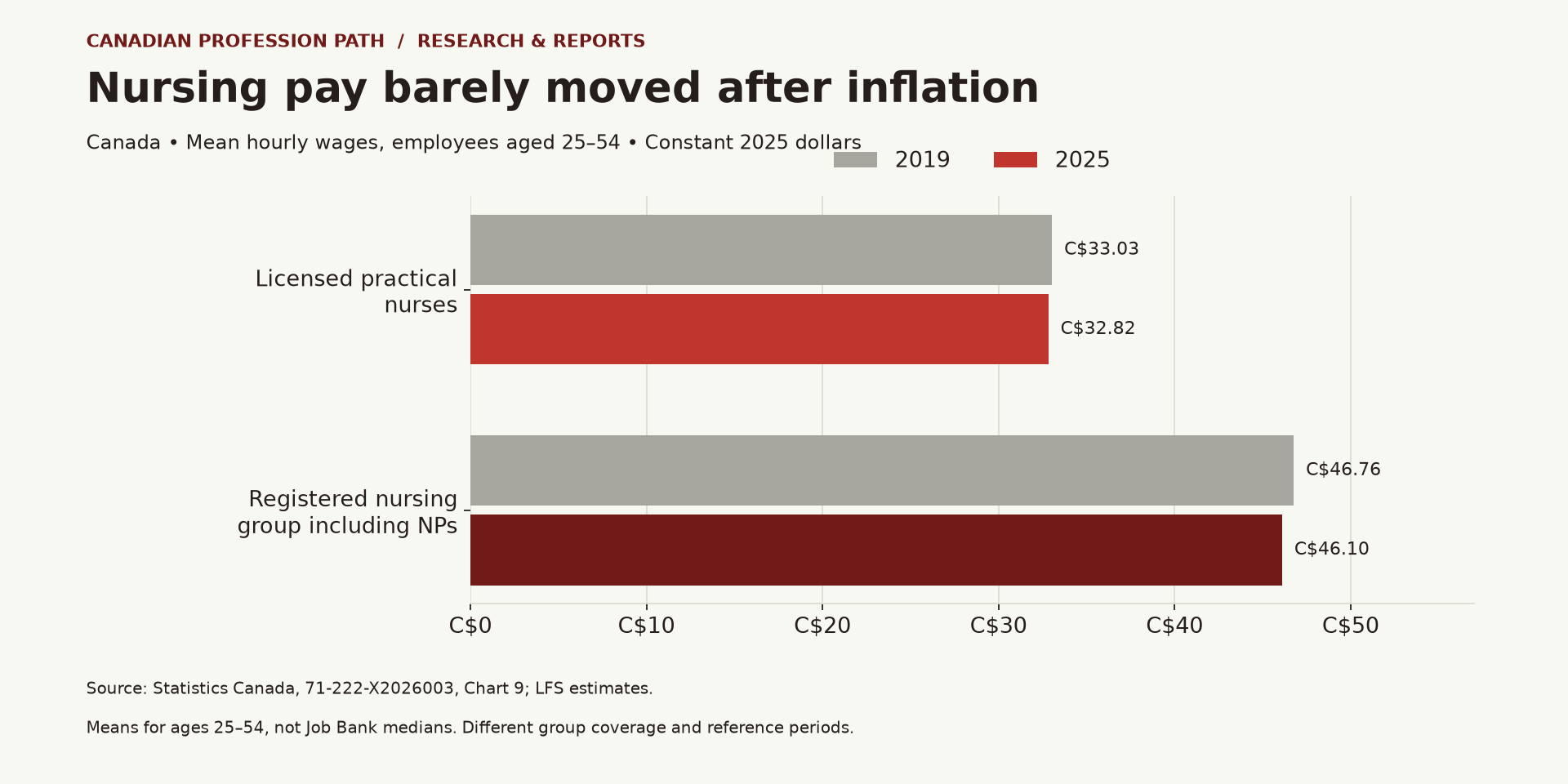
For residents considering LPN vs RN training, this matters because a higher future pay cheque may face higher living costs. Build your study budget around expenses you can verify today. Also allow room for changes in transport, housing and care costs. The chart measures national average purchasing power; your household’s spending pattern will differ.
The wider health job market has cooled from its peak
Health-occupation vacancies fell from 90,700 in 2023 to 67,885 in 2025. That is a reduction of 22,815, or 25.2%, calculated from the published totals. Yet vacancy pressure remains uneven across occupations. A broad claim that every healthcare role is equally easy to enter would miss that distinction.
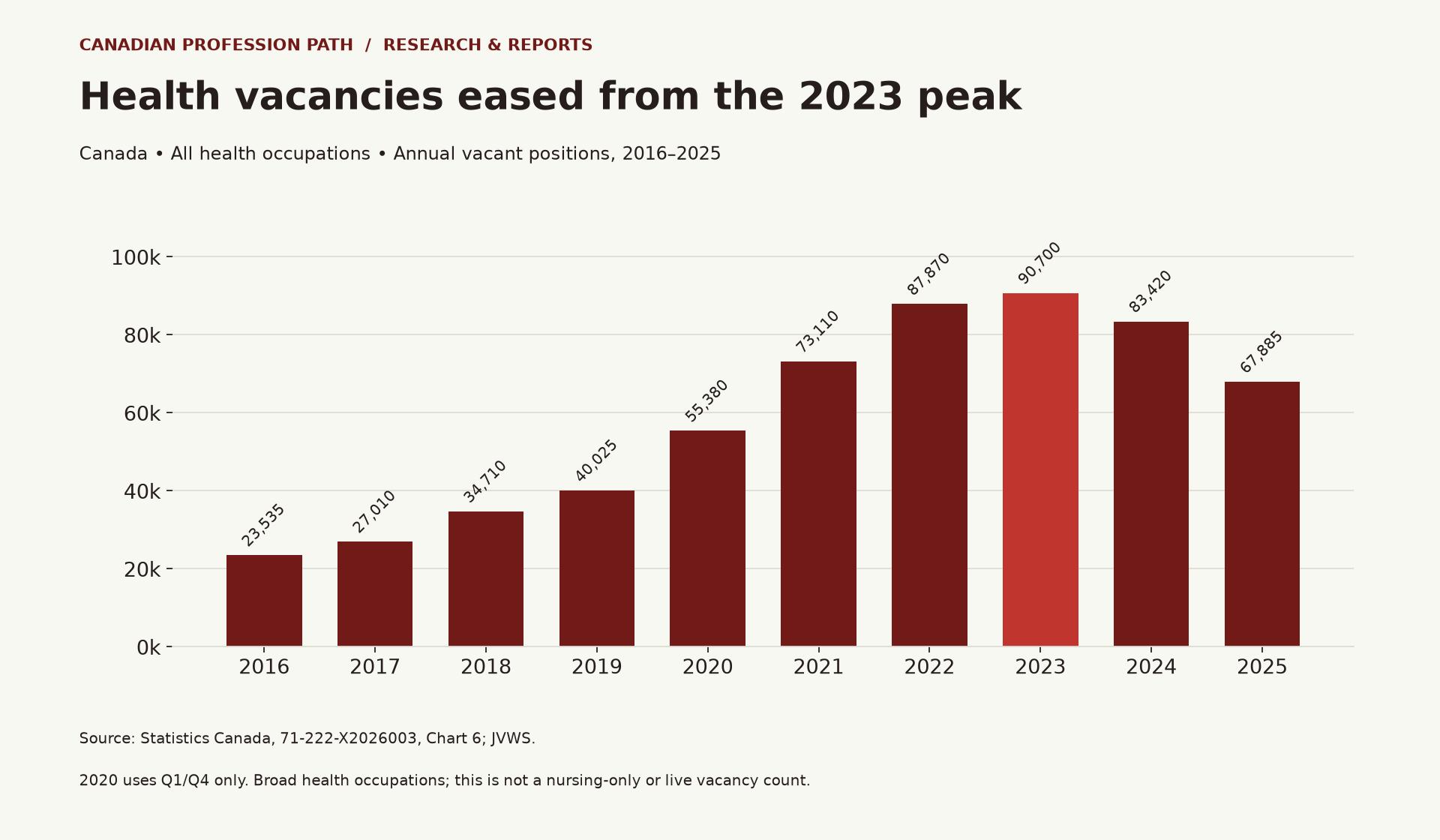
Therefore, treat these annual figures as background for your search. Check fresh employer advertisements when you apply. You can explore our healthcare and medical careers collection for wider role ideas, then return to current regulator and employer sources for entry requirements.
Compare training in the province where you plan to work
Nursing titles need care. Ontario uses registered practical nurse (RPN) for practical nursing. Elsewhere, RPN can refer to a registered psychiatric nurse. Use the full designation when searching for courses or comparing job advertisements. The Canadian Nurses Association’s regulator directory is a useful starting point.
For an Ontario example, the College of Nurses of Ontario lists a baccalaureate nursing degree for RN education and a practical nursing diploma for RPN education. The program must meet its approval or recognition requirements. Education is one part of registration. Read the current CNO education guidance and approved program listings.
Then compare the actual intake you could join. Ask each school about prerequisites, timetable, placements, travel and compulsory fees. For bridging routes, request written confirmation of the credits the school will accept. Do not assume that a course advertisement guarantees registration or that Ontario’s requirements apply across Canada.

Newcomer guidance: check your assessment route first
If you already live in Canada and trained abroad, start with the regulator for your intended province or territory. Ask which documents, assessments and registration steps apply to your education. The CNA’s internationally educated nurse guidance explains that requirements vary by jurisdiction.
Before paying for extra training, confirm that it addresses a requirement in your own application. Keep written advice and a dated checklist. Allow for document preparation and assessment costs in your budget. Neither a national vacancy rate nor a school’s marketing claim establishes your eligibility to practise.
Use the LPN vs RN pathway worksheet
Our two-page worksheet gives both routes the same questions. Fill it in with current local evidence, then identify the gaps that could change your decision. It deliberately avoids a single “best career” score: a route that suits one household may be impractical for another.
- Confirm the pathway. Record the regulator, exact designation, approved program and intake.
- Price the whole commitment. Add tuition, fees, supplies, travel, extra childcare and earnings you may give up.
- Check the destination job. Save recent local advertisements and their licence, experience and scheduling requirements.
- Test daily fit. Compare placements and future shifts with household commitments. Our discussion of nursing work-life balance offers questions to consider.
- Resolve uncertainty. Ask the school, regulator or employer to confirm unclear points before you commit.
Download the printable nursing pathway worksheet (PDF). For reuse and checking, get the chart data and definitions (CSV).
Sources, calculations and limits
Canadian Profession Path transcribed the official tables and calculated the comparisons shown here. The main source is Statistics Canada’s Canada’s Health Workforce: An integrated summary based on Statistics Canada data, 2025, released 19 October 2026. Charts 6–9 supply the vacancy and real-wage series. The downloadable CSV identifies each measure, period, unit and caveat.
The vacancy series combines Job Vacancy and Wage Survey data with employment estimates adjusted for that survey’s coverage. Collection stopped in the second and third quarters of 2020, so that year uses only two quarters. The real-wage comparison covers employees aged 25–54 and excludes self-employment. Job Bank’s separate national wage estimates use the 2023–2024 Labour Force Survey.
We retain source precision for calculations, then round currency to cents and percentage changes to one decimal place. These descriptive comparisons do not establish causation or a personal return on education. We have not estimated confidence intervals, ranked employers, verified every local intake, or treated the published differences as statistically significant. National evidence cannot replace local offers and individual registration advice.
Unlock Your Career Potential
Visualize a clear path to success with our tailored Career Consulting service. Personalized insights in just 1-3 days.
Get StartedSuggested citation: Canadian Profession Path (2026), “LPN vs RN in Canada: Compare Pay, Vacancies and Training,” research edition 21 October 2026. Please link to this report when reusing our calculations or worksheet, and credit the original statistical sources alongside the data.


