




Ontario dealership jobs can involve negotiating a vehicle deal or identifying a replacement part. Those tasks create different questions about training, registration and the employer’s expectations. Start with the actual duties before deciding which advertisement to pursue or which course to buy.
The 20 November Statistics Canada retail release gives useful industry context. September 2026 retail sales rose 0.8% nationally to C$75.3 billion; core retail sales and all-retail volume each rose 0.1%. However, receipts are not a measure of Ontario hiring, individual shifts or the earnings of a salesperson.
Ontario dealership jobs: what the sales chart measures
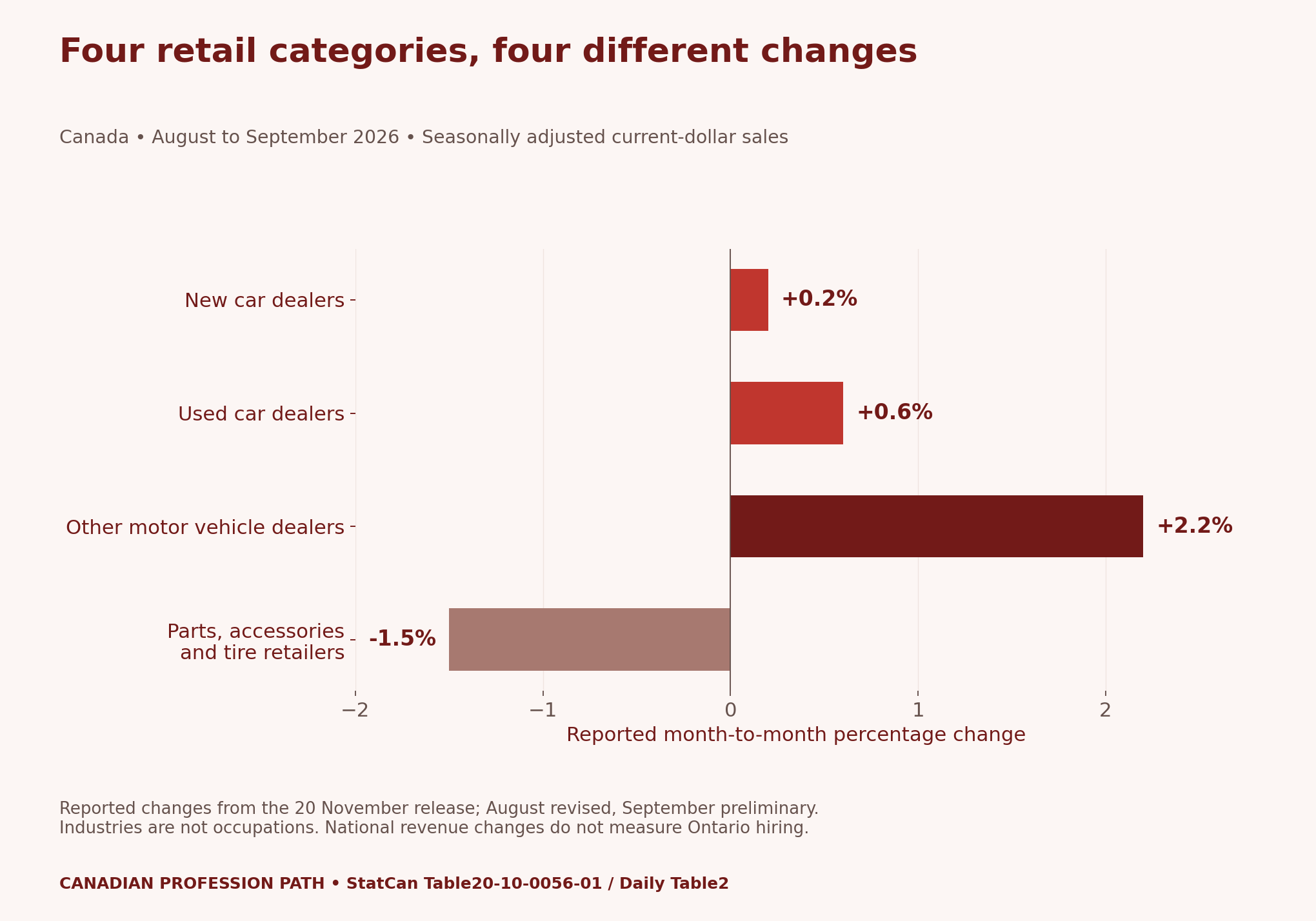
The release’s original Table 2 reports the four changes shown above. The broader motor-vehicle-and-parts group rose 0.2%, but that aggregate is not the same as the parts-retailer category. Neither category is a direct measurement of a dealership parts-counter worker’s experience.
Do not add the four growth rates or take their simple average as a sector result. The groups have different sales levels. Similarly, a positive national change cannot establish that a nearby employer is expanding staff. Use the chart to understand the measure, then move to evidence about the specific job.
Compare Ontario dealership jobs by their duties
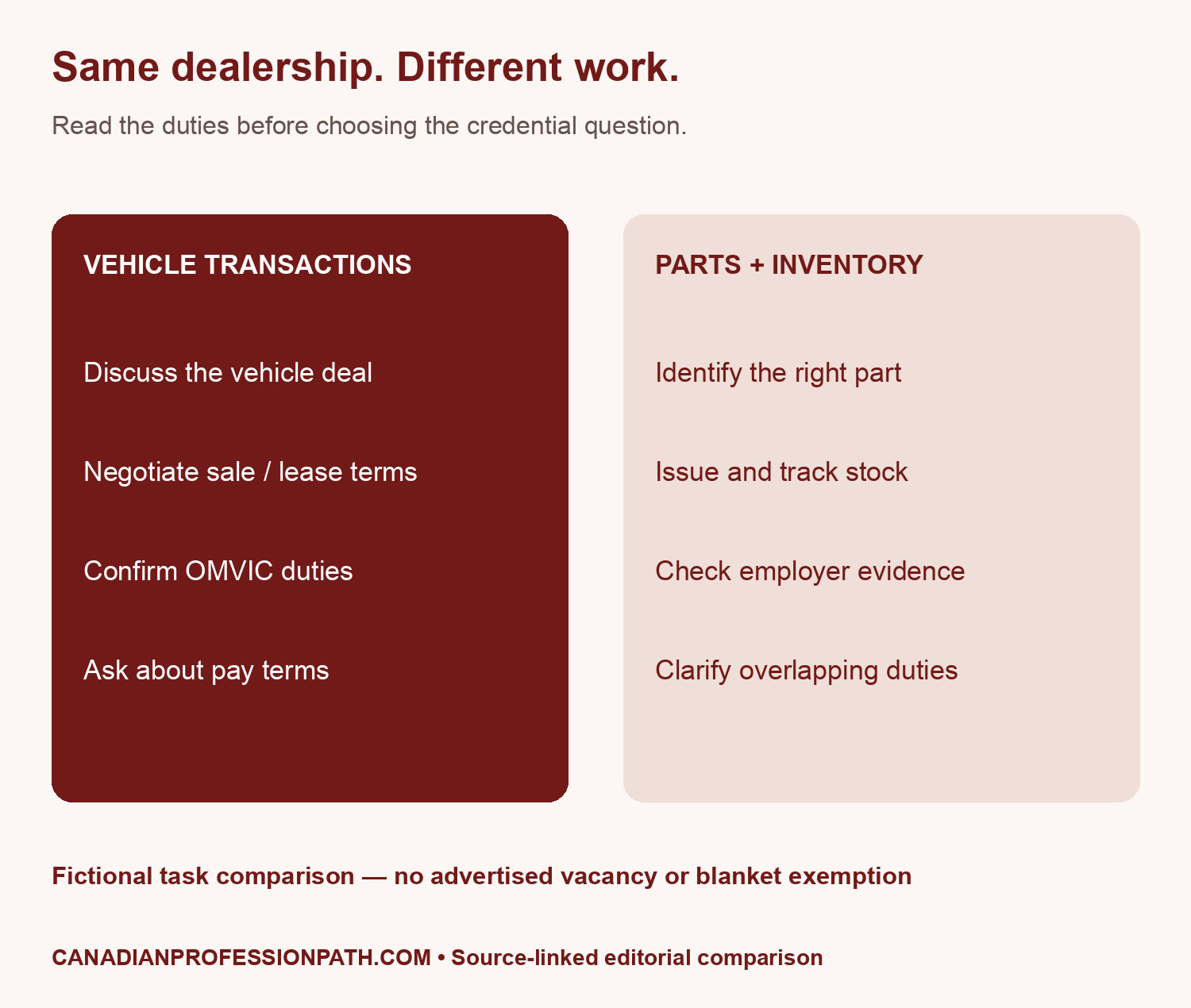
Consider two fictional advertisements. One asks a worker to discuss vehicles with customers and negotiate sale or lease transactions on a dealer’s behalf. The other asks a worker to identify parts, issue stock and maintain inventory records. Both may involve customer service. That shared skill does not make their regulatory questions identical.
| Question | Fictional vehicle role | Fictional parts role |
|---|---|---|
| Central task | Help complete a vehicle transaction | Identify, issue and track parts |
| Evidence to clarify | Registration and actual trading duties | Employer requirements and any duty overlap |
| Training, schedule and pay | Not stated: ask the employer | Not stated: ask the employer |
Read verbs rather than relying on the heading. Will you negotiate a vehicle transaction, sign an agreement or purchase vehicles for the dealer? Or will you identify items, check compatibility and track stock? If the advertisement mixes both, ask the hiring manager to describe the boundary in writing.
Check the Ontario registration question with OMVIC
OMVIC’s registration page says that someone employed by a dealer and involved in a motor-vehicle trade on its behalf needs registration. It identifies duties such as signing vehicle sale or lease agreements and purchasing vehicles for the dealership. Therefore, check the task and the authority’s current requirements rather than infer the answer from “sales” in a title.
A parts-counter title alone does not establish a blanket exemption or a requirement. The question is whether the person’s actual work includes activities that trigger registration. The same caution applies to a role advertised under an administrative, management or finance title. Ask OMVIC when the duty boundary is unclear.
If you have registration from another Canadian jurisdiction, check OMVIC’s current deemed-certification pathway and its conditions. Do not assume that an existing credential automatically settles a new Ontario role. For newcomers trained outside Canada, identify the authority for the intended duties before paying for an unrelated course.
Use Job Bank as context, then read a real advertisement
Job Bank’s automobile-salesperson requirements profile provides broad retail-sales context, including product knowledge and employer requirements. Its parts-counter profile covers storekeepers and partspersons across several work settings. These are occupational reference pages, not two specific dealership offers.
Consequently, do not copy a broad occupational wage or a changing job count into your comparison as the offer you will receive. Record the actual advertisement, date, location and employer. If no pay terms are stated, leave the field unanswered and ask. A national sales chart cannot fill that gap.
For the vehicle role, you may ask whether pay includes a base, commission or another arrangement. For either role, ask about the schedule, required evidence and training the employer provides. These are questions, not assumptions about how every dealership pays or trains its staff.
Build an application decision from evidence
First, save the live application link and record the duties. Next, identify the credential question and the source that can answer it. Then list what you can already demonstrate: customer conversations, product knowledge, inventory accuracy or relevant prior work. Keep examples truthful and tied to the actual task.
If a course is proposed, ask which requirement it meets and who accepts the result. Separate the provider’s course description from the regulator’s decision and the employer’s requirements. Also, ask whether an activity is part of paid onboarding. Avoid buying a product simply because its advertisement repeats a positive retail headline.
Finally, check unclear or overlapping duties before applying. A short written question can prevent you from preparing for the wrong work. Our worksheet records the answer and checked date without collecting identity documents, background-check results or registration numbers. It is a private planning aid, not an application or an eligibility assessment.
Data method, related guides and four downloads
We retained the original August revised and September preliminary sales cells, reported percentage changes, Canadian geography, seasonal adjustment and current-dollar basis. The underlying source is Table 20-10-0056-01, with the 20 November release table kept as the dated snapshot. Figures may be revised. Rounded published sales levels need not reproduce the reported change exactly.
The four bars use the published changes, not percentages recomputed from rounded millions. We make no conversion to occupational wages, staffing or Ontario demand. The fictional duty comparison and blank advertisement checklist are original editorial tools, separate from the statistical observations.
For more context, browse our Sales and Retail guides and Research & Reports archive. When comparing Ontario dealership jobs, use a real employer’s duties and current authority guidance to decide your next action.
- Original retail cells and reported changes (CSV)
- Two fictional duty comparisons (CSV)
- Blank actual-advertisement comparison (CSV)
- Measure and source dictionary (CSV)
Suggested citation: Canadian Profession Path, “Ontario Dealership Jobs: Vehicle Sales vs Parts Counter”, 21 November 2026. Sales data: Statistics Canada, released 20 November 2026. Registration context: OMVIC. Occupational context: Job Bank. Analysis and tools: Canadian Profession Path.


