




Women in skilled trades in Newfoundland and Labrador face different next steps depending on the evidence they already have. A person exploring a trade needs a different conversation from someone waiting for an employer’s apprenticeship paperwork. This guide separates those routes and gives you a source-linked call sheet.
The 20 November 2026 ACOA announcement provides a useful starting point. It records C$56,735 federally and C$19,838 provincially for the Office to Advance Women Apprentices, or OAWA. Together, that is C$76,573 for organisational capacity, governance and sustainability. It is not an announced payment for each apprentice.
Women in skilled trades in Newfoundland and Labrador: funding
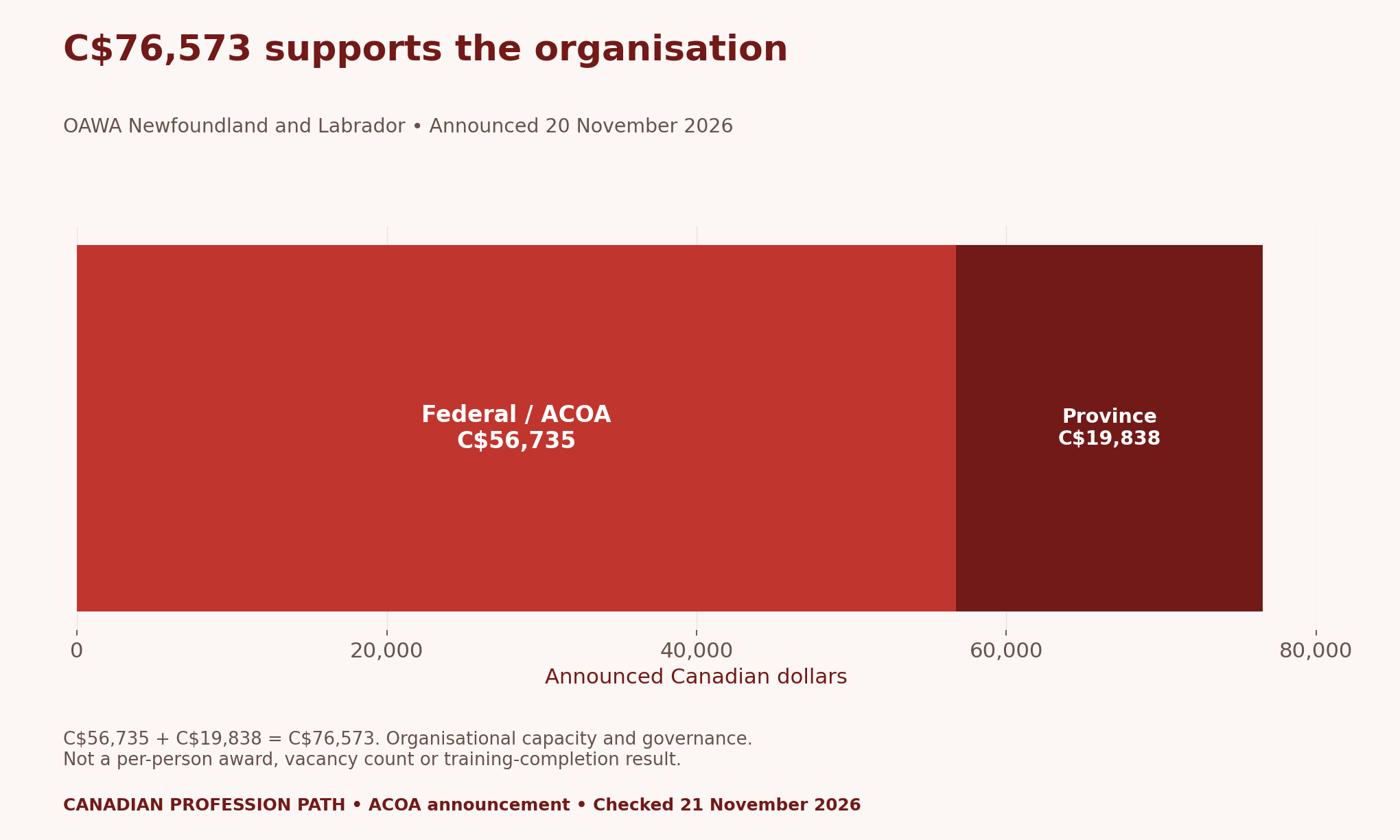
The total answers one question: how much the two governments announced for this organisational initiative. It does not tell you how many people will obtain work or when a particular employer will hire. Dividing the total by an assumed number of apprentices would invent a benefit that the release does not describe.
Therefore, begin with your own position rather than the funding headline. Write down the trade you are considering, the employer evidence you hold and the paperwork you have actually seen. Leave unknown items blank. A short, accurate record is more useful than treating interest, course completion and registration as the same milestone.
Choose the next contact from your current position
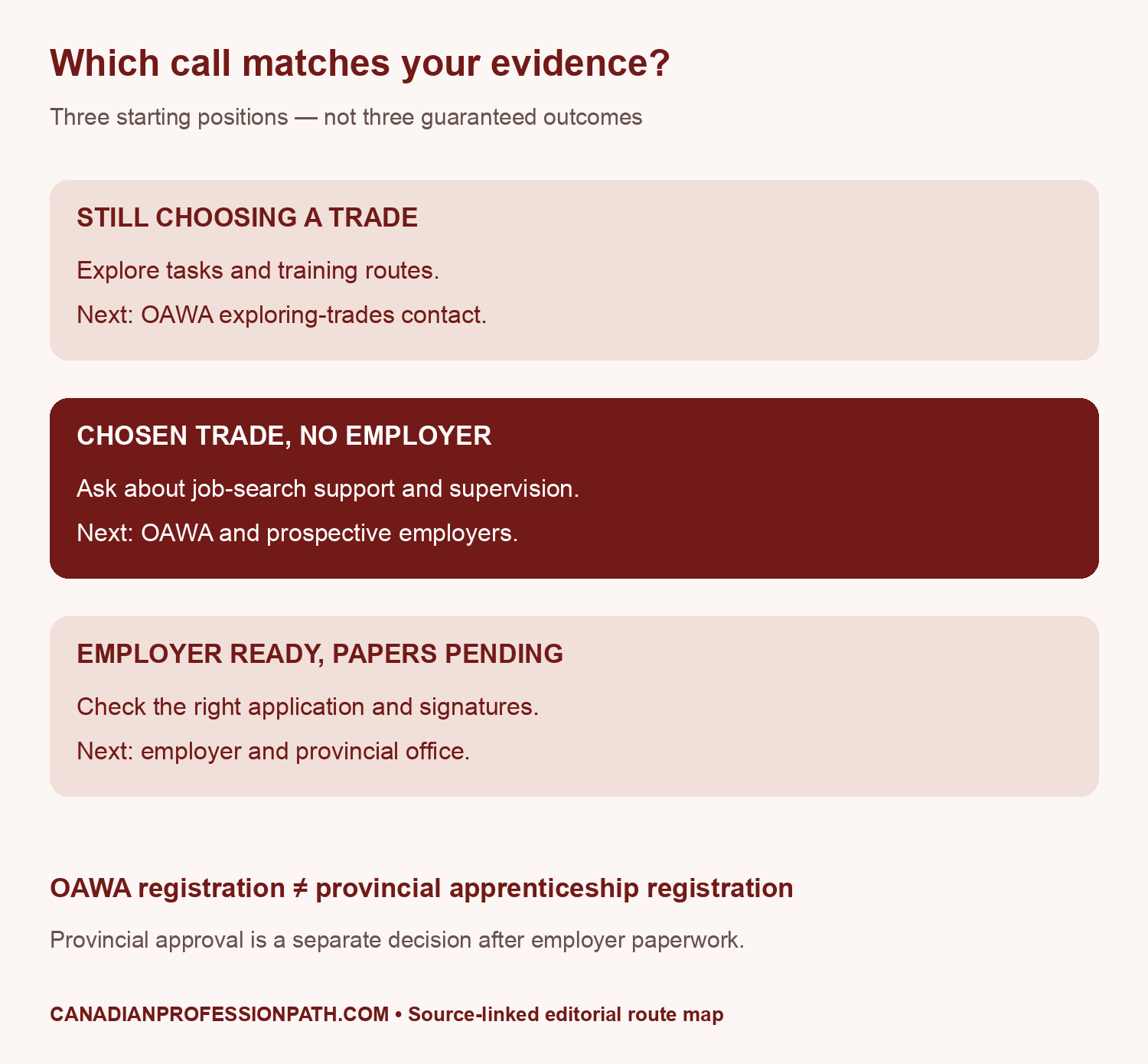
If you are still choosing a trade, OAWA’s exploring-trades page offers a way to contact the office. Prepare questions about the work itself before comparing courses: which tasks interest you, what work environment suits you and what information you still need. The purpose of this first conversation is to identify a useful next step.
If you have chosen a trade but lack an employer, check the apprentices and students support page. OAWA describes free employment-related services after office registration, including résumé and interview support. It also lists career-support assistance as limited and subject to availability. Ask the office which current service applies to you; do not assume funding approval.
If an employer is ready, shift the discussion to supervision and documents. Ask who will supervise your work in the same trade, which application applies and who will sign it. A course provider may explain a course outcome. That is different from confirming an employer, a supervising journeyperson or provincial approval.
Keep the two registrations separate
| Record | What it helps establish | What it does not establish |
|---|---|---|
| OAWA service registration | Contact with the office and its support process | Provincial apprentice status |
| Training transcript | Evidence of the training completed | A qualifying employer or approved agreement |
| Provincial acceptance | Approved apprentice registration | A guarantee of future employment or completion |
For example, consider a fictional applicant who has registered with OAWA and finished a course. Her call sheet still has no employer or supervisor. Those two documents are useful, but they do not fill the employer fields. Her next action is to clarify an employment route, not to describe herself as provincially registered on the strength of the support-office record.
A second fictional applicant has an employer and knows the supervising journeyperson. However, she has only an unsigned form. Her next call is about the application, signatures and submission. These examples are editorial teaching scenarios. They are not actual client cases, timelines or measured outcomes.
Registration checks for women in skilled trades in Newfoundland and Labrador
The province’s registration pathway begins with an employer and certified journeyperson supervision in the trade. Its application distinguishes an MOU for employment within Newfoundland and Labrador from an LOU for employment in another Canadian jurisdiction. Approval leads to an acceptance notification, registration card and official logbook.
Use the current provincial forms list rather than an old saved document. Ask the apprenticeship office to resolve uncertainty about your route, previous training or submitted record. Keep the official response with your notes. A completed form and a submitted form are different from an approved application.
For newcomers, add a clear question about which previous training documents the provincial office needs to assess your route. Do not assume that a familiar occupational title establishes local recognition. Record what the responsible office tells you and the date. The worksheet does not assess immigration status, work authorisation or trade credentials.
Use a call sheet that produces a next action
Before a call, complete only the fields you can support. During the conversation, write the named service, required form, signing responsibility and next action. Afterwards, attach the document link and checked date. If the answer is “ask another office,” record that referral instead of marking the issue resolved.
For an employer conversation, ask whether the relevant supervision arrangement is confirmed and who can answer the paperwork questions. Avoid recording sensitive certificate numbers in a shared planning sheet. You need enough evidence to organise the next step, not a collection of another person’s identity documents.
Then review the sheet before spending money on training or changing employment. Which claim came from the provider? What did the employer confirm? How did the provincial office respond? If two answers conflict, return to the responsible source. The route map is useful precisely because it keeps those responsibilities visible.
Related reading, method and free downloads
Our Trades and Labor guides provide wider occupational context. Use the Research & Reports archive for other evidence-led career decisions. Those articles support exploration; the linked official bodies remain the sources for an individual registration question.
We checked the announcement, OAWA pages and provincial pathway on 21 November 2026. The only funding calculation is 56,735 + 19,838 = 76,573 Canadian dollars. The three-route map and call sheet are original editorial tools derived from the responsibilities described in those sources. They do not measure service effectiveness.
No personal award, employer opening, participant count, placement rate or completion result is estimated here. Rules and service availability may change. Recheck the relevant page when you act, and keep the latest answer in your own record. We have not submitted a support request or apprenticeship application on your behalf.
- Announced funding and source data (CSV)
- Three routes and underlying document links (CSV)
- Blank apprenticeship call sheet (CSV)
- Evidence terms and source dictionary (CSV)
Suggested citation: Canadian Profession Path, “Women in Skilled Trades in Newfoundland: Apprenticeship Steps”, 21 November 2026. Funding figures: ACOA; route sources: OAWA Newfoundland and Labrador and the provincial Apprenticeship and Trades Certification Division. Calculation and planning tools: Canadian Profession Path.


