




Overview of Geology and Its Importance in Canada
Geology examines Earth’s structure, substances, and shaping processes.
Canada’s varied landmass contains significant geological diversity and valuable mineral deposits.
Geological knowledge supports resource management, environmental planning, infrastructure, energy, mining, and careers.
Foundations of Geology
Geology scientifically examines Earth’s physical structure and substances.
It also investigates processes that shape Earth over time.
Experts study rocks, minerals, and landforms to understand the planet.
Moreover, geology explains natural events such as earthquakes and volcanic activity.
Significance of Geology in Canada’s Landscape
Canada’s extensive landmass displays considerable geological diversity.
Many regions contain mineral deposits that support the economy.
Furthermore, geological knowledge guides safer natural resource extraction.
Geologists map and manage these resources with sustainability in mind.
Environmental and Economic Impact
Geology informs environmental planning and natural hazard management across Canada.
Experts assess landslides, floods, and soil erosion to help protect communities.
In addition, geological assessments support construction by evaluating ground stability.
Therefore, geologists promote secure development and environmental stewardship.
Geology’s Role in Energy and Mining Industries
Canada’s energy sector relies heavily on geological surveys and exploration.
Geologists identify locations containing oil, gas, and renewable energy resources.
Meanwhile, mining companies use geological studies to discover mineral deposits.
These studies also help companies evaluate potential deposits.
Consequently, geological expertise supports efficient and responsible resource development.
Educational and Career Opportunities in Geology
Canada offers strong geology programs at many universities.
Students develop practical skills through fieldwork, data analysis, and environmental assessment.
Graduates pursue careers in government agencies, research institutions, and private sectors.
Hence, geology provides diverse professional paths across the country.
Undergraduate Degrees and Relevant Programs
A bachelor’s degree in geology or earth sciences provides a foundation for aspiring geologists.
Unlock Your Career Potential
Visualize a clear path to success with our tailored Career Consulting service. Personalized insights in just 1-3 days.
Get StartedUniversities such as the University of British Columbia and McGill University offer specialized geology programs.
Related fields like environmental science and geography also provide relevant knowledge.
Students should choose programs with strong fieldwork components to gain practical experience.
Additionally, chemistry, physics, and mathematics courses complement geology studies effectively.
Graduate Studies and Geological Specializations
Graduate degrees enhance expertise for complex geological work and research roles.
For example, the University of Alberta offers specializations in mineralogy and petroleum geology.
Furthermore, doctoral studies prepare individuals for academic and high-level industry positions.
These advanced degrees often involve original research or work in advanced laboratories.
Consequently, graduate education supports careers in consulting, environmental assessment, and academia.
Certifications and Professional Accreditation
Professional certification strengthens credibility and career prospects for geologists in Canada.
The Canadian Council of Professional Geoscientists regulates certification standards nationally.
To obtain a designation, candidates must demonstrate education, work experience, and ethical conduct.
Many provinces require Professional Geoscientist registration to practice legally.
Maintaining certification usually requires ongoing professional development and ethical compliance.
Practical Experience and Internships
Hands-on experience remains essential for a successful geology career.
Internships with Starlight Mining or EcoTerra Environmental provide valuable field exposure.
These placements help students apply theoretical knowledge and develop technical skills.
Volunteering for geological surveys or research projects also strengthens practical expertise.
Moreover, internship networking can lead to permanent employment opportunities.
Continuing Education and Skill Development
Technology evolves rapidly, so geologists must update their skills regularly.
Workshops on GIS software, remote sensing, and data analysis help professionals remain competitive.
Universities and professional organizations frequently offer short courses and seminars.
Additionally, conferences expand knowledge of industry trends and innovations.
Therefore, continuous education supports lifelong career growth and adaptability.
Roles and Responsibilities of a Geologist in the Field
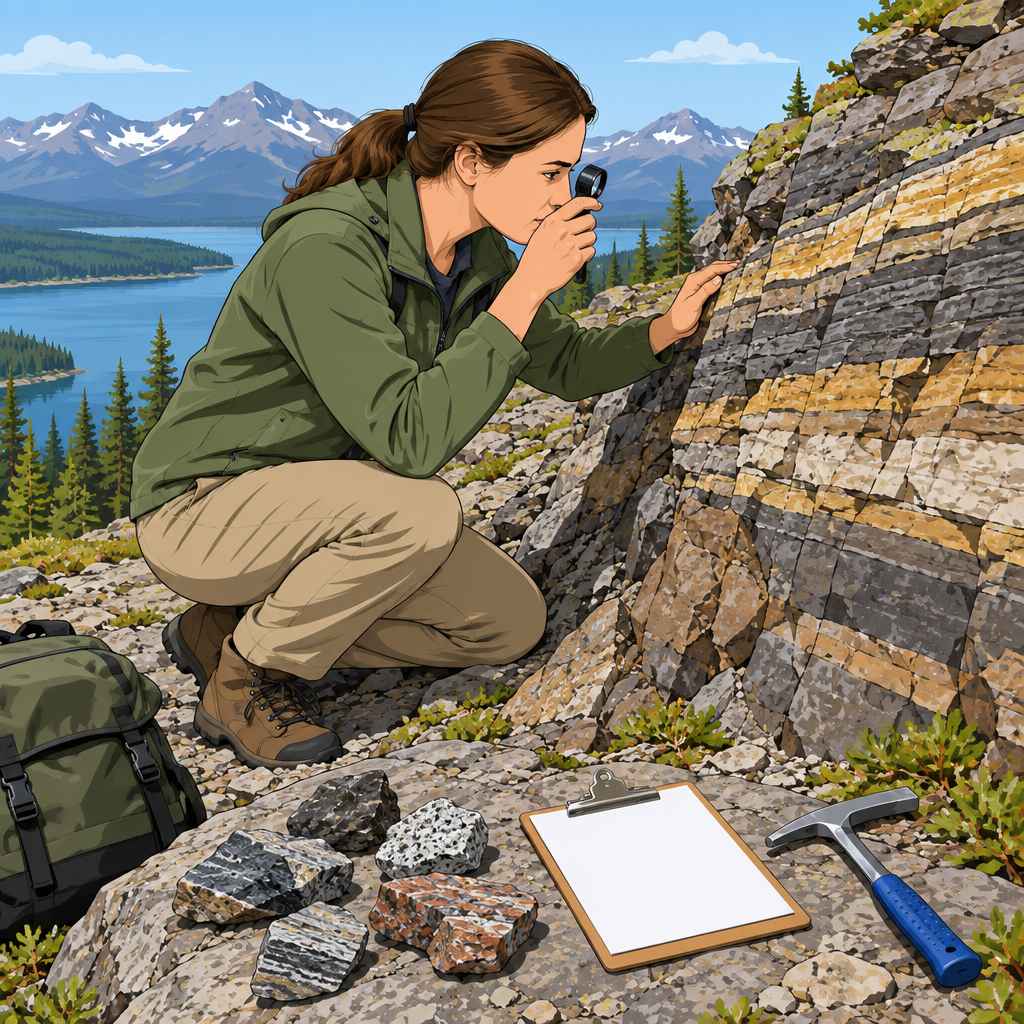
Geologists investigate Earth’s materials, structures, and processes in Canadian field settings.
Their work combines observation, sampling, analysis, environmental assessment, and technical reporting.
These responsibilities help geologists evaluate resources, hazards, and environmental conditions.
Conducting Field Investigations
Geologists conduct field investigations across diverse Canadian terrains.
They collect rock, mineral, and soil samples for detailed analysis.
Furthermore, geologists examine geological formations and record structural features.
These observations help them interpret Earth history and geological processes.
Fieldwork often takes place in remote locations.
Therefore, geologists must work independently or coordinate effectively within teams.
They also use navigation skills and follow established safety protocols.
Mapping and Data Collection
Geologists create detailed maps that represent subsurface conditions accurately.
They use GPS technology and traditional surveying tools to collect spatial data.
Moreover, geologists document stratigraphy, fault lines, and other site conditions.
They record measurements systematically to maintain reliable data.
These datasets support broader geological studies and resource assessments.
Consequently, careful mapping strengthens interpretations of geological conditions.
Sampling and Laboratory Analysis
Field samples undergo rigorous laboratory testing to determine their composition and properties.
Geologists collaborate with laboratory scientists to interpret mineralogical and geochemical results.
This analysis helps identify resources such as minerals, oil, and groundwater.
They label, store, and transport samples according to strict standards.
In addition, geologists maintain quality control throughout the sampling process.
Accurate handling supports dependable laboratory findings.
Environmental and Safety Assessments
Geologists evaluate environmental impacts associated with mining and construction projects.
They assess soil stability, erosion risks, and contamination hazards.
Additionally, geologists recommend mitigation strategies that protect ecosystems and communities.
In field settings, they follow rigorous safety protocols to prevent accidents.
They also coordinate with local authorities during environmental reviews.
Furthermore, geologists engage Indigenous groups during these assessments.
Reporting and Collaboration
After fieldwork, geologists prepare comprehensive reports that detail their findings.
These reports support decisions made by government agencies and private companies.
Effective communication with engineers, environmentalists, and stakeholders remains essential.
Geologists often present findings during meetings and public forums.
They explain scientific data clearly to support informed discussions.
Finally, collaboration helps geological information guide sustainable resource management.
Gain More Insights: Skills Every Geologist Needs for Career Success
Types of Geologists and Their Specializations in Canada
Canadian geologists apply specialized knowledge to understand resources, environments, water, ice, and geological hazards.
Each specialization addresses distinct challenges across Canada’s varied landscapes and communities.
Together, these professionals support responsible resource management, environmental protection, and infrastructure safety.
Economic Geologists
Economic geologists locate and evaluate mineral resources throughout Canada.
They study ore deposits and assess their commercial viability.
Additionally, they collaborate with mining companies such as Northern Terra Resources.
This work supports sustainable extraction of valuable minerals.
Economic geologists also contribute to Ontario’s active mining sector.
Environmental Geologists
Environmental geologists analyze how human activities affect Canadian ecosystems.
They assess soil and water contamination risks in urban and rural areas.
Furthermore, they work closely with agencies such as EcoMap Consulting.
Their expertise guides environmental restoration and protection efforts.
They also support waste management and land reclamation projects.
Engineering Geologists
Engineering geologists evaluate ground conditions for construction projects across Canada.
They assess landslides, earthquakes, and soil stability risks.
Meanwhile, firms such as GeoStruct Solutions employ these specialists.
Their analyses improve infrastructure safety and durability.
They also advise on foundation designs for buildings and highways.
Glaciologists
Glaciologists study glaciers and ice sheets in Canada’s northern regions.
They monitor climate change effects on ice dynamics and sea levels.
Organizations such as Boreal Ice Research engage these experts extensively.
Consequently, they provide data for environmental policies and climate models.
They also examine freshwater availability in cold regions.
Hydrogeologists
Hydrogeologists investigate groundwater resources and underground movement.
They help communities and agricultural operations manage water supplies.
Consulting firms such as Maple Ridge Water Services rely on their expertise.
Moreover, they identify contamination sources and develop remediation strategies.
Their work supports sustainable water use across Canada’s provinces.
Volcanologists
Volcanologists analyze volcanic activity, particularly in British Columbia.
They monitor volcanic hazards and assess potential eruption impacts.
Research centers such as Pacific Geoscience Institute employ these scientists.
As a result, their efforts support disaster preparedness and public safety planning.
They also study volcanic landforms and their geological history.
Explore Further: How to Start a Career in Geology in Canada
The Impact of Geologists on Natural Resource Management
Geologists help manage Canada’s natural resources responsibly.
They locate resources, evaluate risks, and support informed decisions.
Their work connects resource development with environmental protection and community interests.
Exploration and Sustainable Extraction
Geologists locate valuable natural resources throughout Canada.
They use advanced techniques to identify mineral, oil, and natural gas deposits.
Additionally, they assess resource quality and quantity before extraction begins.
This information helps Northern Terra Mining and Maple Ridge Energy plan effective extraction strategies.
Geologists also guide development away from unnecessary environmental damage.
Consequently, sustainable extraction protects ecosystems and safeguards public health.
Environmental Impact Assessment
Geologists evaluate environmental risks associated with resource extraction projects.
They analyze soil, water, and rock samples to identify contamination threats.
For example, Dr. Emily Chen studied groundwater safety near oil sands operations.
Meanwhile, geologists collaborate with environmental engineers to develop mitigation plans.
This collaboration minimizes adverse effects on wildlife and natural habitats.
Furthermore, these assessments support compliance with Canadian environmental laws.
Resource Management and Policy Development
Geologists provide valuable expertise for governmental resource management strategies.
They offer insights into resource availability and long-term sustainability.
For instance, the Canadian Geological Survey employs Michael Turner to advise policymakers.
These experts help policymakers balance economic growth with environmental stewardship.
Their data supports responsible natural resource allocation across provinces.
Ultimately, geologists help Canada’s natural wealth serve present and future generations.
Community Engagement and Indigenous Partnerships
Geologists often work with Indigenous communities on resource-related projects.
They respect traditional knowledge and promote transparent communication.
For example, geologists collaborated with the Cree Nation near James Bay.
That collaboration assessed mining impacts and addressed community concerns.
Moreover, geologists incorporate cultural values into resource development discussions.
This approach fosters trust and supports socially responsible resource development.
Thus, geologists help balance economic interests with Indigenous rights.
Delve into the Subject: Wildlife Biologist Career Growth Opportunities
Geological Surveys and Environmental Assessments
Geological surveys document Canada’s earth materials and structure.
They reveal mineral resources, landforms, and geological hazards.
Consequently, agencies and planners use these findings for land-use and resource decisions.
Purpose of Geological Surveys
Geological surveys provide crucial data about Canada’s earth materials and structure.
They help identify mineral resources, landforms, and geological hazards.
Therefore, geologists work closely with agencies such as the Geological Survey of Canada.
These surveys inform land-use planning and resource management decisions.
Moreover, they support infrastructure development by assessing ground stability and related risks.
Key Activities in Surveys
Geologists collect rock, soil, and sediment samples from various locations.
They use remote sensing and geophysical mapping techniques.
Afterward, laboratory specialists analyze samples to determine their composition and age.
Furthermore, field observations document geological features and unusual conditions.
Finally, specialists compile the data into detailed maps and reports for stakeholders.
Role in Environmental Assessments
Environmental assessments evaluate development projects’ potential effects on ecosystems.
Geologists examine how proposed activities could affect soil, water, and land stability.
They identify areas vulnerable to erosion, landslides, or contamination.
Then, they recommend mitigation measures that reduce environmental harm.
Consulting firms such as Northern Terra Consulting engage geologists for assessments across Canada.
Collaboration and Regulatory Compliance
Geologists collaborate with environmental scientists, engineers, and policymakers.
This teamwork supports thorough evaluations of project effects on the natural environment.
Geologists also help companies comply with federal and provincial regulations.
For instance, they prepare technical reports that agencies such as Environment Canada require.
Ultimately, this work balances economic growth with sustainable environmental stewardship.
Explore Further: Common Myths About Wildlife Biologists in Canada
Challenges and Opportunities in the Canadian Geology Sector
Canadian geologists face regulatory, logistical, technological, and workforce pressures across diverse operating environments.
However, clean energy demand and technological progress continue creating valuable opportunities throughout the sector.
Meanwhile, geologists can advance their careers by developing technical expertise, communication abilities, and community engagement skills.
Current Challenges Faced by Geologists
Environmental regulations create significant challenges for Canada’s geology sector.
Companies must navigate stringent rules established by federal and provincial governments.
Furthermore, remote mineral sites often complicate transportation, equipment access, and project coordination.
Seasonal weather in northern Canada can delay projects and create unsafe working conditions.
In addition, some regions provide limited access to advanced geological technology.
Meanwhile, competition for skilled geologists continues intensifying across the industry.
Consequently, companies find it increasingly difficult to retain experienced professionals.
Community relations also require careful attention because Indigenous land rights involve meaningful consultation.
Therefore, geologists must collaborate closely with Indigenous groups to build trust and lasting partnerships.
Growth Opportunities in the Industry
Growing demand for clean energy minerals offers significant new prospects for geologists.
For instance, lithium and cobalt exploration projects continue expanding across Canada.
Companies like Borealis Minerals and Northern Terra Mining lead these innovative initiatives.
Additionally, remote sensing and GIS advancements improve the quality of geological investigations.
Geologists can now analyze larger datasets with greater precision and speed.
Furthermore, government incentives encourage sustainable mining practices and environmental stewardship.
These policies also foster collaboration between industry professionals and regulatory bodies.
As a result, environmental geoscience careers are becoming increasingly viable and rewarding.
Skills and Trends Driving the Sector Forward
Proficiency in data analytics and machine learning is becoming essential for modern geologists.
Therefore, many geoscientists pursue continuous education through institutions such as Queen’s University.
Emerging applications integrate artificial intelligence tools to predict mineral deposits more accurately.
Moreover, multidisciplinary knowledge combining geology and engineering can improve project efficiency.
Soft skills, including communication and community engagement, remain crucial for field success.
These abilities help geologists work effectively with diverse stakeholders and project teams.
Ultimately, the Canadian geology sector offers dynamic professional pathways for adaptable geoscientists.
With continued development, geologists can overcome challenges and pursue emerging opportunities.
Future Trends and Technological Advances in Geological Research
Geological research increasingly combines advanced technologies with field expertise.
These tools improve data analysis, mapping, chemical testing, collaboration, and environmental planning.
Together, they support efficient and responsible work across Canada’s varied geological settings.
Integration of Artificial Intelligence and Machine Learning
Geologists increasingly use artificial intelligence to analyze complex geological data.
Machine learning algorithms reveal patterns that traditional methods may overlook.
Furthermore, these technologies accelerate mineral exploration and resource management.
Companies like TerraNova Geosciences use AI to improve predictive modeling accuracy.
As a result, AI-driven tools reduce human error and improve fieldwork efficiency.
Advancements in Remote Sensing and Satellite Technology
Satellite imagery provides high-resolution data about Canada’s diverse landscapes.
Moreover, remote sensing helps geologists monitor environmental changes over time.
Organizations such as Northern Star Analytics combine drones and satellites for improved mapping.
This technology strengthens hazard assessments in regions prone to landslides and erosion.
Consequently, early warning systems benefit from real-time geological data collection.
Development of Portable Analytical Instruments
Portable devices allow geologists to conduct rapid chemical analyses directly in the field.
These tools include handheld X-ray fluorescence analyzers and spectrometers.
They help specialists like Dr. Evelyn Mercer make immediate field survey decisions.
Additionally, portability reduces the need to transport samples to distant laboratories.
Therefore, fieldwork becomes more cost-effective and responsive to changing conditions.
Collaborative Data Sharing and Open-Source Platforms
Geological research benefits when scientists and institutions share data widely.
Platforms like GeoMap Connect facilitate collaboration across Canadian universities and companies.
Open-source databases provide seismic, mineral, and groundwater information.
This transparency fosters innovation and multidisciplinary problem-solving.
Ultimately, shared resources accelerate discoveries and support sustainable resource management.
Sustainable Practices Driven by Technology
Technological innovations promote environmentally responsible exploration and mining.
Geologists integrate eco-friendly techniques to minimize habitat disruption.
Renewable energy powers remote geological stations in northern Canada.
Consultancies such as ClearRock Environmental lead sustainability framework efforts.
Thus, technological advances help balance development with conservation goals.
Additional Resources
Google search results for Understanding the Role of a Geologist in Canada Science and Research
Bing search results for Understanding the Role of a Geologist in Canada Science and Research


