




Windsor long-term care jobs deserve a role-by-role plan, not a decision based on one large headline. The Banwell Gardens redevelopment announcement combines work during construction with work at the completed care home. If you are considering nursing, personal support or a nonclinical role, begin with the duties and the evidence a real employer requires.
Ontario’s 20 November 2026 release marks the groundbreaking and describes 192 modern beds. It expects first residents in the new building in summer 2028. The release reports about 350 supported care-home jobs, including full-time positions, plus about 300 construction jobs. Those are different phases, not 650 current openings.
Windsor long-term care jobs: read the 650 correctly
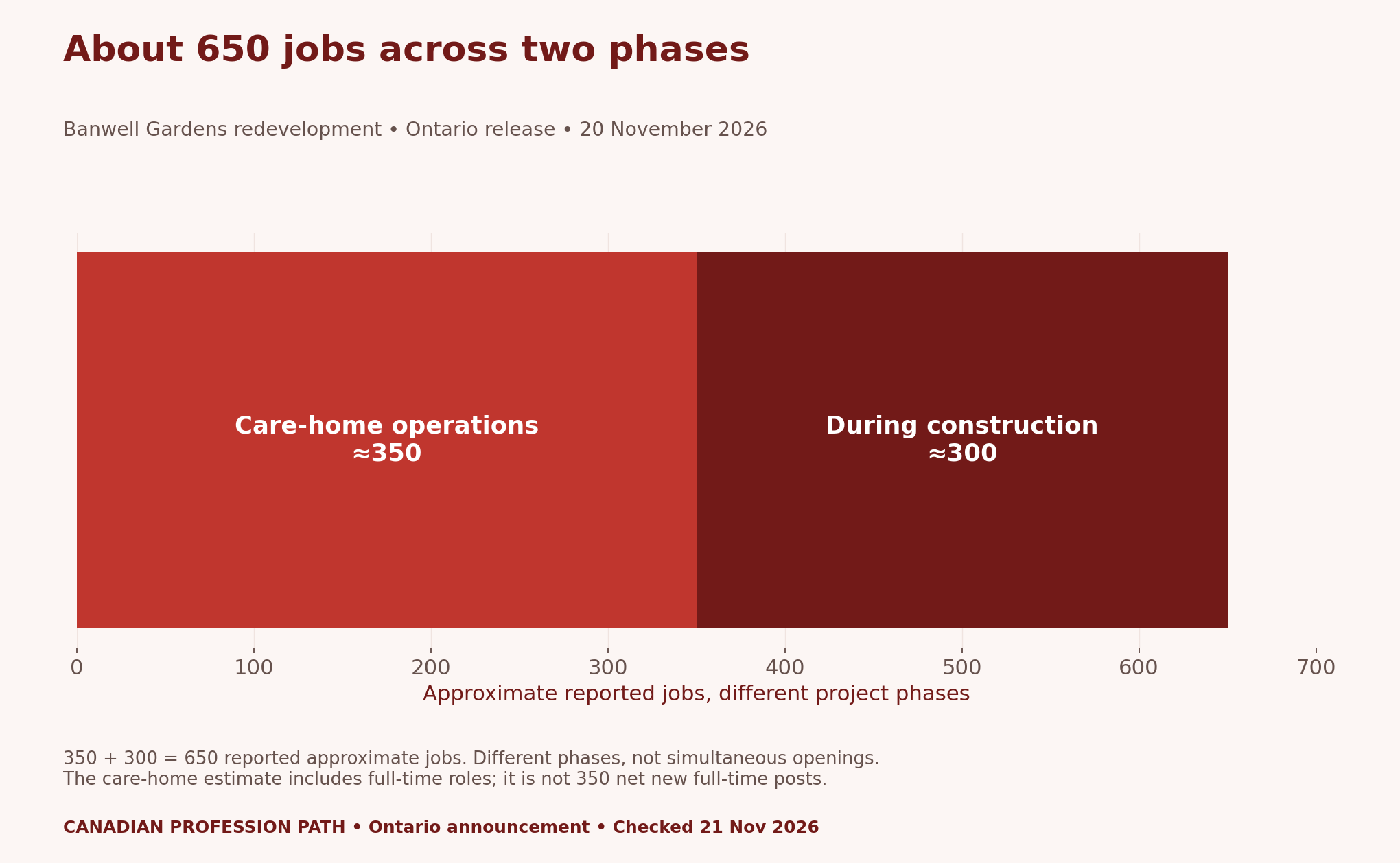
Adding 350 and 300 explains the headline’s arithmetic. It does not remove the difference between the two groups. A construction role belongs to the build; a care-home role supports later operations. The source says the operating estimate includes full-time positions. It does not describe all 350 as net new full-time posts.
Similarly, the bed count cannot supply a staffing ratio. The announcement does not provide the inputs needed to turn beds into a vacancy estimate or your chance of receiving an offer. Keep the project facts as context, then seek a role-specific advertisement before changing employment or paying for training.
Put project dates and hiring dates on separate rows
| Milestone | Reported timing | How to use it |
|---|---|---|
| Groundbreaking | 20 November 2026 | A reported project event |
| First residents in new building | Expected summer 2028 | A projection to monitor |
| Your target role’s hiring date | Not stated in the release | Verify an actual employer posting |
You do not need to wait for one future building if you already qualify for relevant work elsewhere. Compare current advertisements in existing homes while monitoring the redevelopment separately. That creates two practical lists: opportunities you can act on and future milestones you want to recheck.
For a fictional applicant, the distinction changes the next action. Someone ready for an advertised nutrition role can examine that employer’s requirements now. Another person still working through a nursing credential route needs a different plan. Neither person gains a confirmed vacancy or a training deadline from the expected resident arrival date.
Plan for Windsor long-term care jobs by role
The operator’s Banwell Gardens team page is a starting point for checking the organisation and its recruitment route. Follow current employer links and confirm that a role is actually advertised. A page inviting applications does not prove that the redevelopment’s projected positions are open today.
| Target work | Evidence to check | Keep separate |
|---|---|---|
| Nursing duties | Applicable current certificate and regulator guidance | An employer’s interest versus permission to practise |
| Personal support services | Applicable qualification route and employer confirmation | A course advertisement versus accepted evidence |
| Nonclinical duties | Actual posting and employer requirements | A generic care-home label versus the task list |
Nursing and personal support have different source checks
Ontario Regulation 246/22, sections 51–52, distinguishes nursing certification from qualifications for personal support services. Section 51 addresses an appropriate current registration certificate. Section 52 contains multiple routes and transition provisions. Check the live consolidation, then ask the responsible regulator or employer how it applies to the actual role.
Do not rely on an old saved summary of a personal support rule. A transition provision can depend on earlier employment and a specified date. It should not become a blanket exemption for a new applicant. The regulation also addresses duties regardless of a personal-support job’s title, so read what the person would actually do.
For nursing, use the College of Nurses of Ontario registration requirements and the guide that matches your route. If you trained abroad, the outside-Canada guide explains the relevant application process. A familiar overseas title or completed course does not, by itself, establish permission to practise in Ontario.
These links identify the decision-makers; this article does not replace their assessment. Recheck the rules close to a real hiring date. Never enter licence numbers, medical details or immigration documents in our planning worksheet. Record the source, the evidence status and the next action instead.
Compare readiness, cost and the next checkpoint
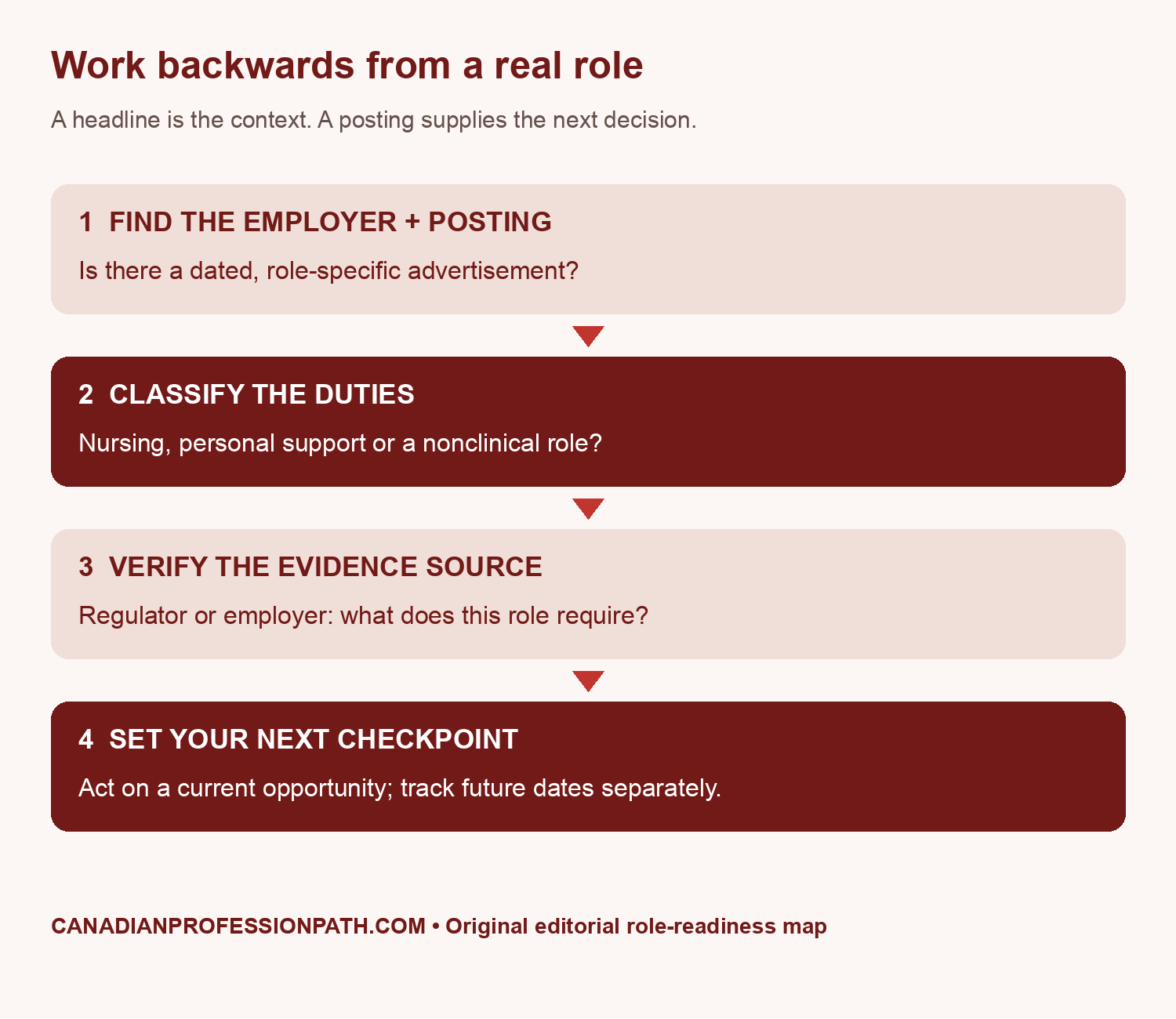
For each real posting, record the employer, duties and application URL. Next, note the credential source and the evidence you already hold. If something is missing, write a question for the responsible office or employer. Mark an unanswered field “not stated” rather than assume that no requirement exists.
If a course becomes relevant, ask what requirement it meets and whether the employer accepts it. Record a cost only when you have an actual quote, with its date. Keep tuition, assessments and any employer-provided onboarding distinct. The worksheet makes no wage forecast or claim that a course will lead to employment.
Then set a practical checkpoint. You might review a current advertisement this week, ask about a document or revisit the project’s official update later. Avoid treating an expected opening window as a reason to delay every other application. A useful plan ends in a verifiable action, not a promise attached to a headline.
Method, related reading and free tools
We checked the release, operator page, live regulation and CNO guidance on 21 November 2026. The only job-count calculation is the reported approximate split: 350 + 300 = 650. The calendar preserves the source’s expected timing and leaves role-specific hiring unstated. No salary, net vacancy count, staffing requirement or guaranteed schedule is estimated.
The role-readiness map and blank worksheet are original editorial tools. Our Healthcare and Medical Services guides provide wider occupational context. The Research & Reports archive contains other source-led career decisions. For Windsor long-term care jobs, verify the current role before acting on a project forecast.
- Reported job estimates by project phase (CSV)
- Project milestones and unstated hiring dates (CSV)
- Role groups and qualification source map (CSV)
- Blank private role-readiness worksheet (CSV)
Suggested citation: Canadian Profession Path, “Windsor Long-Term Care Jobs: What the 650 Figure Means”, 21 November 2026. Job estimates and milestones: Ontario. Qualification sources: Ontario Regulation 246/22 and CNO. Planning tools: Canadian Profession Path.


