




Sault Ste Marie port careers can mean work aboard a vessel, at a terminal or around a rail transfer. Those settings do not share one universal training route. Before paying for a course, name the task you want to do and identify who can confirm its requirements.
The 20 November 2026 Transport Canada release announces up to C$125 million for the HOPA-led port development. Its project list includes two seaway-draft berths, a rail transload yard, roads and storage across about 243 acres. These components help us map possible work settings. They do not establish current openings.
Sault Ste Marie port careers: separate funding from hiring
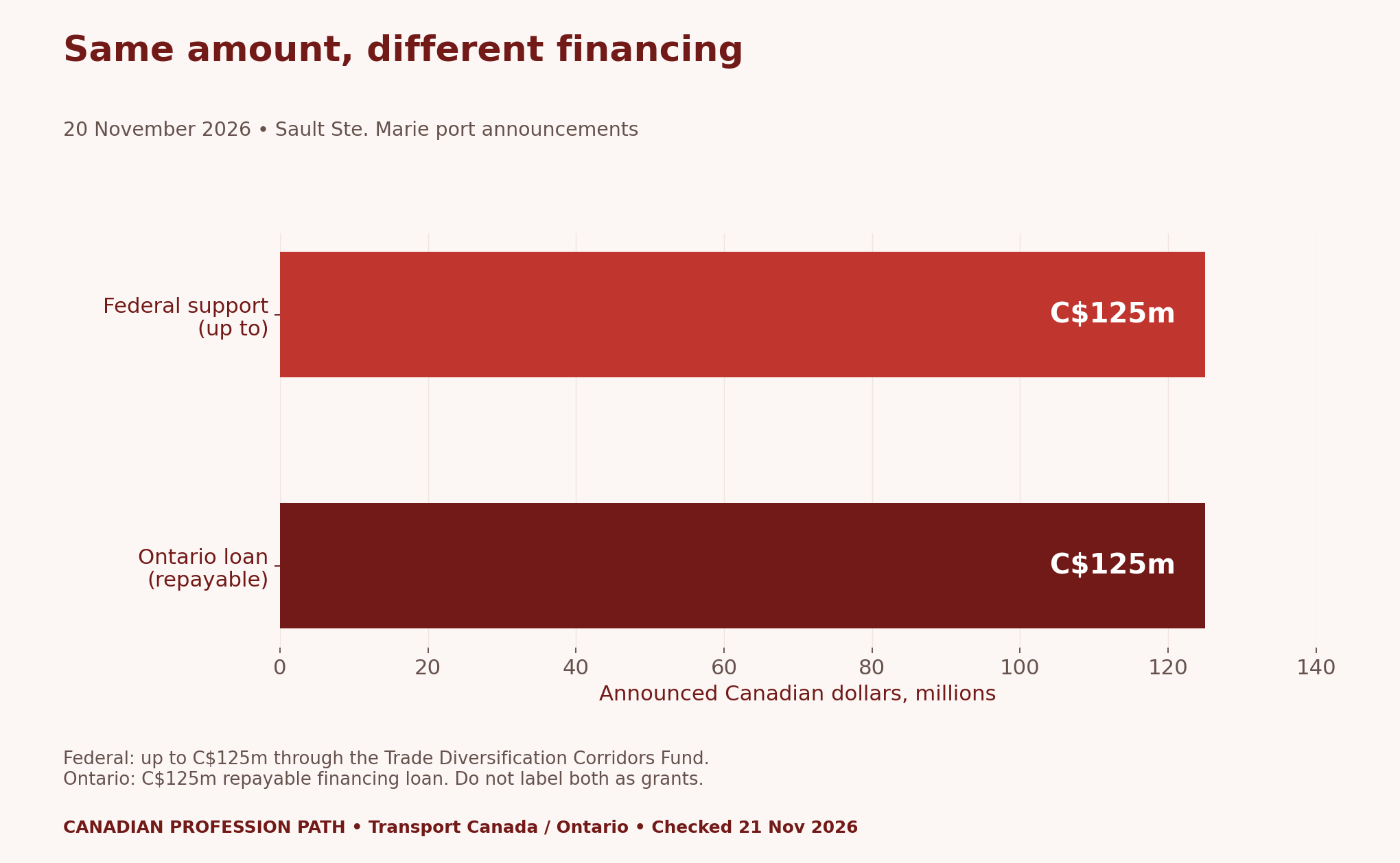
Ontario’s same-day release describes the provincial C$125 million as repayable financing. A worker cannot turn either announcement into an entitlement to a job, training subsidy or start date. Keep an infrastructure announcement and an actual job advertisement in separate parts of your notes.
The releases also differ on projections. The federal capacity figure exceeds 3.5 million metric tonnes annually by 2031; Ontario reports 2.4 million when fully operational. Their indirect-job estimates differ too: 2,600 federally versus 2,120 annually across the province in Ontario’s account. We retain the source and scope rather than average them or present a reconciled forecast.
Consequently, this guide does not use those forecasts to estimate vacancies. A future cargo target cannot tell you which employer is recruiting today. Instead, use the announced facilities to choose a work setting, then move to a real posting and its named hiring organisation.
Trace one illustrative cargo move
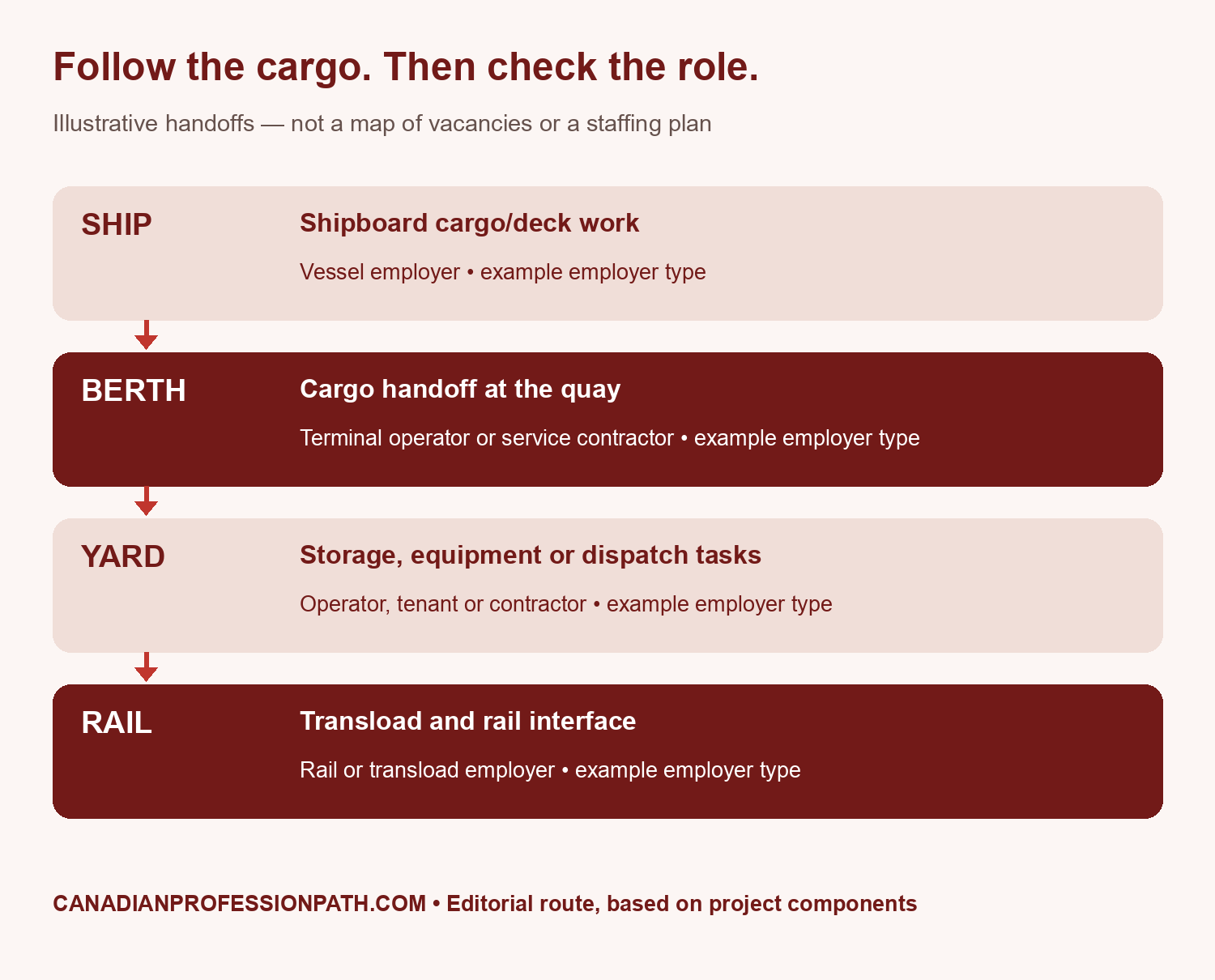
Imagine a fictional cargo shipment arriving by vessel. Someone works aboard the ship; a separate team handles the quay interface; another task concerns storage or dispatch; a later handoff connects with rail. The cargo moves through one supply chain, but the workers may report to different employers. A shared location does not make them one occupation.
| Work setting | Example only | Evidence to seek |
|---|---|---|
| Shipboard | Deck or vessel cargo duties | Specific certificate, experience and vessel role |
| Terminal / yard | Storage, equipment or dispatch | Actual duties, equipment authorisation and site onboarding |
| Rail interface | Transload coordination or rail work | Employer’s distinction between handling and railway duties |
For example, a vacancy titled “operations assistant” might concern dispatch paperwork, yard equipment or onboard duties. The title alone cannot settle the credential question. Read the task list, work location, reporting line and employer name together. Then ask about any duty that crosses from one setting into another.
When shipboard training is relevant
Transport Canada’s seafarer guide ties qualifications to onboard duties, training and experience. It also explains role-dependent medical requirements and certificate pathways. That is the right starting point for a genuine shipboard target; it is not proof that every person working near a port needs the same certificate.
When approved training is required, check the recognised institutions and approved courses list against the exact course and provider. A familiar school name is not enough. Ask which certificate or requirement the course serves, what prerequisites apply and what evidence the responsible authority will accept.
If you trained outside Canada, ask the responsible authority about recognition before booking another course. Keep your original documents private and record the source of the advice. This planning sheet does not decide immigration status, permission to work, medical fitness or recognition of a foreign credential.
Sault Ste Marie port careers on shore and rail
Shoreside does not mean credential-free. Equipment operation, site access and specialised tasks can have separate conditions. However, you should establish those conditions from the actual role rather than borrow a shipboard checklist. Ask what the employer requires at application, what must be completed before starting and what onboarding it provides.
Similarly, distinguish a terminal employee coordinating a rail transfer from a role performing railway operations. Ask which organisation hires and trains for the advertised duties. Keep an unanswered credential field marked “not stated” until you obtain a source. Do not turn an empty field into “not required.”
This approach also prevents unnecessary spending. A training advertisement can explain a product, but a course description alone cannot promise that a particular employer will accept it. Request the written connection between the task, the requirement and the training. If that connection remains unclear, pause the purchase and clarify the role.
Compare a real posting before paying for a course
Start a fresh row for each dated advertisement. Record its employer, application URL and actual duties. Next, copy only the stated credential requirement into your private comparison sheet. Identify the authority or employer that can resolve uncertainty. Finally, ask whether required onboarding is employer-paid and when it occurs.
Consider a fictional applicant comparing dispatch work with a vessel-deck role. Her previous logistics experience may help explain her skills, but it does not automatically satisfy a marine certificate requirement. Equally, buying marine training without checking the dispatch duties could address a gate that her target job never names. The useful comparison is between evidence and tasks.
Return to the employer’s own recruitment page before applying. Check whether the posting is current, whether the work location matches and whether the application route belongs to that organisation. Do not send identity documents to a contact merely because it repeats the port announcement. We have not contacted employers or applied on your behalf.
Method, related reading and free downloads
We checked the two government releases and Transport Canada guidance on 21 November 2026. The financing chart preserves two distinct instruments. The cargo diagram is an original teaching model drawn from the announced components. Its four nodes are selected handoffs, not four observed occupations, vacancies or equal shares of employment.
The evidence CSV retains conflicting projections with their original scope. No job count, wage, course return, hiring timetable or credential exemption is calculated. The blank comparison worksheet is for your own live sources; example employer types are unconfirmed. Recheck requirements when a real advertisement appears.
Explore our Transportation and Logistics guides for wider career context. The Research & Reports archive offers other source-led decisions. Use these resources to frame questions, then seek the answer from the organisation responsible for the actual role.
- Separate financing instruments (CSV)
- Project figures and source discrepancies (CSV)
- Cargo handoffs and role evidence map (CSV)
- Blank live-posting and credential comparison (CSV)
Suggested citation: Canadian Profession Path, “Sault Ste Marie Port Careers: Shipboard, Rail or Shore?”, 21 November 2026. Project sources: Transport Canada and Ontario; training sources: Transport Canada. Diagram, comparison questions and worksheets: Canadian Profession Path.


