







Inuit federal employment training in Nunavut is the focus of a new CanNor announcement. For a learner, the useful question is which documented qualification a real role needs and which training route addresses the gap. A funding announcement alone does not answer that question.
The 16 November 2026 release announces C$31.3 million over eight years through the Pilimmaksaivik Grants and Contributions Program. It aims to strengthen culturally appropriate pre-employment learning for Nunavut Inuit, with priority for Nunavut-based and Inuit-led organizations. The organization-facing expression of interest closes on 7 December 2026 at 11:59 p.m. Yukon Time.
Inuit federal employment training in Nunavut: read the funding scope
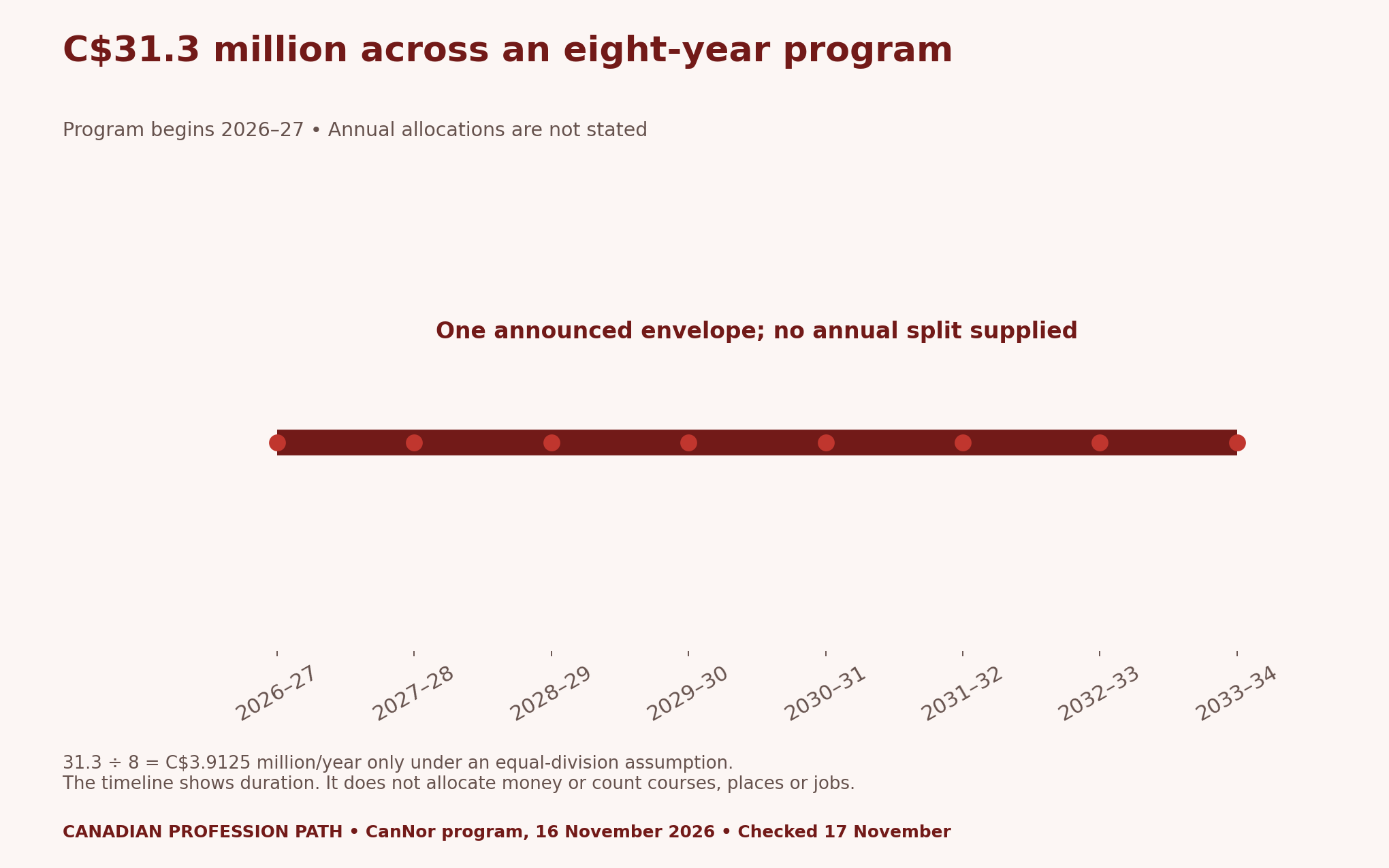
Dividing C$31.3 million by eight gives C$3.9125 million a year under an equal-division assumption. CanNor does not provide that annual split in the announcement. Therefore, do not present the result as each year’s budget or divide it again to invent a per-learner allowance.
The same boundary applies to outcomes. The envelope does not tell us how many courses will run, how many people will enrol or how many federal jobs will result. Keep announced funding, approved projects, learner places and employment outcomes in separate fields. Each needs its own dated evidence.
Separate organizational funding from learner applications
The program specification lists organizational recipients, including not-for-profit associations, post-secondary institutions, educational partners and for-profit enterprises. Projects take place in Nunavut, and relevant academic accreditation is required where appropriate. This is not an announcement of automatic grants to individual learners.
The 2027–28 expression-of-interest page is for proposed projects. Only successful EOI applicants are invited to submit full applications. Its closing date is not a verified course-enrolment deadline. A learner should look for an actual provider notice, admission route and confirmed intake before making commitments.
If a course advertisement mentions the new fund, ask what has actually been confirmed. A proposal, funding decision and open registration are different statuses. Save the provider’s answer and the date. This simple distinction can prevent a promising announcement from becoming an assumed place on a course.
Compare the four streams by what they can change
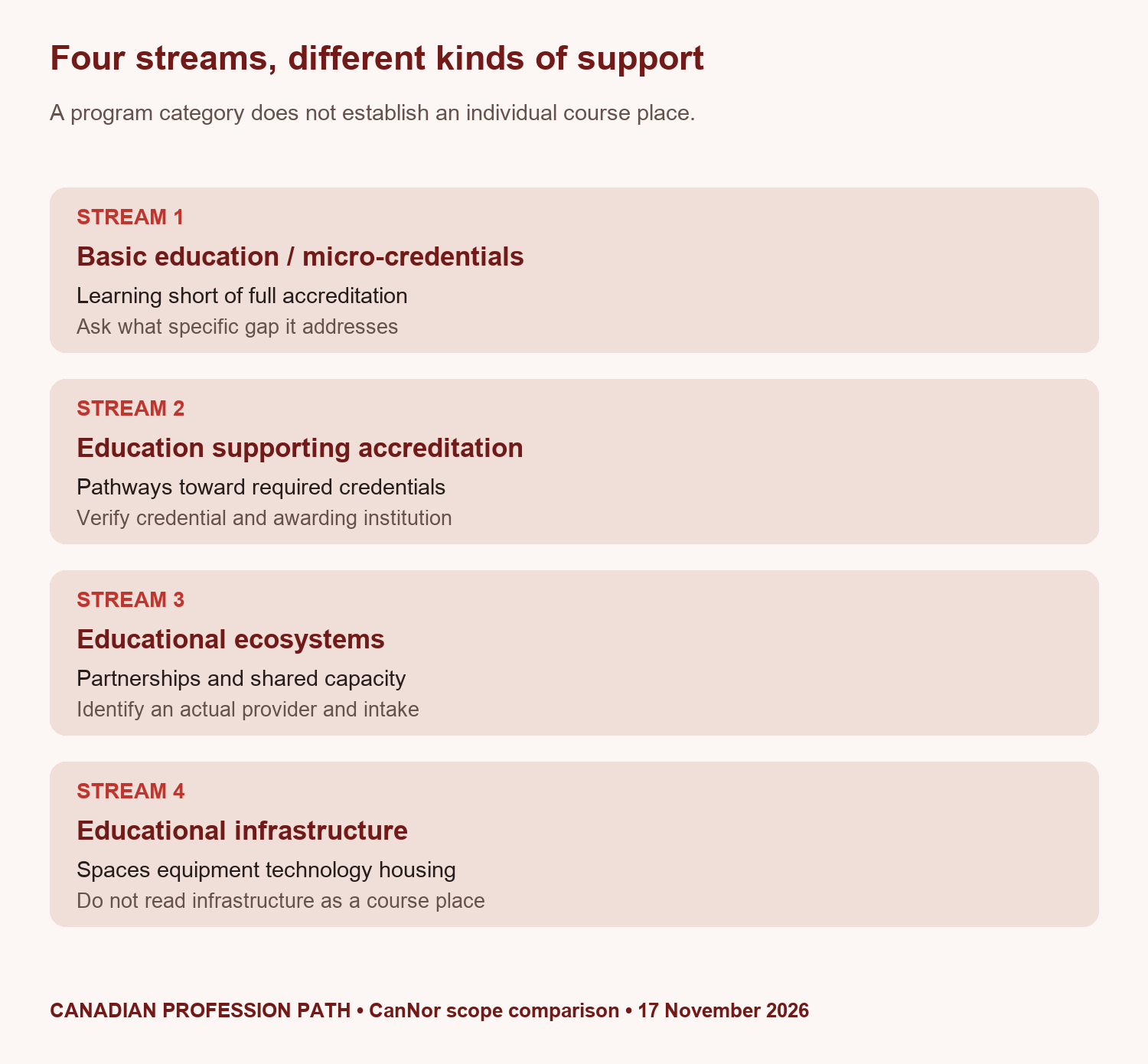
Basic learning can address a specific gap before full accreditation. A credential pathway concerns a different destination. Partnerships and infrastructure can improve delivery conditions, but their existence alone does not identify an available course. The comparison helps you ask a more precise follow-up question.
For example, a learning space may make local attendance more feasible, while a short course may address a narrow skill. Neither automatically replaces a diploma required for a role. Start with the requirement, then determine whether a proposed course, assessment or longer program addresses it.
Copy the requirement before collecting course options
The Treasury Board qualification standards distinguish occupational groups and permitted education alternatives. Employer-approved alternatives apply only where the relevant standard allows them and must appear in the statement of merit criteria. A general course description cannot decide how a specific appointment will be assessed.
Use the blank credential-gap map with a real official job poster. Record its URL, date, classification and exact education wording. Then list the evidence you already have. Keep essential requirements separate from assets and from a provider’s marketing claims. Ask the hiring contact when the acceptance route is unclear.
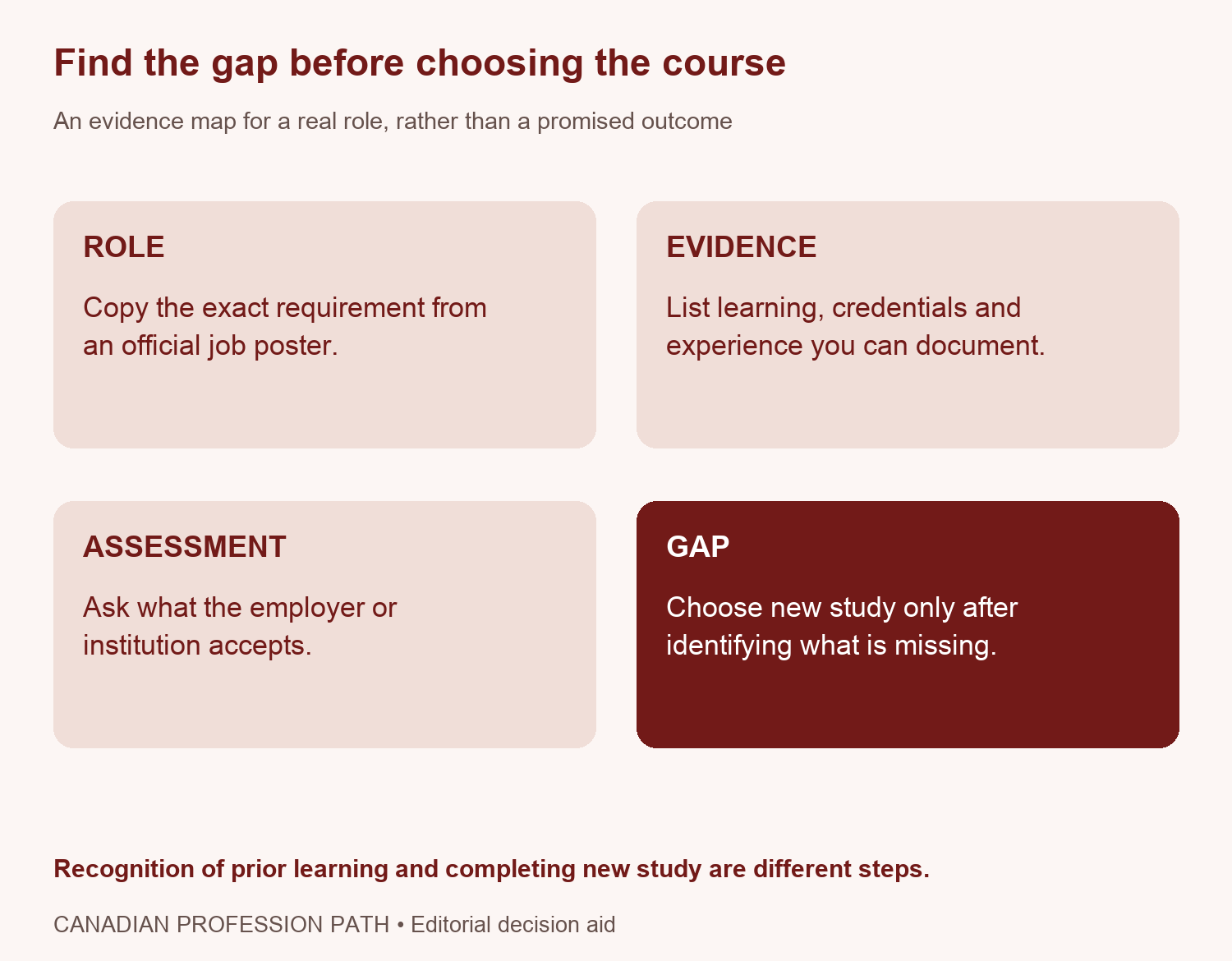
Recognition of prior learning means assessing learning you can already demonstrate. New study means completing learning you still need. An assessment could clarify the size of a gap, but a portfolio or experience record does not automatically become a recognised credential. Keep any written decision with its specific scope.
Verify an actual provider and intake
Before committing money or travel, check who delivers the course and who awards the credential. Ask whether admission is open, when teaching begins and where it takes place. Record the language of instruction and whether remote participation is possible. An unanswered field should stay unresolved, rather than becoming a guessed benefit.
Then check practical supports. Childcare, housing, equipment, travel and fee arrangements can affect whether attendance is feasible. However, a program stream mentioning infrastructure is not confirmation that your chosen course provides all those supports. Ask for the details tied to the specific intake you are considering.
The provider log includes a field for the link between the course and the job requirement. Write down who confirmed that link and on what basis. A provider may explain its curriculum; the hiring authority determines whether the applicant meets the staffing criteria. Those are different responsibilities.
Keep the audience and the unresolved questions clear
This program concerns Nunavut Inuit and the objectives described by CanNor. It should not be presented to all Canadian newcomers as a general federal training subsidy. Other residents can use the requirement–evidence–gap method, but participation in a specific program still depends on its own confirmed rules.
We did not establish individual subsidies, approved project awards, learner start dates or hiring outcomes from these sources. Nor does the absence of a verified intake in this guide prove that no provider has one. Recheck official notices and ask the relevant organization for a dated answer.
For broader Canadian education coverage, see our Education and Training archive. Keep the present guide’s targeted program scope in mind when comparing it with general career resources.
Sources, method and downloadable planning files
We checked CanNor’s dated release, program specification and EOI page on 17 November 2026, alongside the federal qualification standards. The funding timeline derives its end year from the stated eight-year span beginning in 2026–27. No annual allocations, provider rankings or employment estimates were manufactured.
- Funding scope, dates and equal-division caveat (CSV)
- Four program streams and verification questions (CSV)
- Blank job requirement–evidence–gap map (CSV)
- Blank provider, intake and support verification log (CSV)
Suggested citation: Canadian Profession Path, “Inuit Federal Career Training in Nunavut: Match the Credential to the Role”, 17 November 2026. Sources: CanNor and Treasury Board; evidence-map design and arithmetic by the publication.


