







Dick Martin Scholarship 2027 application planning starts with two checks: whether your study fits the rules and whether your argument connects evidence to workplace prevention. This guide explains the scoring arithmetic and provides editable tools. It does not estimate your chances of winning.
The CCOHS announcement of 16 November 2026 confirms two C$3,000 awards, one for a college student and one for a university student. The deadline is 31 January 2027 at 11:59 p.m. EST. Applicants submit an online application and a 1,000–1,200-word essay on one of the official topics.
Dick Martin Scholarship 2027 application: check your route
The current official rules and FAQs cover students already enrolled, full-time or part-time, in qualifying OHS-related study at an accredited Canadian college or university. Citizenship is not required. However, acceptance without current enrolment and study at an institution outside Canada do not meet the stated route. Previous winners and specified CCOHS employee relatives are excluded.
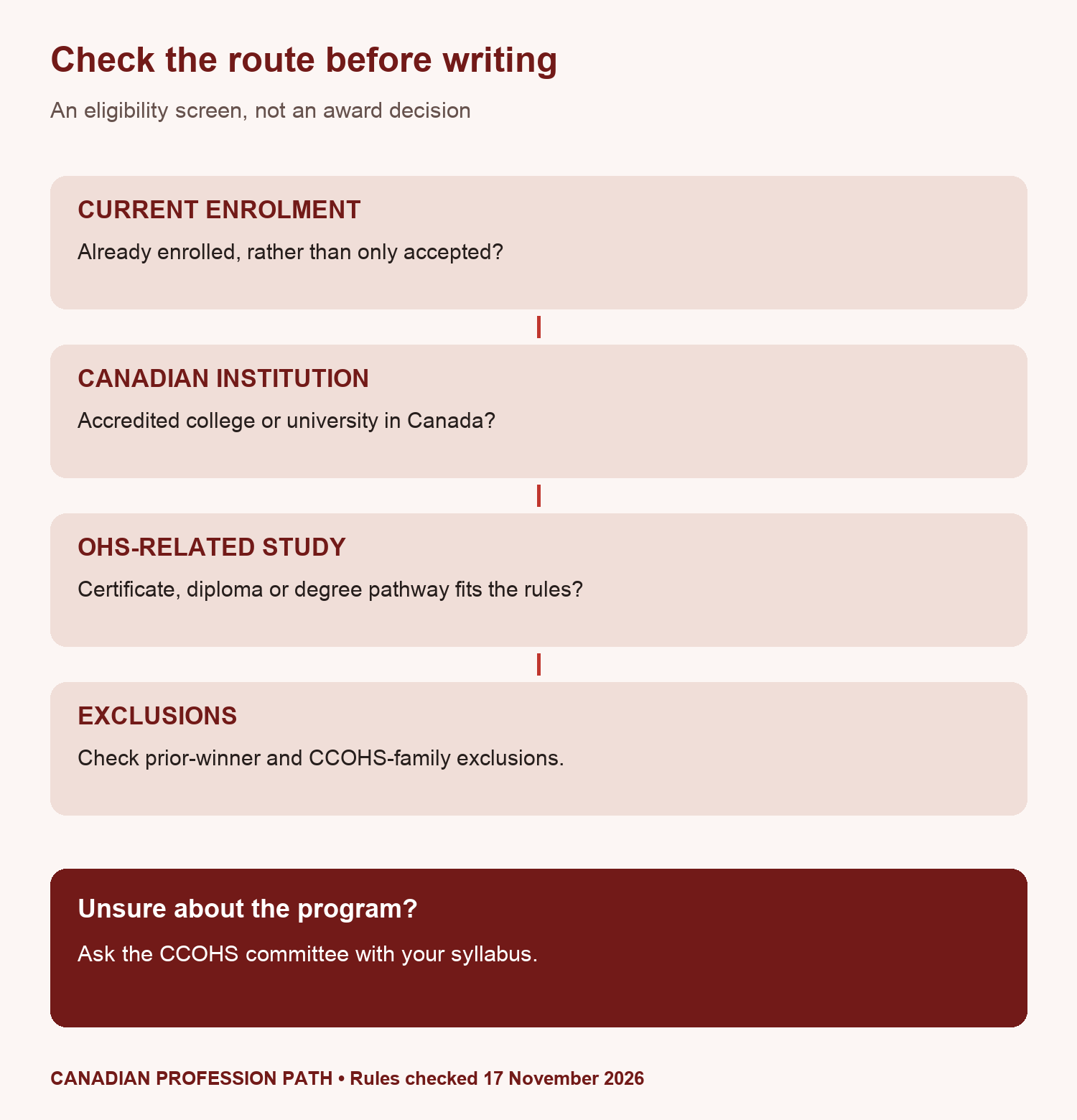
For newcomers, separate citizenship from where and what you study. A familiar subject title alone does not settle the question. If the program’s fit is unclear, send its description or syllabus to scholarship@ccohs.ca. Keep the response with your planning notes before investing time in a full draft.
Translate the nested rubric into one denominator
CCOHS assigns 15% to the application and 85% to the essay. Inside the essay, the weights are 50% intellectual content, 20% practical value, 20% theoretical value and 10% presentation and style. Those two sets use different denominators.
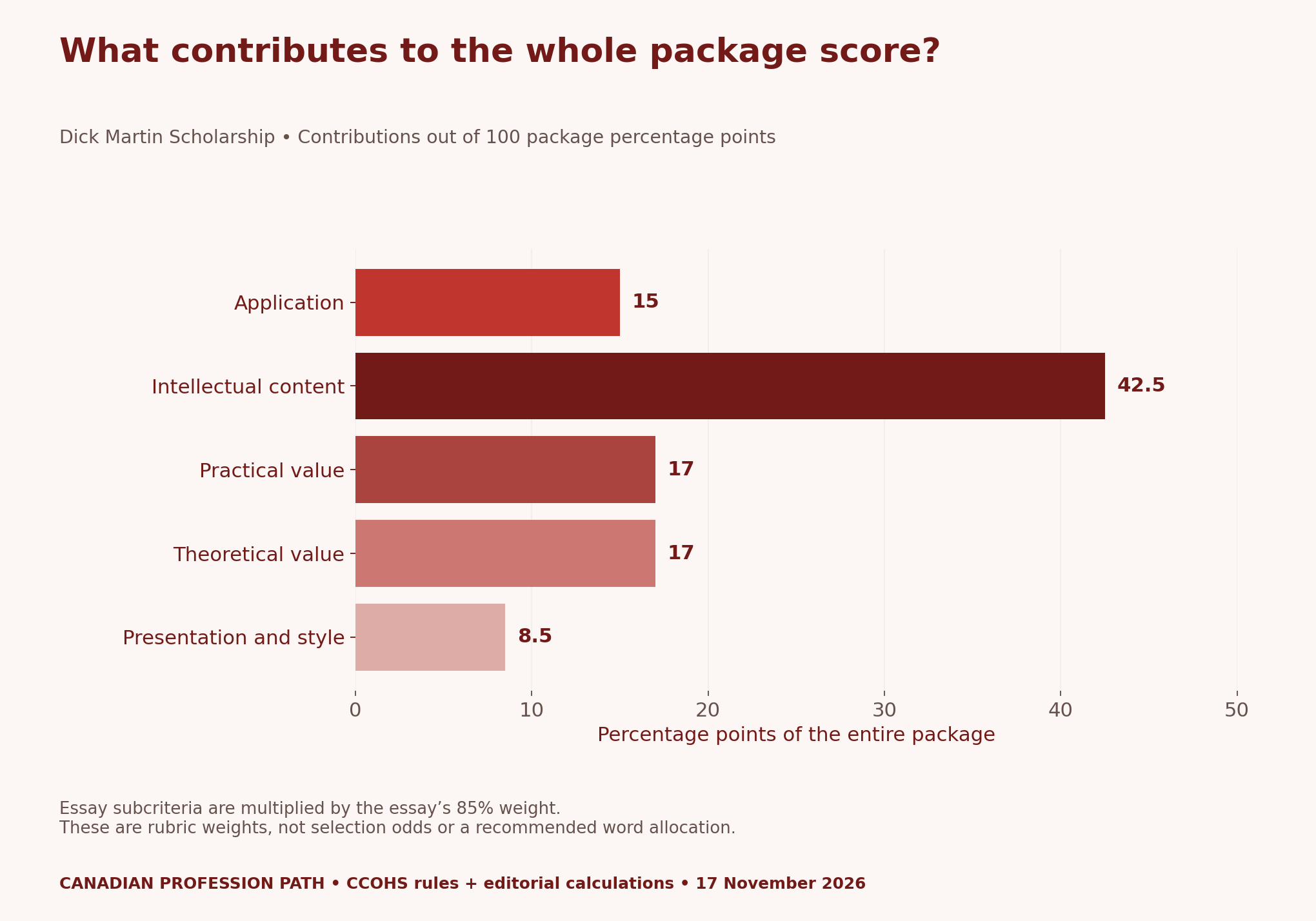
For example, intellectual content contributes 0.85 × 50 = 42.5 percentage points to the package weighting. Each 20% essay component contributes 17 points. Presentation contributes 8.5 points. Add the application’s 15 points and the total is 100. The downloadable calculation file preserves both the original weights and the conversion.
This arithmetic helps you read the rubric consistently. It cannot predict a judge’s score or your selection probability. It also does not imply that 42.5% of your essay should discuss one theme. A short, well-supported explanation may serve several criteria at once.
Choose a question you can actually support
The announcement offers a prevention topic concerning a high-risk workplace hazard and a technical topic about an existing or emerging hazard or risk. Start by choosing one. Then narrow the setting, affected work and question enough to support a focused argument within the word limit.
For example, “workplace safety” is too broad for a short essay. A more usable planning question identifies a particular task, hazard and prevention issue. That is a drafting technique, rather than an official preference for any occupation. Your evidence should determine which claims you can responsibly make.
Build the evidence ledger before writing polished paragraphs. Give each intended claim a source, a population or workplace, a measure and a limitation. Then add the practical implication you can defend. A source about one sector should not silently become evidence about all Canadian workers.
Our forestry health and safety overview offers related career context. For an application’s technical claims, go further: locate the underlying research or authoritative guidance and check its scope. A general career article cannot replace evidence for a specific prevention proposal.
Connect the evidence to a practical implication
A useful paragraph can do three jobs: make a bounded claim, explain the evidence and show what it changes for prevention. Keep those links visible. If a study measures exposure, do not describe its result as a proven reduction in injuries. If a source describes guidance, distinguish that advice from an evaluated outcome.
Practical value also needs an identifiable setting. Ask who would act, what action is feasible and which evidence would show whether it worked. However, do not invent workplace observations or imply that you tested an intervention when you only reviewed published material. An honest limitation strengthens the argument’s traceability.
Use a word budget without confusing it with scoring
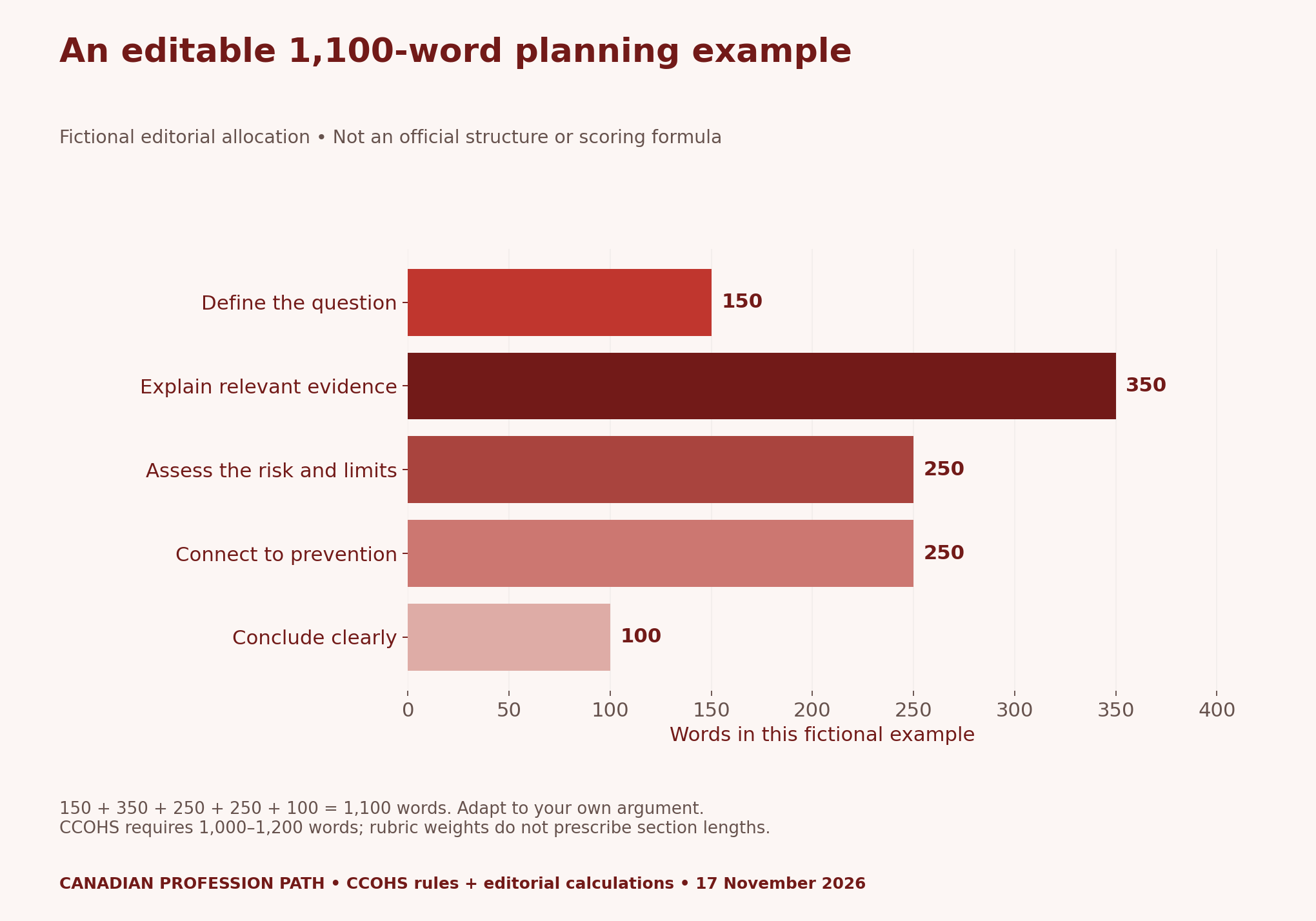
The example leaves space for a question, evidence, risk assessment, prevention and a short conclusion. You can change every section. Its purpose is to expose an overloaded plan before you draft, rather than to force your argument into five headings. The relevant official constraint is the total word range.
After drafting, check whether each paragraph advances the question. Remove repeated background before cutting essential qualifications. Keep the reasoning in your own voice and verify every citation. The worksheet is a planning aid; it does not generate an original essay or complete an application for you.
Run the anonymity and submission checks
The rules require an anonymous essay and filename, 12-point double-spaced text, numbered pages, a word count and a bibliography. Source references need footnotes, which the FAQ excludes from the word count. Inspect the final file, rather than relying on an earlier draft’s compliance.
As an extra editorial safeguard, inspect document properties and any comments before exporting. That precaution is separate from the published formatting rules. The checklist keeps official requirements and additional planning advice visible so you can tell which is which.
Read the ownership terms before deciding to submit: essays become CCOHS property, and winners’ names may be publicised. Use the official application form and retain its confirmation. No application has been submitted through this article, and a saved planning worksheet is not proof of submission.
Method, limits and downloadable tools
We checked the dated announcement and current rules on 17 November 2026. The scoring chart uses exact multiplication of published weights. The word budget contains fictional teaching values. Applicant numbers, judges’ scores and award probabilities are unknown. Recheck the official deadline and requirements before submitting.
- Published rubric and whole-package calculations (CSV)
- Blank claim–evidence–practical implication ledger (CSV)
- Fictional editable 1,100-word planning example (CSV)
- Submission and anonymity checklist (CSV)
Suggested citation: Canadian Profession Path, “Dick Martin Scholarship 2027: Build an Evidence-Led Application”, 17 November 2026. Sources: CCOHS announcement and scholarship rules; rubric conversion and planning tools by the publication.


