






For Nova Scotia boilermaker intro course apprenticeship registration, a course certificate is one piece of evidence, not the whole transition. A learner still needs to check the job, qualified supervision, the registered agreement and any approved credit. Keeping those documents separate makes a promising employment headline more useful.
On 25 November 2026, Nova Scotia Construction Sector Council reported employment for all four people who completed its nine-week Intro to Boilermaker programme. The course ran from 6 July to 4 September in partnership with International Brotherhood of Boilermakers Local 73. The announcement is a report about those completers, not a guarantee for the next applicant.
What the four-of-four result counts
Four employed completers divided by four completers gives 100%. Keep that denominator visible. The report does not publish how many people started, how employment was measured, or how long each job lasted. It therefore does not establish a completion rate for all starters, a retention rate or a future learner’s chance of work.
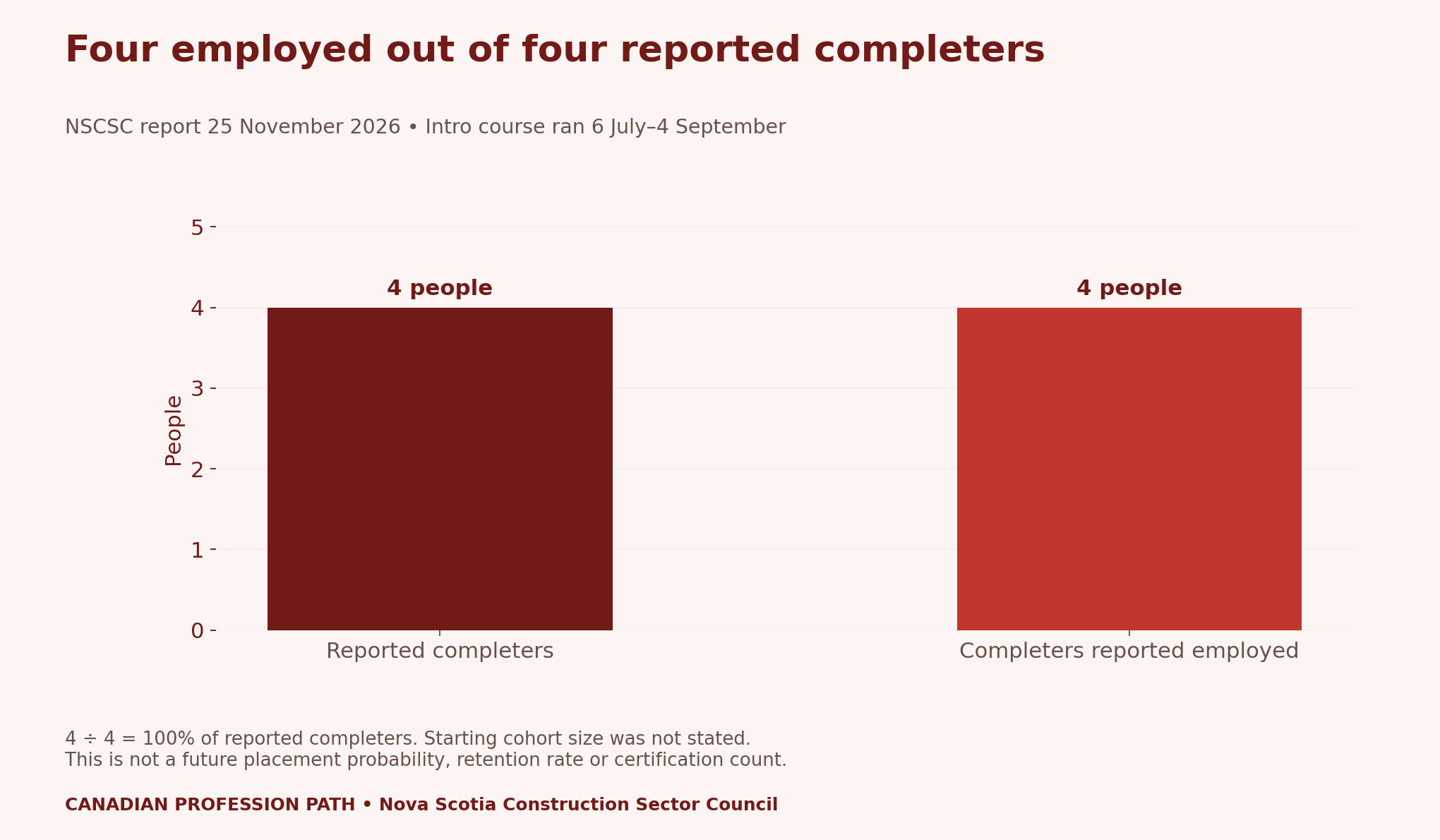
A useful adviser question is “What evidence would I need for my own next step?” rather than “Does this percentage guarantee me a job?” Ask separately about a new intake, its eligibility and its actual dates. A report on a July–September course cannot confirm that another course is accepting applications now.
The apprenticeship term is a separate requirement
Nova Scotia’s Boilermaker Trade Regulations identify it as a compulsory certified trade. The apprenticeship route specifies 5,400 documented hours combining approved practical experience and the relevant skills-learning portion of technical training, together with the required related technical training and certification examination. Do not turn that into 5,400 classroom hours or a promise that any short course counts automatically.
The course’s nine weeks and the regulation’s documented hours use different measures. This article does not convert weeks into credited hours. Only a written assessment can tell a particular learner how prior training affects their remaining programme requirements. The separate trade-qualification route also must not be substituted for the apprenticeship route described here.
Three records to keep in the transition file
| Record | What to request | What it does not establish |
|---|---|---|
| Course | Completion document and transcript | Automatic agency registration or approved credit |
| Employment | Offer, duties and certified supervisor | A completed apprenticeship agreement |
| Agency | Registered agreement, applicable permit and written credit decision | Certification before the remaining requirements are met |
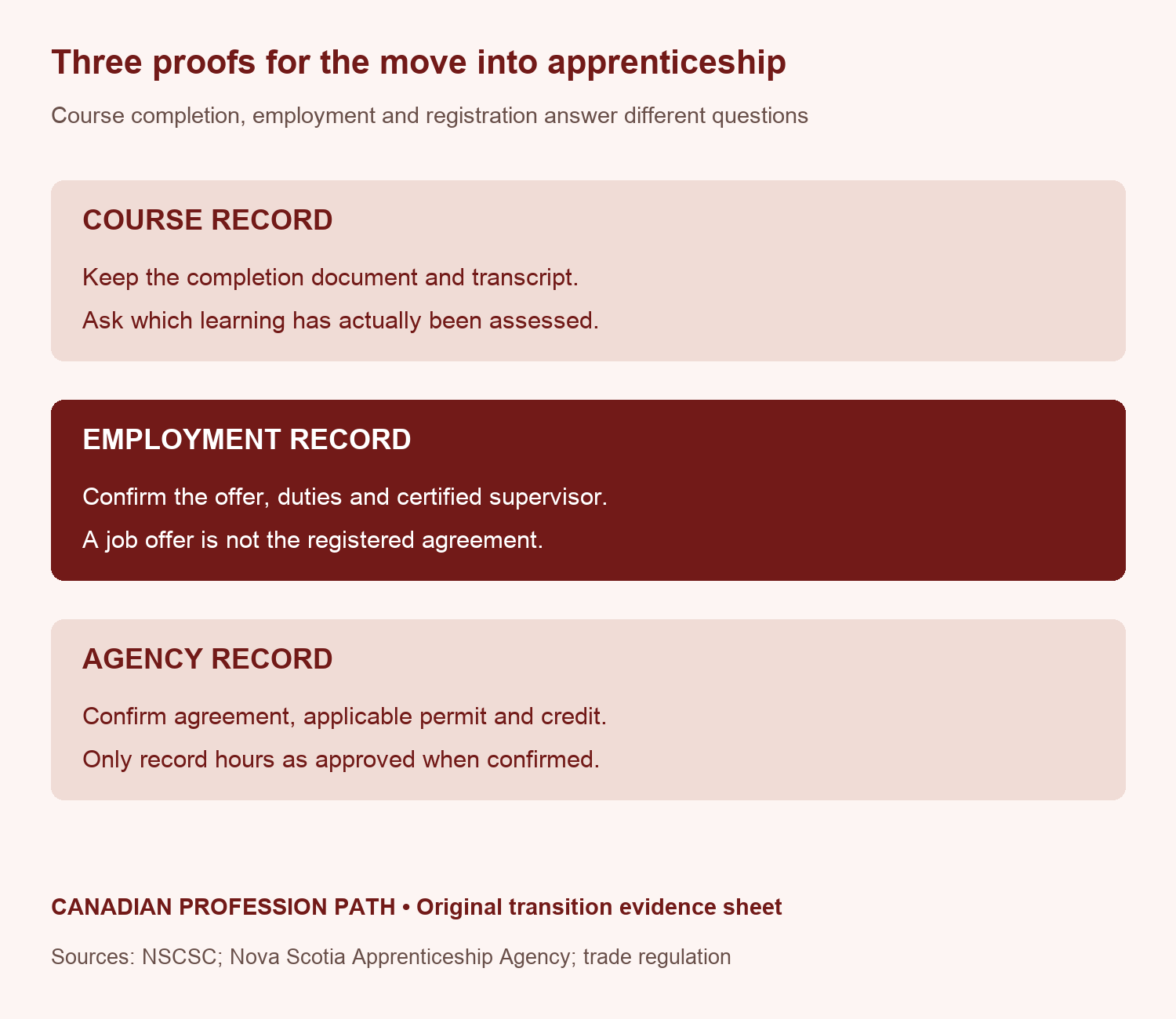
The agency’s getting-started guidance describes a paid employer–apprentice arrangement with supervised workplace learning. It also allows an application for credit from previous work or approved pre-employment training. Possible credit is not the same as credit already awarded. Keep the transcript and relevant work evidence, then ask the Industry Training Consultant for the recorded decision.
The registration page explains the agreement process and certified journeyperson supervision. For work in a compulsory trade while registration is being processed, it directs people to discuss an applicable temporary permit with the agency. Do not infer permission to carry out restricted duties from a course completion document alone.
A fictional offer that still needs two answers
Imagine a fictional learner who has finished an introductory course and receives an offer described only as “industrial helper”. The learner has a transcript but no named certified supervisor and no written credit decision. The useful next step is to clarify the actual duties and supervision, then ask the agency how registration and any permit apply. The offer should not be relabelled as a registered apprenticeship just because it follows training.
In the blank checklist, mark each answer as confirmed, pending or not applicable, with its source and date. Keep the job offer beside the supervisor details. Keep the agency agreement beside the credit decision. A missing document should remain a question, rather than becoming an assumed entitlement in a chart or CV.
An adviser can use this file to make a focused enquiry: which document is missing, who can confirm it and what action depends on the answer? That is more practical than sending the same broad question to several organisations. Avoid putting personal identification or confidential employer documents in a public worksheet.
Methods, limits and downloadable tools
Checked 29 November 2026. The employment chart uses only NSCSC’s reported completer counts. The regulatory discussion follows the current public consolidation and agency guidance. We did not assess a learner’s eligibility, confirm a vacancy, reserve a course seat or determine individual prior-learning credit. The fictional offer is an original teaching example.
Our Manitoba training booking guide similarly distinguishes a calendar from an actual receipt. Here, the distinction is between completion, employment and registration evidence. This Nova Scotia boilermaker intro course apprenticeship registration guide gives readers a file structure, not an individual licensing decision.
- Reported cohort counts and denominator (CSV)
- Three-stage evidence framework (CSV)
- Blank transition checklist (CSV)
- Source and scope register (CSV)
Suggested citation: Canadian Profession Path, “Nova Scotia Boilermaker Training: What Comes After the Intro Course?”, 29 November 2026. Credit NSCSC, Nova Scotia and the Apprenticeship Agency for primary information, and Canadian Profession Path for the original chart and tools.