






For Canada retail job vacancies September 2026 roles, the useful next step is a local search with a dated evidence log. A national sector increase can suggest where to look. It cannot identify the store, occupation, shift or application status that fits you. Keep those decisions separate.
Statistics Canada’s 26 November release reports retail vacancies up 5,500, or 11.0%, from August and 10,900, or 24.4%, from September 2025. The monthly gain offset the cumulative decline from May through August. These preliminary seasonally adjusted sector figures describe September, not openings verified today.
Read the comparison window before the size of the bar
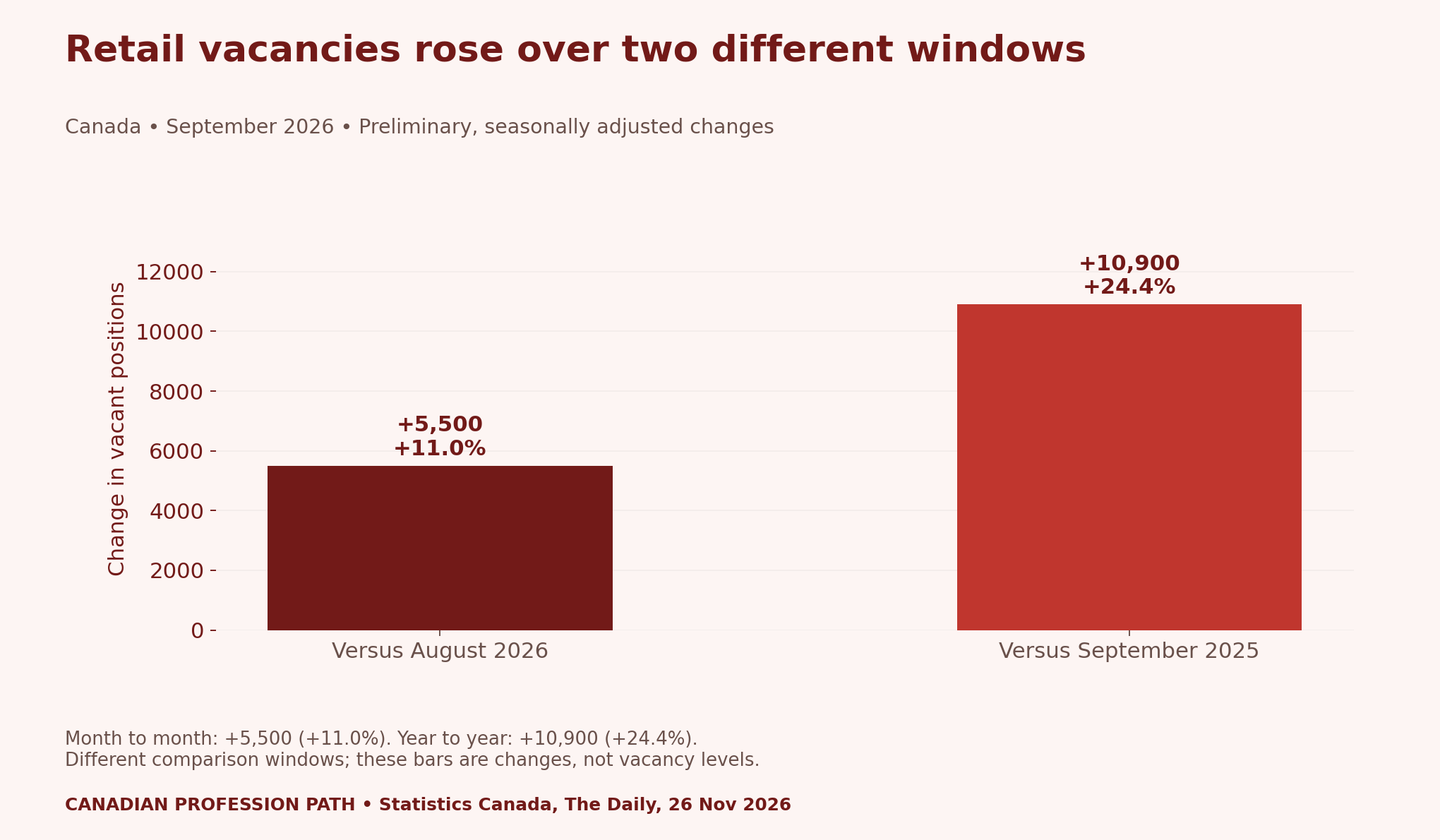
The two bars answer different questions. Do not add them together, call the larger one the monthly increase, or use either as an employer’s vacancy count. A percentage also needs its own comparison period. In your notes, write the reference month and the baseline beside every figure before deciding what to search.
This habit makes a research headline usable without turning it into a promise. A candidate can treat the increase as a reason to inspect current listings. The next piece of evidence must then come from an actual role and employer, rather than another calculation on the national total.
Payroll contributors belong in a separate panel
The same release separately identifies year-on-year payroll-employment gains in food and beverage retailers (+5,900), general merchandise retailers (+5,300), and motor vehicle and parts dealers (+5,100). Those measure filled payroll jobs. They are not a published breakdown of the retail vacancy increase by occupation.
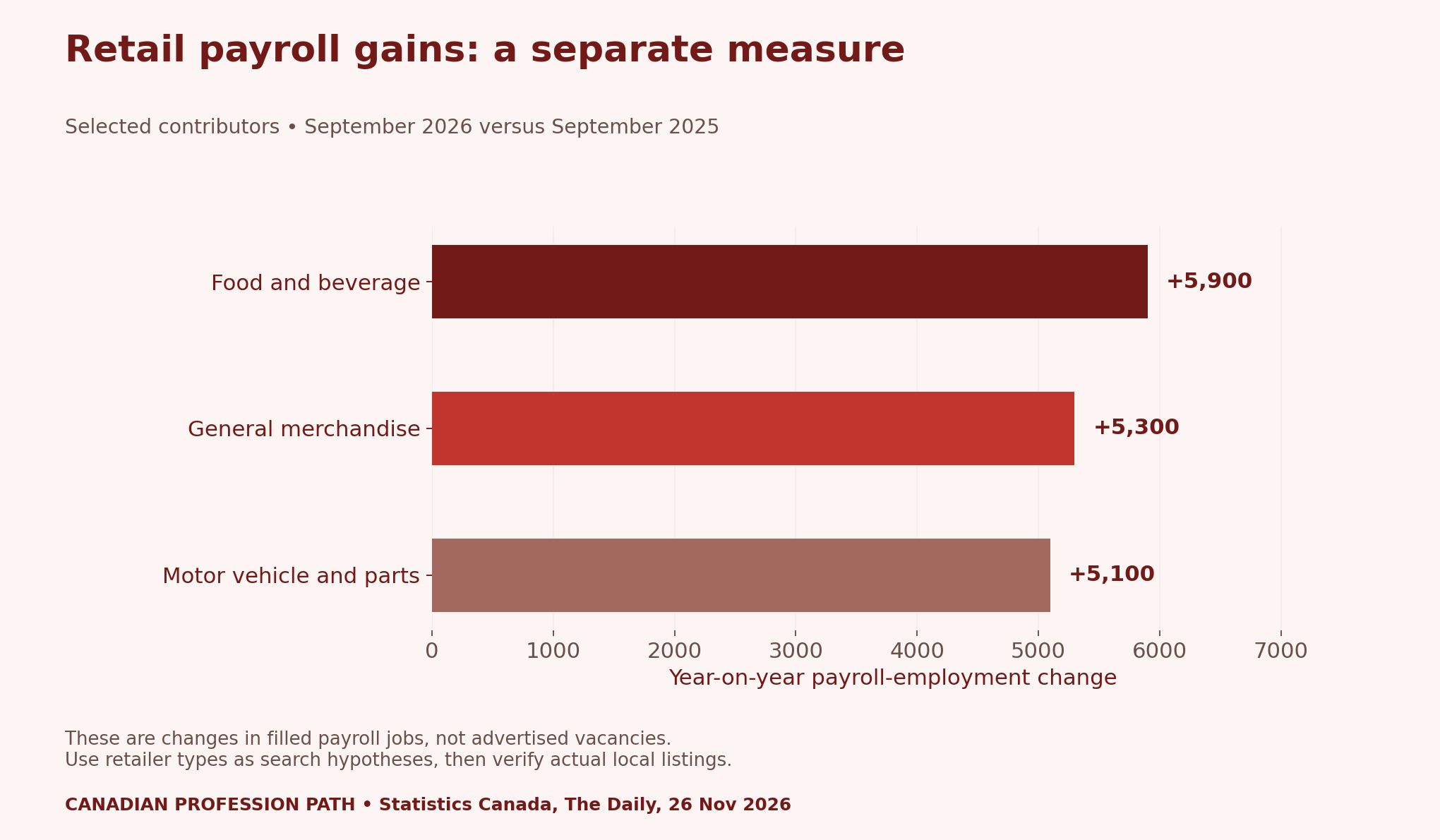
Use these retailer types only as hypotheses for a search. A grocery store can have customer-facing, stock, delivery or specialist work, but this article has not verified any particular opening. Likewise, the name of a retailer type cannot tell you which credentials, physical tasks or shift pattern a specific employer requires.
Three passes from a sector signal to a local lead
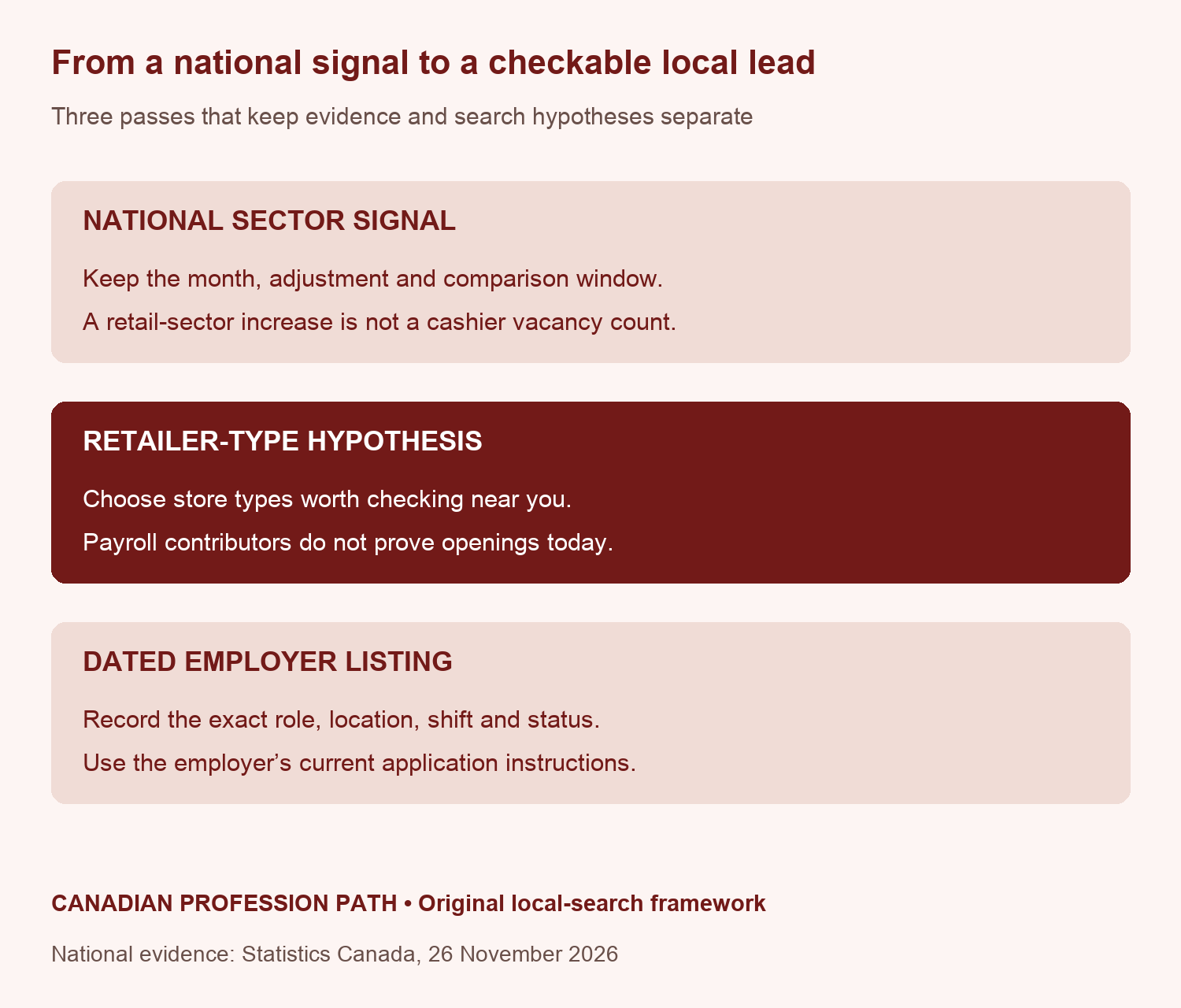
First, record the sector signal accurately. Write September 2026, the adjustment, the comparison window and the release date. Leave a separate field for the date you checked the source. This prevents an older reference month from being described as a real-time local hiring count.
Second, choose a small set of retailer types and locations that you can realistically consider. Treat the choice as a search plan, not a ranking of job-finding odds. A workable commute and suitable shift may matter more to a particular applicant than a larger national change in another type of store.
Third, open the employer’s current listing and record the exact title, worksite, hours, stated pay when provided, closing status and application instructions. Do not fill a missing wage with a national average or assume that an undated listing remains open. Mark unanswered fields as pending and keep the source link.
A fictional search example
Imagine a fictional applicant who can work evenings near home and is considering grocery and general merchandise stores. Their log finds one official listing with weekday daytime hours and another with evening work at a location outside their commute range. Neither is automatically suitable because retail vacancies increased nationally. The next action is to check another current listing or clarify a stated condition.
In the worksheet, retain a separate row for each listing. Record what the advertisement actually says, then put your own assessment in the evidence-of-fit column. Avoid changing the source wording to make it match your availability. A role that fails one important requirement is still useful information for refining the search.
| Search field | Evidence to keep | Avoid assuming |
|---|---|---|
| Role and location | Exact title and worksite from the current listing | All branches or occupations are hiring |
| Shift and hours | Published schedule or a dated employer response | A sector increase means flexible hours |
| Application status | Closing information and date checked | An old saved link is still open |
Methods, limits and four CSV tools
Checked 29 November 2026. The first chart uses the release’s retail vacancy changes. The second uses its separate payroll contributors. We do not reconstruct a vacancy level from rounded percentages or combine the measures. The local-search framework and fictional scenario are original planning tools; no employer listings or individual job outcomes are claimed as verified in this article.
Keep the distinction when sharing the charts: a national industry measure is a starting point for a question, not an answer about your next employer. This Canada retail job vacancies September 2026 roles guide does not forecast interview rates, pay or hiring. Our training-to-apprenticeship evidence guide applies the same discipline to a different career decision.
- Retail vacancy changes and comparison windows (CSV)
- Separate payroll-employment contributors (CSV)
- Blank local employer-listing log (CSV)
- Source and measure register (CSV)
Suggested citation: Canadian Profession Path, “Canadian Retail Job Vacancies: Which Store Roles Should You Search For?”, 29 November 2026. Credit Statistics Canada for primary data and Canadian Profession Path for original charts and search tools.